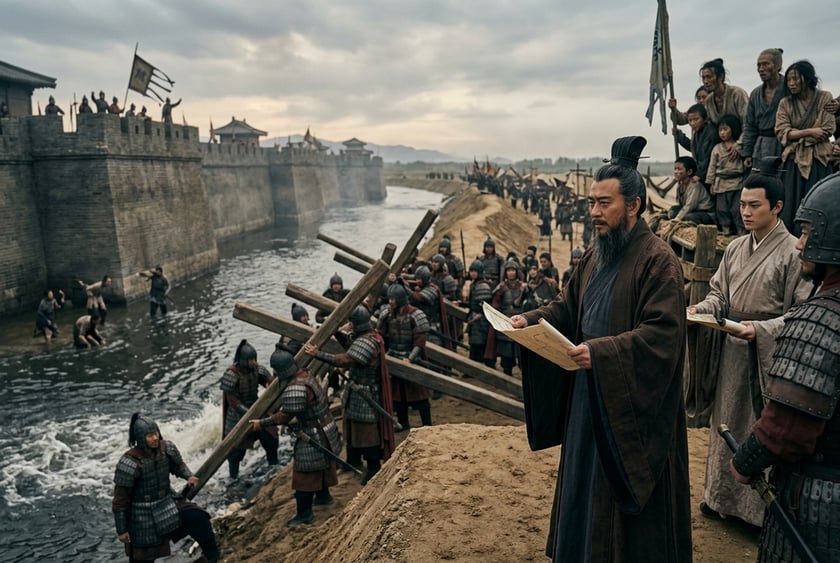
Background
The political landscape of Shuhan in the sixteenth year of Yanxi was at a tipping point: the recuperative policy of the Zhuge-Jiang-Fei line was on the verge of giving way to Jiang Wei's northern-campaign line. After Zhuge Liang's death, Jiang Wan and Fei Yi had governed in succession, following a moderate course of reducing the frequency of northern campaigns, consolidating internal administration, and rebuilding national strength — a course that in essence acknowledged that Shuhan, with the resources of a single province, could not sustain large-scale military operations indefinitely. Fei Yi was especially cautious, repeatedly blocking Jiang Wei's requests to move troops, and citing the precedent of "even when Duke Wan and the Duke of Gong were in office, they could not march east" to limit Jiang Wei to a deployable force of fewer than ten thousand men. This restraint made Fei Yi the last bastion of the Shuhan "dovish" position, and in the eyes of the war faction, the critical figure standing in the way of restoration.
Key Figures
The central actors in this event were Fei Yi and Guo Xun (also written as Guo Xiu), with Jiang Wei, the Caowei young emperor Cao Fang, and Sima Shi's regime providing the backdrop. Fei Yi had opened his headquarters in the fifteenth year of Yanxi; his power was at its peak, and the first-month grand assembly was the highest-ranking civil-military gathering on the Shuhan front. Guo Xun's identity is intriguing: he was originally a Commandant of Liangzhou who had been captured in one of Jiang Wei's northern campaigns. By Shuhan practice, enemy officers of moderate rank or above who were captured were given preferential treatment and retained in service; Guo Xun had been taken under Fei Yi's wing and assigned to his personal staff. This arrangement was later condemned as a catastrophic failure of security protocols. Analyzing the motive, Guo Xun had at least three plausible reasons: he may have been on a long-term infiltration mission under secret orders from Wei; he may have been acting on the instigation of Jiang Wei or a pro-Wei faction (the source of the later "Jiang Wei assassination theory"); or he may have been personally unwilling to live out his days subordinate in Shuhan and reportedly attempted to kill Liu Chan first before turning against Fei Yi. The Wei court's ostentatious posthumous enfeoffment of Guo Xun as Marquis of Changle did not come until eight months after the event — this delayed reaction suggests it is more likely an opportunistic assassination than a long-planned operation.
Core Issue
On the surface, the issue is the cause-and-effect of a single assassination; at a deeper level, it is the security cost of Shuhan's institutional practice of "admitting surrendered men into the command staff." Shuhan, cramped and thinly populated, tended to accept and employ enemy officers who were captured — Jiang Wei himself was the product of exactly this policy. Strategically necessary as it was, the policy lacked any matching security screening mechanism: Fei Yi "treated Guo Xun with great warmth," imposing no period of isolation or extended observation. This incident in fact exposed two major weaknesses in Shuhan's late-period civil administration: first, the persons of senior officials were not protected by any institutional safeguards — there were neither bodyguard arrangements nor search procedures for banquets; second, political vetting of surrendered men relied entirely on the personal judgment of the presiding official rather than any institutional mechanism.
Political Consequences
The most immediate consequence was a vacuum at the civil center of Shuhan. After Fei Yi's death, no one in Shuhan possessed the combination of political prestige, administrative experience, and a workable relationship with Jiang Wei. Chen Zhi rose from Imperial Secretary to Acting Secretary of the Interior in a supervisory role, but his prestige was nowhere near sufficient to check Jiang Wei. Jiang Wei was thereby freed from Fei Yi's restraints, and launched large-scale northern campaigns continuously from the sixteenth year of Yanxi onward: siege of Nan'an in year sixteen, seizure of Didao in year seventeen, defeat of Wang Jing at Taoxi in year eighteen, defeat at Duangu in year twenty, another expedition into the Qin highlands in the first year of Jingao — over ten years, the pace of mobilization far exceeded that of the Zhuge, Jiang, and Fei periods. This series of campaigns consumed the already fragile national strength of Shuhan; Chen Shou assessed the result as "campaigns and military expeditions raised repeatedly, without achieving success." Seen over a longer span, Fei Yi's death can be regarded as the hidden starting point of Shuhan's path to destruction in 263: ten years of accelerated attrition after losing the man who applied the brakes left Shuhan without mobile forces to deploy when Deng Ai arrived at the walls in 263. From the Wei side, regardless of whether Guo Xun was acting under orders or on his own initiative, the court's high-profile posthumous honors confirmed one fact: using low-cost assassination to eliminate the chief minister of an enemy state was a legitimate tool of intelligence warfare under Simashi rule. This logic would appear again and again in the subsequent cases of Deng Ai, Zhong Hui, and Jiang Wei.
Counterfactual Analysis
Had Fei Yi not died, what path would Shuhan have taken? One possibility is that the "dovish" line would have continued to dominate: Fei Yi was not yet fifty, and if his moderate course had held for another decade, Shuhan's national strength might have recovered to the level of the mid-Zhuge period, with Jiang Wei confined to "limited probing expeditions" and the state not reduced to having no troops available in 263. But the ceiling of the Fei Yi line was "holding without advancing"; over the long run it still could not resolve the fundamental imbalance of "one province against nine provinces" — Shuhan's survival might have been extended from forty-two years to roughly fifty-five, but the ultimate outcome would have been hard to change. A more radical line of speculation: had Guo Xun's assassination attempt failed, Fei Yi would have been forced to completely overhaul bodyguard arrangements and procedures for surrendered men, and Shuhan's political system might thereby have moved toward greater institutionalization, indirectly compensating for the talent shortage. Of course history followed only one path — a sudden dagger at a banquet, pulling out Shuhan's most important "brake pad," after which this vehicle lost the power to slow down.