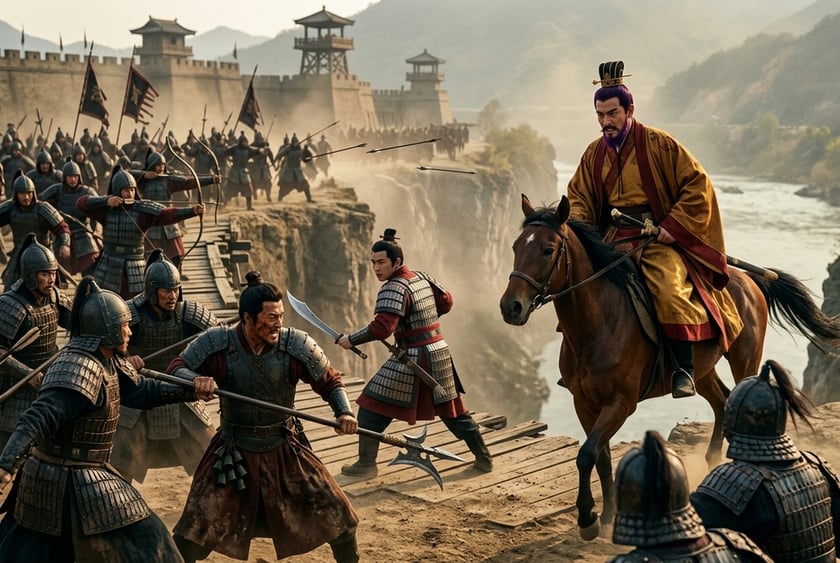
Background of the Meeting
In the second year of Huangchu, Sun Quan had just seized Jingzhou by ambushing and killing Guan Yu, incurring a blood feud with Liu Bei; simultaneously, Cao Pi had replaced Han with Wei, and Caowei's military pressure along the Huainan and Xiangfan lines could move south at any time. Unable to single-handedly resist both Liu Bei's forces of revenge and Caowei's pressure from the north, Sun Quan adopted a highly pragmatic solution: temporarily acknowledging submission to Wei as a vassal in exchange for peace on the northern front, concentrating his forces to deal with Liu Bei. This kind of "expedient submission" was by no means uncommon in the Chinese political tradition, but the price was accepting the asymmetric "superior state — vassal state" relationship in matters of ceremony. Cao Pi dispatched the Grand Rector Xing Zhen as the investiture envoy specifically to make this ceremonial asymmetry official and visible — he intended to have Sun Quan publicly accept the title of "King of Wu" along with the Nine Bestowals, the symbolic act of incorporating an independent power into Wei's tributary system.
The Dialogue
Xing Zhen's political mission was a delicate one: he had to complete the investiture ceremony without allowing Wei to come off second-best in ritual terms. Arriving at Wuchang, he entered the city in the arrogant manner befitting an envoy of the superior state, and Sun Quan came out in person to receive him — already a rare concession by the standards of traditional diplomatic protocol between the two parties. Even so, Xing Zhen remained seated in his carriage and refused to descend, deliberately performing the full "superior state" posture. This incensed Zhang Zhao: as the most senior elder statesman of Sunwu, Zhang Zhao loudly reprimanded Xing Zhen for his breach of propriety, his words carrying the implicit threat that "if you show no respect, our state need not remain forever in a subordinate position." Confronted with the public rebuke of an elder official and reading the expressions of the surrounding Wu commanders, Xing Zhen had no choice but to descend from his carriage and prostrate himself in apology. This passage of dialogue carried political meaning far beyond the ceremonial: it was transmitting a signal to Wei that Wu could accept vassal status in form, but would not accept any substantive humiliation beyond the form.
Decision Outcome
The investiture ceremony was ultimately completed and Sun Quan was formally invested as King of Wu and received the Nine Bestowals. But Wei's subsequent substantive demand — that the heir apparent Sun Deng be sent to Luoyang as a hostage — was fended off by Sun Quan with various pretexts and ultimately refused. This dual-track strategy of "formal acceptance, substantive refusal" is a hallmark expression of Sun Quan's diplomatic acumen. Following this investiture, Wei-Wu relations maintained a surface appearance of alliance for roughly a year, enabling Sun Quan to concentrate his forces for the decisive Yiling engagement of 222 and defeat Liu Bei. Once the Yiling victory was secured and Liu Bei had died of illness, Sun Quan immediately reversed course, from 223 onward secretly preparing to restore the Shuhan alliance, and formally completing that reversal the following year through Deng Zhi's mission to Wu. Xingzhenshiwu can thus be viewed as the opening act of Sun Quan's sequential diplomatic maneuver: "first secure the northern front, then decide the southern contest, then break alliance, then re-ally."
Historical Significance
The historical significance of Xingzhenshiwu operates on three levels. First, it empirically demonstrated the flexibility and realism of Sun Quan's diplomatic style — his ability to weigh practical interests against considerations of moral reputation without being bound by nominal status. Second, through Zhang Zhao's forceful reaction, it declared the political red line that "Jiangdong may submit to the ceremonies of the superior state but will not endure personal humiliation" — a line-consciousness that recurred in multiple subsequent Wu diplomatic frictions with Wei and Shu. Third, from the perspective of institutional history, this was one of the earliest relatively complete diplomatic arrangements of the "formal vassal, substantive independence" variety in Chinese history: Wei obtained nominal suzerainty, Wu obtained substantive strategic respite; this pattern recurred repeatedly in later Chinese history — in the relationships between Liao, Jin, and Xi Xia; between the Ming and Korea; between the Qing and the Ryukyu Kingdom — and Xingzhenshiwu can be regarded as one of the early paradigms of this tradition of "dual-layer diplomacy."