Final Circumstances
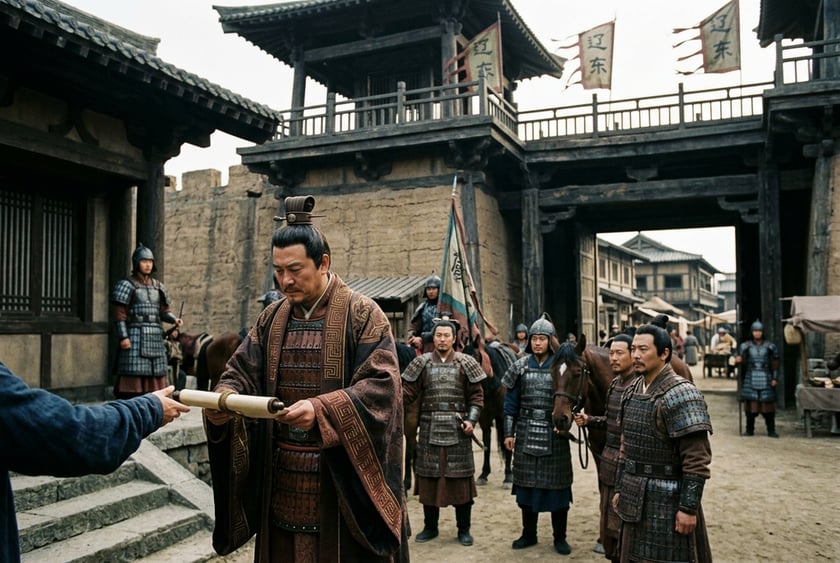
The winter of the fourth year of Jingyuan through the following first month was both the apex and the implosion point of Deng Ai's life. After completing the reception of Shuhan's surrender in Chengdu, he exercised a field commander's discretionary powers: following the Han founding model of pacifying former officials, he invested Liu Chan as General of the Agile Cavalry and preserved the dignity of his remaining entourage, and settled Shuhan's former officials by various assignments. These measures were entirely reasonable as military post-conquest administration, but in Sima Zhao's eyes they constituted an unauthorized "personal appointment of offices and personnel" — especially Deng Ai's unsolicited declaration of intent to "prepare for the conquest of Wu," which was read as an attempt to leverage the merit of destroying Shu into an independent power base [c:17921]. Sima Zhao simultaneously dispatched Wei Guan to the front to supervise and contain Deng Ai, and issued an edict ordering him transported back east in a cage-cart. Before Deng Ai reached Luoyang, Zhong Hui's rebellion at Jiange collapsed in failure; with the Wei army settling scores amid the chaos, Wei Guan, fearing that Deng Ai's return to court would lead to an investigation of his own role in the arrest, sent the護軍 Tian Xu to pursue him from behind [c:17922]. Tian Xu bore a private grievance against Deng Ai — Deng Ai had punished him during the Jiangyou campaign — making this an arrangement that used private enmity to execute a public imperative. Deng Ai and his son were ultimately cut down near Mianzhu by men under Tian Xu's command, ending in the span of a few months the extreme arc of "destroyer of a state — prisoner in a cage-cart — slain in the chaos of war."
Final Words or Testament
Neither the official histories nor the Romance of the Three Kingdoms preserve specific last words spoken by Deng Ai before his death. What can be inferred from his conduct is this: even after being taken into custody by Wei Guan, Deng Ai maintained that he had committed no crime, argued forcefully, and repeatedly insisted that "the investiture of former officials was the rightful prerogative of a field commander." This stance was precisely the reason he was killed — what Sima Zhao needed was a general who would bow his head, attribute all credit to the Prince of Jin, and accept subordination; what Deng Ai presented was the image of a man who continued to see himself as a frontline supreme commander. In this sense, Deng Ai's "testament" was in fact written into his treatment of Shuhan's former officials: he believed that as a soldier he had the authority to make political decisions in the field, and that belief became the final straw that broke him.
Aftermath
After Deng Ai's death, his family was implicated: the sons in Luoyang were executed; his wife and grandchildren were exiled to the western regions. Not until the ninth year of Taishi (273) did Emperor Wu of Jin posthumously rehabilitate Deng Ai, following a memorial submitted by Duan Zhuo, and posthumously confer on his grandson Deng Lang the title of Gentleman-of-the-Palace. This pattern of "killed under one reign, vindicated twenty years later" was almost the standard fate of ministers whose merit had eclipsed their sovereign. Wei Guan, for his part, rose steadily after Deng Ai's death, ultimately reaching the pinnacle of power in early Western Jin; Tian Xu, as the executor, received poor marks from historians but was not punished — implying that Sima Zhao's true attitude toward Deng Ai's death was not "Wei Guan committed unauthorized murder" but rather tacit approval, or even anticipation, of the outcome.
Historical Assessment
The significance of Deng Ai's death in medieval Chinese military history operates on three levels. First, it is a canonical example of the sovereign's systematic elimination of "an excessively capable frontier general" — a pattern that runs from Han's Han Xin and Peng Yue to Tang's Li Guangbi, of which Deng Ai is one of the more representative instances. Second, it reveals the "high rebound" of the immense political capital generated by a war of extermination: anyone who monopolizes that kind of achievement will inevitably face suspicion; sharing the credit is the norm, and Deng Ai's refusal to share credit with Zhong Hui or to bow deferentially toward Sima Zhao left him crushed from two sides. Third, from Shuhan's perspective, Deng Ai's violent death became a kind of historical symmetry: the general who destroyed Shu perished through foul play the very same year, never living to enjoy his glory — a fact some later historians read as a "note on the workings of heaven's justice." This narrative, though laden with emotional projection, also demonstrates that the reverberations of Deng Ai's death in cultural memory did not belong to Wei alone.