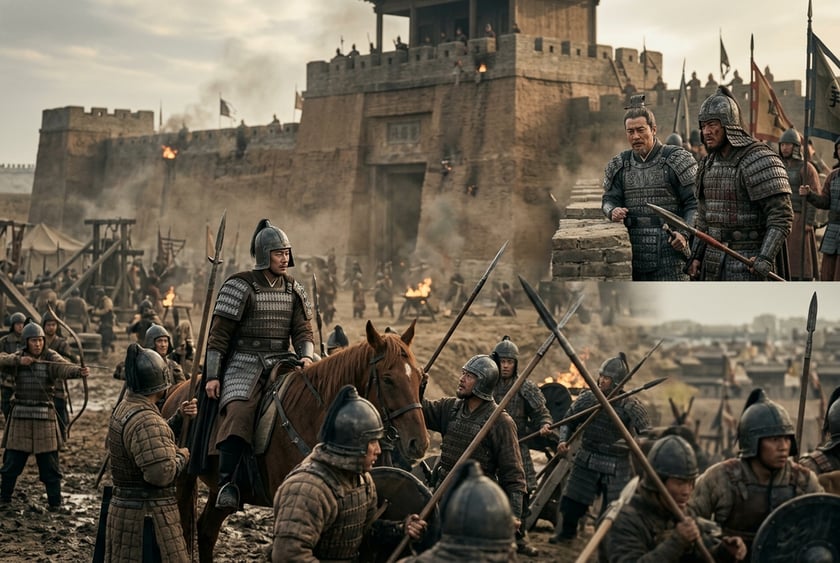
The Final Scene
The seventh year of Jianxing (229) — Zhao Yun was already past seventy. Since the fifth year of Jian'an (200), when he had joined Liu Bei at Yecheng, he had followed him for nearly thirty years: from a subordinate trooper under Gongsun Zan to a General Who Pacifies the South in Shuhan, he had been present at almost every key juncture in the expansion of Liu Bei's power — the single-rider rescue of the young heir at Changbanpo, the empty-camp stratagem that turned back Cao Cao's forces at Hanshui, the pacification of the commanderies during the entry into Yizhou, the rearguard defense at Jiangzhou during the Battle of Yiling, and the first northern expedition as the trailing army with Zhuge Liang heading through Jiegu. After the defeat at Jieting in the sixth year of Jianxing (228), Zhuge Liang demoted himself three grades; Zhao Yun, as the commander of the rear army, voluntarily requested demotion to General Who Stabilizes the Army on the grounds that he had "drawn his forces together and held firm without suffering a catastrophic defeat" — this was his final campaign. In the following spring Zhao Yun died of illness in Chengdu. In chapter 97 of the Romance of the San Guo, this death is handled with unusual dramatic force [c:17870]: a pine tree in the courtyard is split by wind; Kongming consults the oracles; the sons Zhao Tong and Zhao Guang arrive breathlessly with the news; Kongming throws down his cup and weeps bitterly — nearly every detail is arranged to signal to the reader that "the era of Shuhan's great generals of the founding generation has come to an end." The official histories record it more plainly: he died in the seventh year of Jianxing and was posthumously titled the Marquis of Shunping. But in both historical record and novel alike, this moment is treated naturally as the passing of the last elder general of the "Five Tiger Generals" — Guan Yu, Zhang Fei, Ma Chao, and Huang Zhong had all died before him; Zhao Yun's departure marked the final fading of a warrior of the Liu Bei generation.
Last Words and Legacy Intentions
The official histories record no detailed deathbed words from Zhao Yun, but a few of his recorded statements were repeatedly cited by later historians and literary figures, and may be taken as the spiritual testament of his life. The first is the remonstrance he offered to the generals during the distribution of farmland upon entering Yizhou: "Huo Qubing said that so long as the Xiongnu had not been destroyed he had no home to found — and today the enemies of the state are not merely the Xiongnu. It is not yet the time to seek ease." He argued against Liu Bei's wish to distribute Yizhou fields and houses to the generals and urged that they be returned to the people — a pivotal moment in Shuhan's early turn toward civilian governance and people-centered politics. The second is the lone remonstrance he delivered to Liu Bei before the Battle of Yiling: "The enemy of the state is Cao Pi, not Sun Quan; if we first destroy Wei then Wu will submit of itself" — urging Liu Bei not to launch an eastern campaign of revenge for Guan Yu. This is one of the extremely rare judgments among Shuhan's generals that operated at the level of grand strategy; regrettably Liu Bei did not heed it. These two "legacy intentions" resonate far beyond ordinary deathbed words. Together they embody Zhao Yun's political restraint as a military man: neither to disturb the people in the name of military merit, nor to let personal emotion drive national policy. This character kept him the lowest in formal rank and the lightest in noble title among the Five Tiger Generals — but left him with the highest reputation of all.
Aftermath
After Zhao Yun's death, the posthumous emperor Liu Chan posthumously granted him the title of Grand General and the posthumous noble title of Marquis of Shunping; he was buried on the eastern slope of Jinping Mountain near Chengdu, with a shrine erected for seasonal sacrifices. The title "Shunping" was exceptionally rare in Shuhan — "gentle, wise, and compassionate is Shun; regulated and measured in conduct is Ping" — an official authentication of the balance Zhao Yun maintained throughout his life between political and military affairs. His eldest son Zhao Tong inherited the marquisate and served as a Cavalry Commander, later rising to Tiger Assault Colonel and Inspector-General of the Army; his second son Zhao Guang served as a Cavalry Commander and, in the Jingao years, died in battle following Jiang Wei's campaign at Dazhong. Zhao Guang's death in battle was significant not only personally, but as the Zhao Yun family's demonstration across two generations of the Shuhan ideal of "generals' descendants in lifelong public service." After Jiang Wei took the reins of power in the Yanxi years, the Shuhan military structure never again produced a figure like Zhao Yun — at once capable of leading a charge in battle and carrying real weight in the court. In the thirty-four years from Zhao Yun's death to the fall of Shuhan, the state's military decision-making grew ever more aggressive, drifting ever further from the spirit of "military restraint" that Zhao Yun embodied.
Historical Assessment
The placement of Zhao Yun's biographical entry in San Guozhi is revealing: Chen Shou groups him together with Guan, Zhang, Ma, and Huang in the "Biographies of Guan, Zhang, Ma, Huang, and Zhao," but devotes comparatively little space to him. The assessment concentrates on "Huang Zhong and Zhao Yun — bold and fierce, mighty and strong — both serving as teeth and claws; were they not of the order of Guan Ying and Xiahou Ying?" — comparing him to the junior lieutenants of the early Han, Guan Ying and Xiahou Ying. This characterization as a "junior lieutenant" stands at quite a remove from the legendary image of "one of the Five Tiger Generals" found in the novel. The key is that when Chen Shou wrote the biography, Shuhan had already fallen; he drew on the old Shuhan archives, and Zhao Yun's noble rank and military accomplishments were genuinely a grade below Guan and Zhang's. But Zhao Yun's abilities in political restraint, communication with civil officials, and rearguard defense could not be fully conveyed by Chen Shou's spare strokes. By the time of the Romance of the San Guo, Zhao Yun was elevated from "junior lieutenant" to "one of the Five Tigers," and the stories of saving the young heir at Changbanpo, the empty-camp stratagem, and the Hanshui campaign were polished and re-polished into the most familiar warrior image in Chinese popular culture — the gap between "historically spare, novelistically exalted" is itself a splendid case study in the evolution of Zhao Yun's image. From any perspective, Zhao Yun's death was the final footnote on the founding generation of Shuhan's warriors: thereafter Shuhan would never again produce a figure who combined martial valor, political restraint, and moral prestige in the way he had.