Background
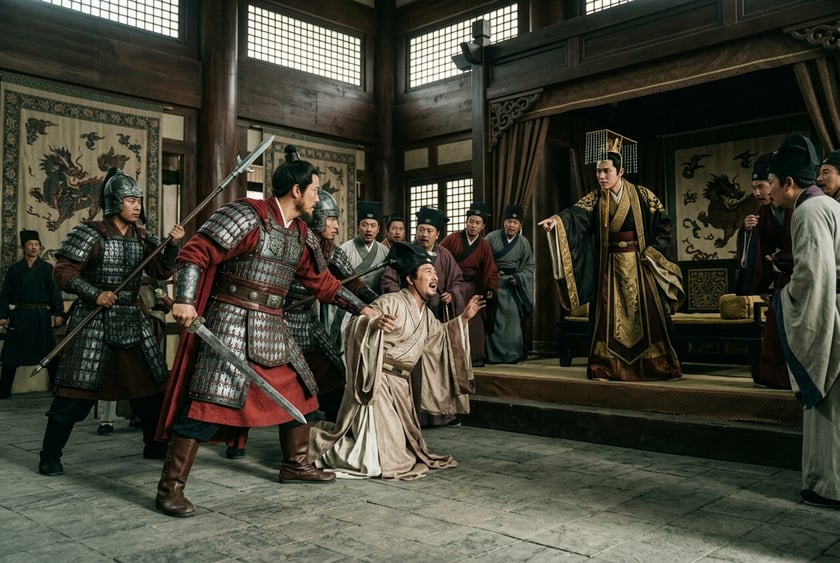
Yufanxijiaozhou — Yu Fan's exile to Jiaozhou — occurred in the period surrounding Sun Quan's declaration as king (Huangwu first year, 222), when the political atmosphere was tightening sharply. Yu Fan, styled Zhongxiang and a native of Yuyao in Huiji, was an irreplaceable core figure in Eastern Wu's intellectual world and the Jiangdong native gentry network — he was deeply versed in the Zhou Yi (Book of Changes), broadly read across the classics, and accomplished in calendrical astronomy; he had been praised in his youth by Kong Rong, Wang Lang, and other Central Plains luminaries. He served in succession under Wang Lang, Sun Ce, and Sun Quan, and participated in several key events: Sun Ce's pacification of Jiangdong (Suncepingdingjiangdong), Sun Quan's seizure of Jingzhou, the capture and execution of Guan Yu, and the defection of Mi Fang to Wu. But he was blunt by nature, fond of wine, and prone after drinking to reproaching others with classical texts — a trait that could still be tolerated in the Sun Ce period, when the political style was broad-minded and adventurous; by the later years of Sun Quan, as the Eastern Wu political environment grew suspicious and harsh, Yu Fan's conduct became an increasingly serious problem. In the broader context, Sun Quan in the period surrounding his proclamation as king was reshaping Eastern Wu's political authority: he needed to transform the Jiangdong commanders from "retainers of the Sun clan" into "subjects of the King of Wu," while also maintaining balance among gentry, commoners, and the locally-rooted versus the Jiangbei transplants. Any gentry representative who dared to openly confront the ruler or his colleagues would be seen as a potential challenge to this new order; Yu Fan was a typical sacrifice of this period.
Key Figures
Yu Fan is at the center of the event. His scholarly achievements actually constituted part of Eastern Wu's official ideology — his commentary on the Zhou Yi was recognized during the Han-Wei transition as an authoritative work, and his image as a classical scholar gave him a political standing different from that of an ordinary Jiangdong military commander. Mi Fang is one of the triggers: he had been a former retainer of Liu Bei and Guan Yu's elder comrade, and had surrendered to Sun Quan during the Xiangfan campaign; but Yu Fan had always harbored resentment over Mi Fang's "betrayal of loyalty and trust" and publicly mocked Mi Fang as "a man who handed over two cities and still calls himself a general" — destroying Mi Fang's dignity. Zhang Zhao was the final detonator: Yu Fan, in front of Sun Quan, pointed at Zhang Zhao and said "they are all dead men, yet they speak of immortals" — publicly humiliating Eastern Wu's chief elder statesman in the ruler's very presence. Sun Quan's long-accumulated anger finally erupted; he used this as the pretext for exiling Yu Fan to Jiaozhou. The relationships among these three figures reflect the delicate ecology of the Wu court — Yu Fan represents the "gentry standing on scholarship," Mi Fang represents the "military commander enriched by surrender," Zhang Zhao represents the "Jiangbei transplant core of steady regency" — and Sun Quan had to maintain supreme arbitration among all three.
Core Issues
This event has three core issues. The first is the boundary of ruler-minister ritual. What Yu Fan repeatedly transgressed was not specific policies but political ritual — through classical texts, through wine, through his blunt character, he pushed "a scholar may speak plainly" to the edge of "a scholar may humiliate the ruler." Sun Quan had long been displeased with this, but had taken no action, because Yu Fan's value in scholarship and diplomacy (such as his persuasion of Shi Xie to surrender, and his participation in negotiations with Shu envoys) made him difficult to dislodge lightly. The second issue is the political space of the Jiangdong native gentry. Yu Fan was a representative of the Huiji gentry; his exile to Jiaozhou signals that Sun Quan's tolerance threshold for Jiangdong native gentry had tightened; also suppressed around the same time were Zhang Wen (deposed in the third year of Huangwu) and Ji Yan (who committed suicide in the third year of Huangwu) and other native luminaries — together forming a wave of systematic "native gentry purges." The third issue is the shift in Sun Quan's personal character. The early Sun Quan was known for "promoting the worthy and able, letting each man give his all"; his later years trended toward suspicion and severity — the Ergongzhizheng (Succession Strife), Lu Xun's death of grief, Lv Yi's false accusations against senior officials, and other events followed in succession; Yu Fan's exile to Jiaozhou can be seen as an early signal of this shift.
Political Consequences
Yufanxijiaozhou had four layers of political consequence. The first is the personal level: Yu Fan lived in Jiaozhou for over twenty years and ultimately died there in exile, never returning to Jiangdong. But during his years in the place of banishment he lectured without cease, with students often numbering in the hundreds, taking root in Lingnan for Yi studies — a contribution of no small significance to the southward transmission of Han-Wei classical scholarship. The second is the family level: the Yu clan's political standing fell because of Yu Fan's crime, but its scholarly standing continued — Yu Fan's sons Yu Si, Yu Song, and Yu Bing and others remained known for classical scholarship in the Western Jin period, constituting an important branch of the literary lineage of southern gentry since the late Han. The third is the political atmosphere level: after Yu Fan's exile, the number of native gentry in the Wu court willing to speak frankly declined ever further; by the time of the Ergongzhizheng in Sun Quan's later years, those who dared to clearly oppose Sun Quan's moves regarding the succession were almost entirely Jiangbei transplants (Lu Xun being a Jiangdong exception), and the "critical voices" of the Jiangdong natives had essentially disappeared. The fourth is the Jiangnan cultural level: Yu Fan's more than twenty years of lecturing in Jiaozhou inadvertently promoted cultural and educational development in Lingnan, making Central Plains classical scholarship systematically enter the Guangdong-Guangxi region and northern Vietnam for the first time — providing a distant starting point for the flourishing of southern learning in the Six Dynasties period that followed.
Counterfactual Analysis
If Sun Quan had not exiled Yu Fan to Jiaozhou but merely subjected him to a mild rebuke in court, how would Eastern Wu's political path have unfolded? In the short term, the personal conflict between Sun Quan and Yu Fan might not have been fundamentally resolved — Yu Fan's character meant he would likely offend ruler-minister ritual again at any moment, and exile to the frontier was only a matter of time. But at the structural level, if Yu Fan had been able to remain at court, the network of native gentry criticism in Eastern Wu might have been preserved; during the Ergongzhizheng, Lu Xun would not have been fighting alone; and the late-regime disorders of Lv Yi's monopolization and the Sunjunsunchenzhuanquan might have had a stronger internal check. In other words, Yufanxijiaozhou looks on the surface like a quarrel between individuals, but was in reality the symbolic moment when Eastern Wu's "window of tolerance for criticism" was shut; and once that window was shut, every political ailment of Sun Quan's later years was amplified to its maximum by the absence of any internal error-correction mechanism. From a longer perspective, this pattern of "using suspicion to handle frank speakers" recurs repeatedly in ancient Chinese political history; Yu Fan is merely one of the earlier examples, but his fate provides a mirror: when a ruler begins to view the freedom of expression of the scholarly class as a challenge to his own authority, the decline of the regime has already quietly begun.