Background
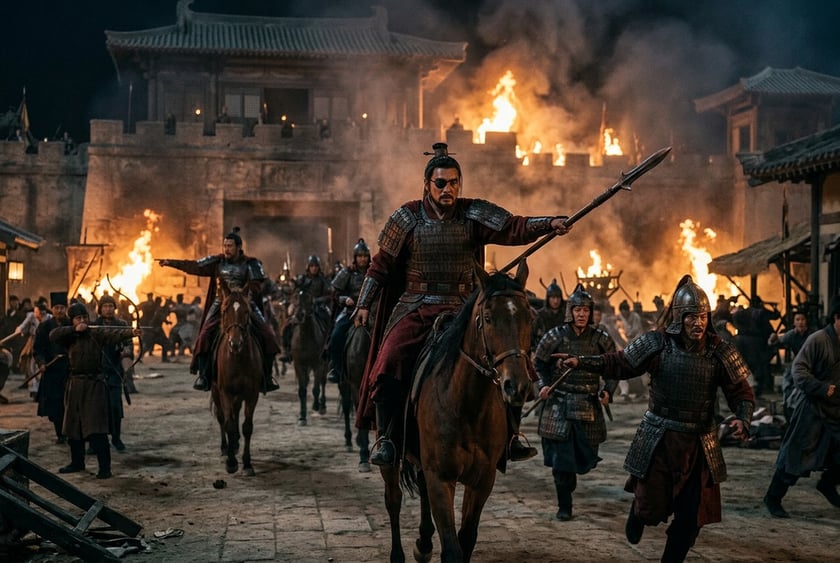
In the winter of the thirteenth year of Jian'an, the Battle of Chibi had just ended and Cao Cao's main force was in routed retreat northward, leaving the southern front as a whole in a state of strategic vacuum. Sun Quan seized this window and personally led his main force north to besiege Hefei. Hefei was the core strongpoint on the eastern line of the Huai River south, commanding the waterway of the Shi River into Chaohu Lake; toward the north it could threaten Shouchun; toward the east it could protect the lower reaches of Yangzhou — a strategically critical location for both Cao Cao and Sun Quan. From Sun Quan's perspective, the momentum of Chibi was still fresh, and Cao Cao was temporarily unable to look south; Hefei was the decisive test of whether Wu could translate a tactical victory into strategic expansion. From Cao Cao's perspective, the defeat at Chibi had already shaken morale across the Central Plains; if Hefei fell as well, the entire Huai River defensive line would be forced to pull back entirely to the Xu Chang corridor, and the central prestige painstakingly established through the "honoring the Son of Heaven" policy would suffer a severe blow. The reinforcements Cao Cao could mobilize were extremely limited: the main force had just suffered an epidemic after Chibi, with more than half the soldiers dead of disease; Zhang Xi's column of a thousand cavalry, even supplemented by soldiers from Runan, was further reduced by epidemic illness along the route, and the actual forces that could be committed to Hefei were far below what their reputation implied [c:17588]. This was the objective situation Jiang Ji confronted upon taking the stage — not enough reinforcements, not enough time, yet the battlefield had to be saved.
Course of Events
Jiang Ji's strategy was to substitute "information" for "troops." In his capacity as Yangzhou Bieju (Deputy Governor of Yangzhou), he secretly reported to the Governor of Yangzhou and forged a letter purportedly from Zhang Xi, stating that the infantry and cavalry numbering forty thousand led by Zhang Xi had arrived at Yulou (between present-day Gushi and Shangcheng in Henan), and requesting that the Yangzhou Zhubù (Senior Administrator) go to meet the incoming army. This forged letter was transmitted into Hefei by three separate routes: one successfully reached the hands of the Hefei garrison commander, informing the defenders that "forty thousand relief troops are about to arrive" to stabilize morale; the other two were deliberately leaked for the Wu forces to intercept, ensuring Sun Quan received the same information. The brilliance of this design was: if Sun Quan had seen only one intercepted letter, he might have suspected a lure. But when he received the same information from multiple channels, he was instead inclined to judge it as "routine internal Cao communications intercepted at multiple points" — which actually increased the credibility. Sun Quan fell for it and, fearing being caught between the forty thousand relief troops front and rear, immediately burned his encirclement works and withdrew [c:17588]. The entire operation consumed not a single soldier and yet achieved the strategic objective of relieving the siege of Hefei — a classic case of psychological warfare in the late Han.
Outcome
The campaign's result was that the siege of Hefei was lifted and Wu's first large-scale expansion effort on the northern front failed. In the short term, Cao Cao's forces held the Huai River defensive line at minimum cost; Sun Quan's side was forced to shift its center of gravity toward Jingzhou, and the political maneuvering between Sun Quan and Liu Bei — the lending of Nanjun, the Xiangshui Treaty — entered a new round. In the medium and long term, Hefei became the "knot in the heart" that Sun Quan could never crack for the rest of his life — thereafter he launched major northern assaults on Hefei in the twentieth year of Jian'an (215), the second year of Jiahe (233), the third year of Jiahe (234), and others, all without success; the Xiaoyaojin defeat (215) was especially devastating, nearly costing him his life at the hands of Zhang Liao. Hefei's impregnability owed much to the valor of defenders like Zhang Liao, Le Jin, and Li Dian, but it also benefited from the strategic breathing space won by Jiangjiweishujiuhefei in the fourteenth year of Jian'an — during that interval Cao Cao was able to reorganize his southern front, deploying Cao Ren, Xiahou Dun, Zhang Liao, and others into position; when Sun Quan came again, he was facing a systematized Caowei Huainan defensive line.
Significance
The significance of Jiangjiweishujiuhefei operates on three levels. The first is personal: this action brought Jiang Ji to Cao Cao's attention; in the fourteenth year of Jian'an he traveled to Qiaojun to report to Cao Cao, who recognized him as a man of talent and drew him into his own advisory staff. On the question of relocating the Huainan populace, Cao Cao consulted Jiang Ji — Cao Cao wished to imitate the relocation of the Baima residents at the time of Guandu and move more than one hundred thousand Huainan people northward; Jiang Ji remonstrated that "now that your authority overawes the empire and the people harbor no other intentions, a forced relocation will certainly scatter them." Cao Cao refused to listen; the more than one hundred thousand Huainan people did indeed scatter and flee into Wu territory; afterward Cao Cao apologized to Jiang Ji and praised his foresight [c:17588]. This series of events established Jiang Ji's image in the Caowei regime as "a shrewd planner who dares to speak plainly," enabling him to serve four successive rulers and ultimately to play the decisive intermediary role of "persuading Cao Shuang to surrender" during the Gaopinglingzhibian (249). The second level is the military-cultural level: this action established the Caowei southern front's tradition of "compensating for troop inferiority through intelligence superiority" — thereafter Zhang Liao defending Hefei, Wen Pin defending Jiangxia, and Man Chong managing the Huainan front all used similar psychological warfare and information warfare techniques to varying degrees. The third level is the historiographical evaluation level: scholars such as Qian Daxin, Lu Bi, and Tian Yujing, in their commentaries on late-Han military affairs, frequently cite Jiangjiweishujiuhefei as an exemplar of "saving a crisis through wit" — it and Xun Yu holding Juancheng, Jia Xu's dissuasion from relocating citizens at Guandu, and Liu Ye's dissuasion from a distant campaign all compose the common style of the Caowei advisory corps: "against war, avoiding the strong, using intelligence" — forming an interesting contrast with the offensive style of Zhuge Liang and Pang Tong for Liu Bei, and the steady style of Zhou Yu and Lu Su for Sun Quan. A single strategy from a single man held not just a city but the generational transmission of a style of governance.