Background
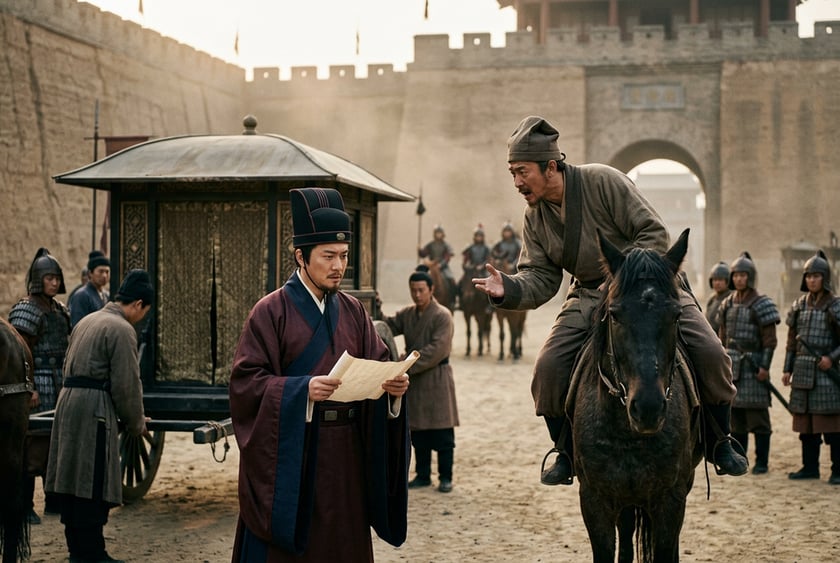
The rise of Gongsun Zan is a textbook specimen of the militarization of the Eastern Han frontier army. Youzhou lay at the intersection of Han Chinese, Wuhuan, and Xianbei territories; since the Huan and Ling emperors the court had depended on local military strongmen to hold the frontier while finding it impossible to restrain their tendency toward private-army formation. Gongsun Zan rose from the position of Commandant of Liaodong Dependent State through his meritorious service against Zhang Chun and the Wuhuan, reaching the rank of General of Martial Valor and Marquis of Ji; his "Baima Cavalry" — the White Horse Righteousness Force — became the most feared light-cavalry designation in the north. From the close of the Zhongping era through the early Chuping years, Youzhou in effect operated on a dual-track structure of "Liu Yu governing administration, Gongsun Zan commanding the military" — and it was precisely this institutional arrangement that sowed the seeds of the later armed clash.
Principal Figures
Liu Yu was a descendant of the Prince of Donghai, long serving in his capacity as an imperial kinsman to pacify the northern frontier; he advocated a policy of accommodation — stabilizing the border through trade and enfeoffment of Wuhuan chieftains — and was the only border official simultaneously regarded by court and public opinion as "fit to succeed to the imperial throne." Gongsun Zan represented a purely military line, convinced that against the border peoples "only decisive force could bring a stop to it" and launching repeated expeditions beyond the passes. Apart from these two, Yuan Shao was the critical third pole: he had first alienated Gongsun Zan by failing to install Liu Yu on the throne, and then exploited Gongsun Zan's massacre of Liu Yu to claim the moral high ground for his subsequent campaign of retribution. Liu Yu's son Liu He had long been detained by Dong Zhuo; after escaping he made his way circuitously to Yuan Shao, becoming the political banner under which the coalition of Hebei factions could rally against Gongsun Zan.
Core Issue
The true issue in the contest for Youzhou was not personal enmity but "whether a frontier military strongman could be made compatible with a court appointee-governor." Liu Yu sought through institutionalized conciliation to reduce military expenditure and stabilize production, but this undermined the war-spoils and conscription apparatus on which Gongsun Zan's expansion depended. Gongsun Zan wanted to comprehensively transform Youzhou into a military-economic body with cavalry at its core. The two lines collided in their most extreme form in the confrontation of Chuping year four — Liu Yu mobilized a hundred thousand troops to suppress Gongsun Zan and died in defeat; Gongsun Zan had him executed in the Ji market on the charge of "planning to usurp the throne by imperial edict." This execution not only politically erased the court's legitimate representative in Youzhou but also caused every gentry family, every Wuhuan chieftain, who had been waiting to see which way the wind blew, to defect to Yuan Shao's side.
Political Consequences
After Gongsun Zan withdrew to Yijing in Jian'an year two, his behavior became increasingly paranoid: he dug a moat ten trenches deep, had his consorts and concubines transmit documents personally, and cut off all contact with visitors and guests. This "fortress mentality" caused him to lose his outside allies — Zhang Yan and the Heishan forces, the Liaodong clan of Gongsun Du, and even potential connections as far as the Guanzhong region. In Jian'an year four Yuan Shao's main force surrounded Yijing; Zhang Yan's relief army never arrived; Yuan Shao finished the siege with tunneling to collapse the platform and fire attacks. Gongsun Zan first strangled his sisters and wives and then immolated himself. The commanderies of Youzhou, Yuyang, and Youbeipingfell one after another into Yuan Shao's domain. In the short term this allowed Yuan Shao to complete the integration of Hebei in the year before Guandu; in the long term Youzhou, having lost its locally rooted military proxy, confronted Cao Cao during his northern Wuhuan campaign with only the half-disintegrated governance structure Yuan Shao had left behind.
Counterfactual Analysis
Had Gongsun Zan in 193 abandoned direct confrontation with Liu Yu and instead accepted a court appointment under a "civil–military separation" model, Youzhou would in all probability not have collapsed in Jian'an year four. Even had Yuan Shao moved against him, he would have faced a composite opponent who held the orthodox mandate, commanded Wuhuan allied forces, and had an established military-colony base; Cao Cao's later northern campaign would also have been far less straightforward with an independent Youzhou force in the picture. A further step back: had Gongsun Zan, when surrounded in Yijing, accepted views other than Guan Jing's — and actively broken out toward Bingzhou or Liaodong — he would at least have preserved a mobile armed force in exile. But he chose to stake everything on the fortress, taking the dual-track structure of Youzhou to the extreme of "sole military dictatorship," so that when Yijing fell, the entire north was left with only Yuan Shao's voice — which is precisely what provided the opponent for the Battle of Guandu four years later.