Background
Shentingxiangbo took place in the course of Sun Ce's crossing of the Yangtze and pacification of Jiangdong, around the first year of Jian'an (196). The political landscape along the lower Yangtze at that time had a dual structure of "nominal center plus actual local power": the Inspector of Yangzhou, Liu Yao, represented the residual legitimate administrative system of the Eastern Han, was based at Qua, and held nominal authority; Sun Ce, leading a crack force assembled from his father Sun Jian's old troops, troops borrowed through his maternal uncle Wu Jing, and soldiers acquired upon parting with Yuan Shu, had crossed at Liyang with the goal of "seizing Jiangdong," and represented an emergent local military power. These two forces were bound to clash; the only question was which battle would become the watershed. Geographically, Shentingling — roughly in the area of today's Shenting Village, Xuebu Township, Jintan, Changzhou — lay to the southwest of Qua, between Danyang and Yanling, and was a necessary passage both for Sun Ce to reconnoiter Liu Yao's positions and for Liu Yao to track Sun Ce's movements. That a purely accidental reconnaissance skirmish would happen there was both coincidental and inevitable. In terms of the individuals involved, Taishi Ci was from the same commandery as Sun Ce and should by rights have been a prospective talent Sun Ce could win over — but at this moment Taishi Ci held a nominal post under Liu Yao's banner, and Liu Yao did not think highly of him. Liu Yao's stated reason for refusing to grant Taishi Ci command authority was, astonishingly, "If I were to use Zizi, would not Xu Zijian mock me?" — this kind of "self-censoring one's personnel decisions based on the opinion of famous arbiters of talent" is a textbook example of how the gentry literati culture of the late Eastern Han distorted practical judgment in appointments.
The Encounter
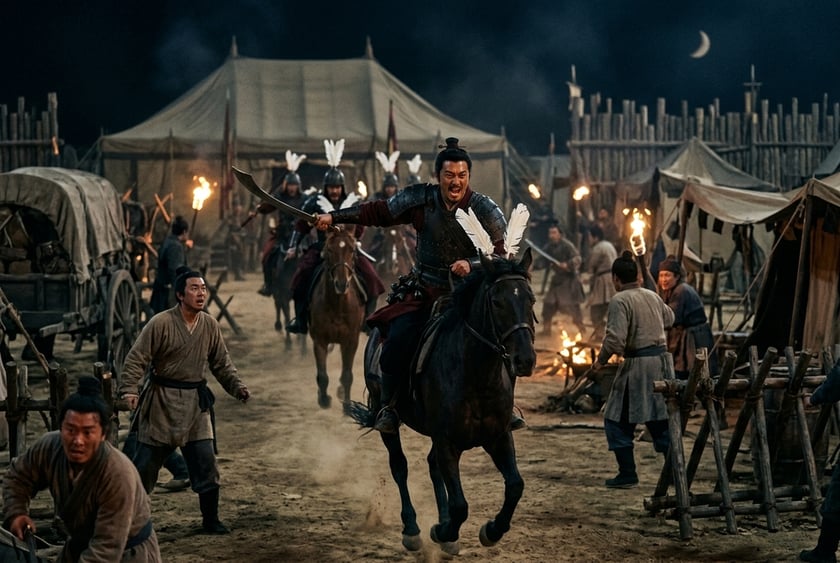
The core of the event was a single combat lasting perhaps twenty minutes. Taishi Ci had been ordered to conduct reconnaissance and rode out with only one companion; Sun Ce led Han Dang, Song Qian, Huang Gai, and ten other riders on a sortie from camp. When the two small reconnaissance parties met at Shentingling, the rational choice for both was to withdraw at once and report. But Taishi Ci chose a direct challenge — a choice that can only be explained by his desire to prove himself in a single fight, since within Liu Yao's camp he had already been marginalized and had no chance to distinguish himself through normal channels. Sun Ce's response carried the typical energy of the "Little Conqueror": rather than sending one of his accompanying fierce generals forward first, he personally engaged. The two fought until Sun Ce stabbed Taishi Ci's mount and seized the hand-halberd he carried at the back of his neck, while Taishi Ci grabbed Sun Ce's helmet — these two items were later worked into the romance as props "mutually proving each other's valor," but in the historical sources they are simply things seized in the melee. Most crucially, at precisely that moment relief cavalry from both sides arrived simultaneously, and the single combat was forcibly broken off. The romance version extends the opening phase of the duel to "fifty bouts without a decision," adds a general melee after both relief forces arrive, and then stages a scene the next day where each side displays the captured hand-halberd and helmet before their battle lines — elevating what was in reality perhaps a few minutes of fighting into a heroic narrative that serves as the prologue to Sun Ce's conquest of Jiangdong.
Outcome
From a tactical standpoint, Shentingxiangbo was an inconclusive chance encounter; neither side achieved a clear result. But from a political standpoint, both sides accurately identified the significance of this skirmish. For Sun Ce, who was just establishing his prestige in Jiangdong and urgently needed a heroic narrative that could circulate widely, "fighting to a draw" with a fierce enemy general was both honorable and safe — winning outright was fine, but a draw also demonstrated the opponent's caliber and enhanced the "comparability" of his own record. For Taishi Ci, this battle was the only window through which he could demonstrate his worth to the wider world; his situation within Liu Yao's army did not visibly improve afterward, but Sun Ce's side had taken note of him — and that planted the relational seed for his eventual submission to Wu. Specifically, after Liu Yao's defeat, Taishi Ci was run down and captured alive by Sun Ce, who personally unbound him and asked, "Would you be willing to join me?" Taishi Ci agreed to go and recall Liu Yao's remaining troops, and returned at the appointed time — Sun Ce never doubted him. The foundation of that trust was laid precisely at Shentingling, where the two men had encountered each other on the field and earned each other's respect.
Impact
The long-term impact of Shentingxiangbo has three layers. The first is at the tactical level: it demonstrated to the Jiangdong generals a model of leadership in which "the commander can personally fight in single combat." This model was reprised repeatedly in the era of Sun Ce and Sun Quan (as in Taishi Ci's fierce duel with Sun Ce, or Sun Quan being pursued by Zhang Liao at Ruxu) and created the enduring impression of a Wu army whose commanders possessed personal valor — a striking contrast to the Caowei style of "commander directing from behind the curtain." The second layer is at the personnel level: it directly produced the critical talent transfer of Taishi Ci's submission to Wu. Without Taishi Ci, Liu Yao's camp collapsed quickly at the Battle of Qua; with Taishi Ci, Sun Ce gained a commander capable of independent action for his campaigns to take Nanjun and pacify the various commanderies of Jiangdong. From a broader vantage, this is the landmark event through which the nascent Jiangdong regime accomplished talent integration by "recognizing men on the battlefield." The third layer is literary formation: the romance used Shentingxiangbo as the foundational scene for Sun Ce's image as the "Little Conqueror" and Taishi Ci's image as the "valorous man of faith and honor," fixing both figures in the minds of later readers far beyond their actual weight in the historical sources — especially Taishi Ci, the most fully recorded old acquaintance from the same commandery in the Wu section of Sun Ce's biography, whose character, valor, and integrity were all defined through this battle and the subsequent submission. From this angle, Shentingxiangbo was not merely an inconclusive fight, but a key event that shaped the early cultural DNA of the Jiangdong regime.