Strategic Background
Around the first year of Jian'an (196), Jiangdong was still in the stage of "multiple strongmen each controlling their own commanderies and counties." After his father Sun Jian's death Sun Ce had attached himself to Yuan Shu, then crossed the river eastward to carve out his own base; within a few years he had pacified Lujiang and Danyang and set his sights on the Yangtze south heartlands of Wujun, Huiji, and Yuzhang as his next necessary targets for absorption. Huiji's particular character lay in being the commandery with the most mature Han administrative tradition and the deepest gentry culture in the south of the Yangtze — its seat at Shanyin (modern Shaoxing) backed mountains and faced the sea, was rich in produce, and was the last large remaining unabsorbed territory in Jiangdong. Wang Lang held this territory in his capacity as Huiji Administrator with a formal Han-court appointment; he was not merely a local official but a representative figure of those still earnestly maintaining the Eastern Han commandery-kingdom system and insisting that "Han officials cannot bow their heads to a rebel". This identity determined that his conflict with Sun Ce was not a simple military problem but a collision between two political narratives: "taking the Han as sovereign" versus "taking Jiangdong as home."
Disposition of Forces
Sun Ce's deployment continued the rapid-attack paradigm he had employed since crossing from Jiangxi: simultaneous advance by water and land, cavalry seizing key points, never prolonged standoffs with adversaries. His core group of meritorious officials at this time consisted mainly of Zhou Yu, Cheng Pu, and Huang Gai, skilled at mobile strikes in the canal-dense terrain of the Jiangnan region. Wang Lang's side had no professional field army under the traditional commandery-kingdom system, relying mainly on Huiji commandery's garrison troops and a handful of privately recruited household soldiers, as well as the Shanyue forces occupying the surrounding mountain areas (the novel's so-called "White Tiger" is a later misidentification) to resist. His advisor Yu Fan was the key figure; though still young, he was already known for his understanding of military logic, and advised Wang Lang that "if strength cannot resist, it is better to withdraw" — meaning that Huiji's garrison troops were insufficient to oppose Sun Ce directly, and it was better to preserve the viable force for a prolonged attrition campaign against Sun Ce, or to withdraw to Dongye (modern Fuzhou area) to use maritime routes to liaise with Jiangnan magnates.
Critical Decision Points
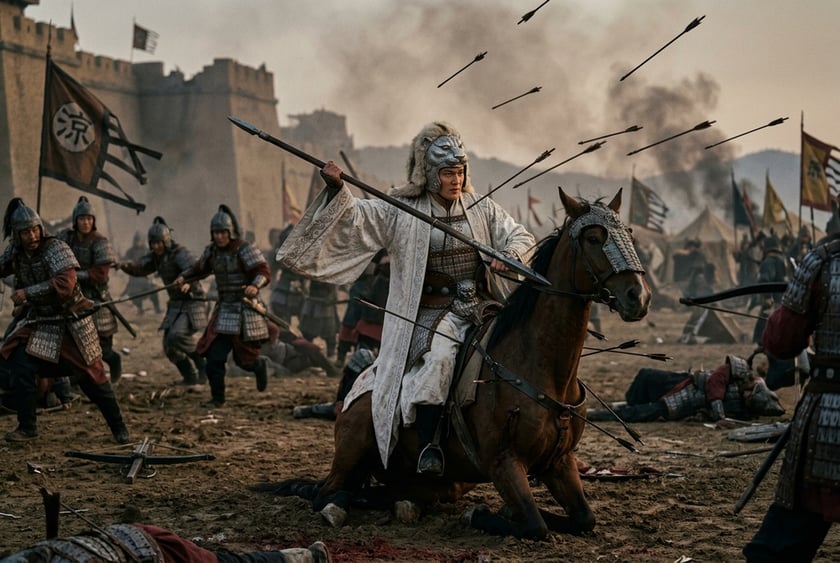
Wang Lang's critical choice in this battle was between "defending the name" and "defending the territory." He chose to defend the name — in his capacity as a Han official he insisted on marching out for a direct engagement. This choice had a clear political logic: once he sidestepped a frontal confrontation he would tacitly acknowledge Sun Ce's legitimacy, and his political signboard as "Huiji Administrator appointed by the Han court" would immediately lose effect. But from the military standpoint this was the worst option. Sun Ce used his speed advantage to rout Wang Lang's garrison troops in a single engagement within Huiji's territory, forcing Wang Lang to flee south along the coast; when he finally reached Dongye Sun Ce caught up and again inflicted a major defeat. Sun Ce also demonstrated toward those who submitted what became his characteristic united-front approach in Jiangdong: Wang Lang as a refined and cultivated man of reputation had value for public opinion — killing him would damage Sun Ce's own name, so he only rebuked Wang Lang in words without harming him; at the same time he absorbed the official Yu Fan, making him a think-tank talent for the Wu court of subsequent generations.
Outcome and Reverberations
In military terms this engagement was the concluding campaign of Sunwu's absorption of Jiangdong's last large commandery; politically it was the template for Sun Ce's policy of "offering courteous treatment in exchange for gentry cooperation." Though Wang Lang was defeated and fled by sea, he was afterward courteously released by Sun Ce, ultimately served Caowei, and became a ceremonial authority of Three Excellency rank in Wei; Yu Fan became deeply involved in the Sunwu court and served as an important advisor to both Sun Ce and Sun Quan. Looking at the longer timeline, this battle laid a critical resource for the subsequent San Guo configuration: Sunwu's base was not any single fortified city but the Jiangnan heartland of Huiji–Wujun–Danyang. Without this heartland, defending the Yangtze would have been impossible; and Wang Lang's defeat essentially transferred political control of this heartland from the system of formally appointed Han commandery administrators to Sun's private armed forces — this was precisely the foundational event of Sunwu's "Jiangdong localization." The novel's Chapter 15 dramatizes this process, staging a verbal duel between Wang Lang and Sun Ce on open ground outside Shanyin with Yu Fan's surrender offer being rebuffed, recasting the military victory narrative as a moral debate on loyalty and ambition versus self-interest.
Counterfactual Analysis
Had Wang Lang adopted Yu Fan's strategy of avoiding battle, the outcome would have been very different. Huiji's mountain terrain and coastline were well suited to prolonged attrition — if Wang Lang had himself retreated to Dongye to liaise with Jiaozhou forces and even established contact with Liu Biao's side, Sun Ce would have faced a grinding front stretching across the Min-Zhe region, and absorption of Huiji would have been delayed by at least several years. And with Yuan Shu's proclamation of the emperorship and the Battle of Guandu several years later bringing chaos to the north of the river, this delay would have been enough to cause Sun Ce to miss the optimal window for incorporating the territory. But Wang Lang's political identity determined that he could not adopt such a course: to do so would have meant first abandoning the Han-court signboard, in which case he would no longer be the adversary whom Sun Ce found worth "preserving his reputation by not harming." The true lesson of this battle is: in the chaos of the late Han, "defending one's identity" and "preserving one's strength" were frequently irreconcilable, with the mainstream-legitimist administrators often trading their integrity for defeat, while the newly risen warlords turned that integrity into a political resource for subsequent integration of the gentry.