Background
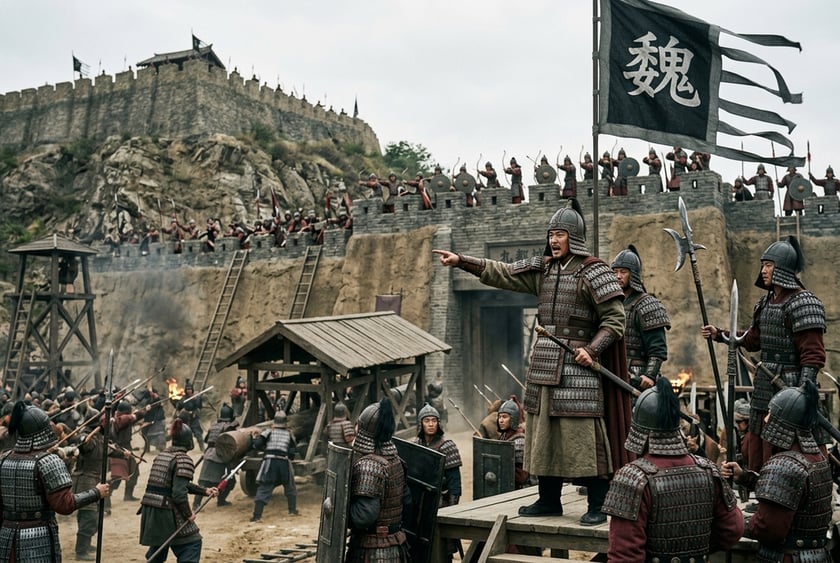
Ever since Sunwu seized Jingzhou, the regime's territorial map had harbored a "soft underbelly" problem: the commanderies of Wuling, Lingling, Guiyang, and others in the southwest of Jingzhou covered a vast mountain region where the Wuxi area — the five streams of Xiong, Man, Chen, You, and Wu — was home to large concentrations of minority tribal peoples whom the central plains dynasties called "Man." Relations between these tribes and the commanderies of the Han plains had long been tense; whenever Sunwu's main force went out on campaign or the regime experienced internal turbulence, the Wuxi area was prone to revolt. By the third year of the Huanglong reign (231), Sun Quan had proclaimed himself emperor two years earlier and the southern regime was entering a consolidation phase. Yet the military standoff against Caowei in the Huainan direction and the maintenance of the alliance with Shuhan both required a stable rear. A Wuxi uprising broke out at just this moment, threatening the grain supply and human resources of the middle Yangtze — it had to be suppressed quickly.
Key Figures
The supreme commander of this pacification campaign was Pan Jun — a figure who occupied a peculiar position in Sunwu's political landscape. Originally a subordinate under Liu Biao and later Liu Bei, he had served as Executive Administrator under Guan Yu when Guan Yu garrisoned Jingzhou; his relationship with Guan Yu was contentious. After Lv Meng seized Jingzhou in the twenty-fourth year of Jian'an (219), Pan Jun submitted to Sunwu; well versed in Jingzhou's local conditions, he enjoyed Sun Quan's deep trust. Another key figure was Lv Dai, at the time a senior commander in the Jiaozhou region, renowned for his multiple suppressions of uprisings among the southern peoples of Lingnan and Jiaozhou. Shi Ji (Zhu Ji, son of Zhu Ran, adopted into the Shi family branch) was one of the newer generation of commanders and was given experience in this campaign. This combination reflects Sun Quan's characteristic approach to personnel: the experienced Pan Jun as primary strategist, the veteran Lv Dai in coordination, and younger commanders in training — a three-tier structure fully in place.
Central Issue
The root of the Wuxi problem was not a purely military one; it was a long-standing tension between Sunwu's central authority and the minority peoples along its margins. The mountain terrain of Wuling was treacherous and its tribal settlements scattered — purely military conquest was prohibitively costly to sustain. Yet to allow full autonomy would risk border strongmen allying with tribal groups to form de facto independent powers. Pan Jun's strategy can be summarized as "combining military suppression with conciliation, with conciliation primary." Relentless military force was applied to the core tribes that continued to resist, but tribes willing to submit were offered land, farming tools, tax remissions, and other accommodating policies; the appointment of tribal chiefs as local Wu officials drew ethnic governance into the imperial bureaucratic system. This approach was not Pan Jun's invention — every dynasty since the Eastern Han had followed a similar policy toward the Wuling Man — but Pan Jun executed it with particular care, and his own background as a Jingzhou native, familiar with the local languages and customs, made him more effective than an officer posted in from outside.
Political Consequences
The pacification of the Wuxi campaign had several layers of impact. In the short term, the rear security of Sunwu's middle Yangtze was safeguarded, allowing Jingzhou forces to be shifted with confidence to the western front (the Shuhan border) or the eastern front (the Huainan battlefield against Caowei). In the medium term, commanders like Lv Dai and Shi Ji accumulated experience in mountain warfare in the south during this campaign, providing the foundation for Lv Dai's later pacification of Jiaozhi and Shi Ji's garrisoning of Jingzhou. In the long term, Sunwu's governance model in the southwest of Jingzhou — appointing tribal leaders and using ethnic officials in administration — continued into the era of Lu Kang, producing a relatively stable frontier order. The fragility of that order began to show on the eve of the Western Jin's destruction of Sunwu: as the Sunwu center weakened, the "Man" peoples of Wuxi, Changsha, and elsewhere grew active again, ultimately becoming one of the secondary factors in Sunwu's collapse. But through the efforts of Pan Jun's generation, the Wuxi frontier enjoyed close to half a century of relative calm.
Counterfactual Analysis
If Sun Quan had chosen to handle the Wuxi problem through pure military conquest — as Cao Cao had used a thunderbolt strike against the Wuhuan — he might have achieved a more complete short-term victory, but at the cost of depleting a large portion of Sunwu's main force while leaving the Yangtze front unable to resist Caowei pressure. Conversely, if Sun Quan had completely left Wuxi to govern itself, the Wuling mountain region might have gradually slipped outside Sunwu's control, becoming an independent power analogous to Zhang Lu's regime in Hanzhong, which could then have been exploited by Shuhan or the later Western Jin to form a strategic encirclement of Sunwu. The middle path Pan Jun chose — limited military action combined with long-term conciliation — was the most pragmatic option given Sunwu's limited national capacity. This case also became the reference template for Zhuge Ke's subsequent pacification of the Shanyue (around 244 AD): for southern regimes, governance of internal minority peoples is invariably a compound of administrative wisdom and military pressure.