Background
The coup plot of the first month of the first year of Zhengyuan (254) was the last organized resistance by the Caowei imperial house against the Simashi's monopoly on power since the Gaopinglingzhibian (249). After Sima Yi died in the third year of Jiaping (251), his eldest son Sima Shi succeeded as Grand General and Director of the Masters of Writing, wielding power even greater than his father's. In 252 the defeat at Dongxing had at one point exposed the instability of the Simashi's political foundations outside the court; in 253 Jiang Wei besieged Didao and Guanqiu Jian began preparing a rising, while external pressures intensified rapidly. These events gave Caowei's imperial clan a misleading impression — that Sima Shi was not invincible. By this point Cao Fang was already twenty-two years old, with a strong desire to exercise personal rule; combined with the fact that Zhang Ji (father of the empress Zhang Huanghou), the imperial in-law Xiahou Xuan (son of Xiahou Shang, elder brother of Xiahou Ba), and Li Feng (Palace Writer, controlling the drafting of central documents) still enjoyed significant prestige at court, a three-way conspiracy took shape that seemed to offer a feasible plan for moving against Sima Shi.
Principal Figures
Li Feng served as Palace Writer, commanding the drafting authority at the center with "eyes and ears within"; he had long maintained a posture of "outward compliance but inner divergence" toward Sima Shi to blunt the latter's edge. He himself proposed "to use Your Majesty's bright imperial decree to assemble the heroes of the realm and eliminate this traitor" [c:17098], and was the chief architect of the conspiracy's rhetoric. Xiahou Xuan held the post of Grand Minister of Ceremonies, representative of the Cao-clan imperial in-laws; his elder brother Xiahou Ba had already defected to Shuhan out of fear of Simashi persecution, and Xiahou Xuan himself had long occupied the political position of "a kinsman of the state — how can one sit by while a treacherous minister throws the realm into chaos?" [c:17098]. Zhang Ji, father of Empress Zhang Huanghou and the emperor's father-in-law, was the bridge figure connecting the imperial house with the outer court. Cao Fang himself was the highest source of legitimacy for the conspiracy; his gesture of "removing his dragon-phoenix undershirt and biting open his fingertip to write a blood edict" [c:17099] was intended to invoke the precedent of the Yidaizhao of Emperor Xian of Han and to give the coup historical legitimation. Sima Shi, as the target of the coup, was also its ultimate suppressor; his several critical responses during the event — arriving at court with his sword, confronting the conspirators in the street, turning on them on the spot — constituted a total rollback of the conspirators.
Core Issues
The core issues in this case concentrate on three levels: the legitimacy of the coup, its organizational feasibility, and the timing of execution. First, on legitimacy: Cao Fang's blood edict borrowed the political symbolism of Emperor Xian of Han's Yidaizhao, explicitly distinguishing Li Feng, Xiahou Xuan, and Zhang Ji from Dong Cheng [c:17099] — "We are not men of Dong Cheng's kind; how can Sima Shi be compared with the Martial Ancestor?" This rhetorical move had a high level of tension, but it also exposed the conspirators' insufficient grasp of historical lessons: the ultimate outcome of the Yidaizhao had been the extermination of Dong Cheng's clan and Liu Bei's flight into exile — it did not succeed in toppling Cao Cao. It appears that Li Feng and his associates had not noticed that this historical parallel already foreshadowed their own fate. Second, on organizational feasibility: the inner conspiracy circle of the three men and Cao Fang was far too small — no military forces, no outside support, no internal agents; blood edicts and oaths alone could not prevail against Sima Shi's command of the palace guards [c:17098]. Third, on timing: all three men had scarcely left the palace when they ran directly into Sima Shi arriving at court with his sword [c:17099]. This detail is highly dramatic, but the underlying reality was almost certainly that Sima Shi had already obtained intelligence about the conspiracy through his informants and had deliberately set a trap to confront them on the spot. The three were questioned in the street, searched, and seized; throughout, almost no opportunity for resistance existed.
Political Consequences
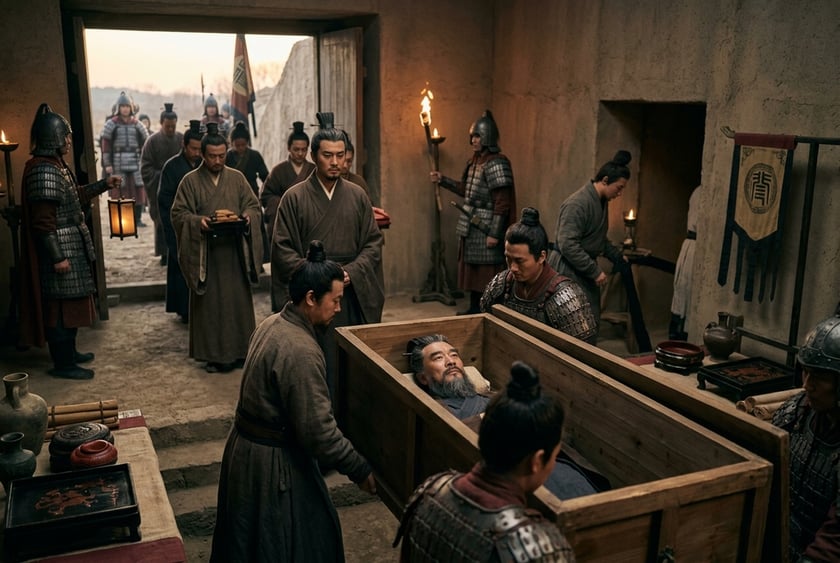
Sima Shi ordered Li Feng, Xiahou Xuan, and Zhang Ji "executed by halving at the waist in the marketplace, their three clans exterminated" [c:17100], and entered the rear palace to hold Cao Fang accountable, having Empress Zhang strangled with white silk cord inside the Donghua Gate. This suppression had several far-reaching effects. First, it completely purged the last batch of influential opponents from within the Caowei imperial clan at the center of power — Xiahou Xuan was the most commanding figure in the Xiahou family, and his clan's extermination meant the Xiahou clan's complete withdrawal from the Caowei political stage; Li Feng and Zhang Ji were the central figures among non-clan gentry who had supported the Cao house, and their destruction marked the loss of any personnel base in the outer court for organizing an anti-Simashi movement. Second, the event directly provided the pretext for deposing Emperor Cao Fang in the same year — Sima Shi cited "the ruler's depraved and immoral conduct" in the deposition edict, but the true motive was that Cao Fang could no longer be tolerated. Third, the event sent a clear signal to all potential opponents: any attempt at a coup against the Simashi, no matter how well-grounded in legitimacy, would end in the extermination of the whole clan. This deterrent force meant that subsequent anti-Sima movements (the Wuqiujianwenqinzhiluan and the rising of Zhuge Dan) were concentrated entirely at the military level and no longer dared take the form of a palace coup.
Counterfactual Analysis
If Sima Shi had not detected the conspiracy in advance, could Li Feng, Xiahou Xuan, and Zhang Ji have actually brought him down? Almost certainly not. The greatest obstacle was not Sima Shi's own alertness but the conspirators' lack of military power. As Grand General, Sima Shi already effectively controlled the command chain of the Luoyang palace guards; without corresponding internal allies — theater generals holding military tallies, such as Guanqiu Jian or Zhuge Dan — any palace coup could only be launched by "using a blood edict to summon heroes across the realm." And such a summons, under conditions where the Simashi controlled the central communications and document systems, could never have produced an effective response. Conversely, had the three men suppressed their impulse and refrained from plotting directly in the palace — instead working through external military forces such as Xiahou Ba and Guanqiu Jian to set things up from the outside — they might have created genuine coup pressure. This is precisely the path that Guanqiu Jian and Zhuge Dan later attempted, though both also ultimately failed. From a structural historical standpoint, imperial resistance to the Simashi had by the first year of Zhengyuan already lost any institutional feasibility. The true significance of the Lifengxiahouxuanzhibian was not whether it could succeed, but that it laid bare in full the Caowei imperial house's utter predicament — no organization, no military power, no outside support — and at the cost of three clan exterminations pressed fast-forward on the tempo of the abdication that would follow.