Background
Fuhuanghouzhisi must be understood within the entire sequence of power steps leading from "Cao Cao's elevation to Duke of Wei — elevation to King of Wei — preparation for abdication and usurpation." In the fifth month of 213, Cao Cao was enfeoffed as Duke of Wei, received the Nine Honors, and established the Wei state — a clear progression pointing toward abdication; 214 was the critical year in which the Wei duchy's institutional structure took root and Cao Cao began exerting more direct control over the Han power center. Prior to this, the Xian Emperor's faction had organized one counter-Cao conspiracy through Dong Cheng's Yidaizhao in 200, which was exposed and failed; the conspiracy in which Empress Fu participated was in essence a sister episode to Yidaizhao — equally led by the imperial family's maternal relatives, equally dependent on transmitting sealed letters, and equally swiftly exposed by Cao Cao's intelligence apparatus. The consecutive failures of both conspiracies marked the permanent sealing-off of the last space for the Han imperial house's "legitimate resistance." From this perspective, the death of Empress Fu in 214 was the "political funeral of the Han imperial house" — occurring a full six years before the "procedural funeral" of 220, when Emperor Xian abdicated in favor of Cao Pi.
Key Figures
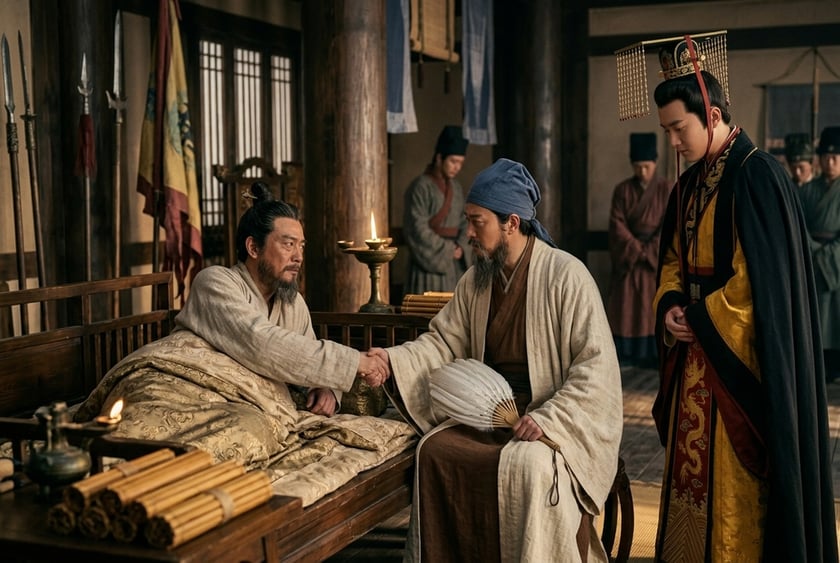
Empress Fu was Emperor Xian's principal and legitimate consort; her father Fu Wan was from a classical-studies family background and held the office of Colonel of the Qianqi Imperial Guards — a figure with moral prestige at court but no real power. In the novel she is depicted as a tragic figure who "lived day and night as though sitting on a bed of needles, and felt it better to die than to go on like this" [c:16139] — a female character archetype grounded in the personality keynote of "even death is preferable to passive submission," which is extremely rare in San Guo narratives and whose spiritual prototype traces back to the tradition of the Heroic Women of pre-Qin antiquity. The role of Mu Shun as messenger must not be overlooked — in the novel he is described as "one to whom loyalty and righteousness can be entrusted" [c:16139] and ultimately refuses to confess even under severe torture, making him the morally purest figure in the entire conspiracy. Cao Cao's image in this event presents a notably different "harsh and severe side" from his usual persona: the detail of searching headdresses and combing through hair [c:16140] displays his extreme confidence in his political sensitivity, while the decision to exterminate the Fu clan to the third degree shows his Legalist bedrock of being "willing to pay any price for the security of the regime." The roles played by Xi Lv and Hua Xin as executors are a marker of the deep co-optation of the shi-dafu official class into Cao Cao's system — Hua Xin's act of "seizing the Empress by the hair and dragging her out" [c:16141] became the stain for which he was attacked by Confucian historians for the rest of his life.
Core Issues
The core issue of this event is "how imperial autonomy disappears under the system of the powerful minister." The surface issue is the suppression of a coup plot; the deeper issue is how "the political body of the Empress" is handled. In traditional Chinese politics, the Empress, as the Emperor's "ritual counterpart," inherently possessed a function of checking imperial power; but when imperial power had already been hollowed out by a powerful minister, the Empress herself became a "ritual threat" to the powerful minister — deposing the Empress was in reality the most profound level of humiliation the minister could inflict upon the Emperor. Cao Cao's choice to depose the Empress on the charge of "conspiring against the state by correspondence" was not only political liquidation; it was also the deliberate spiritual crushing of Emperor Xian — forcing the Emperor to watch with his own eyes as his most intimate companion was dragged away by the man the Emperor should most have been able to trust. Emperor Xian's lament, "I do not know when even my own life will come to an end" [c:16141], marks the complete abandonment of his own consciousness of existence as "the Emperor" in any political sense. From this event until his abdication six years later in 220, Emperor Xian left no record of any further resistance — which was precisely the psychological objective this event was designed to achieve.
Political Consequences
The most direct consequences were that the Han imperial political forces were entirely cleared out: the Fu clan to the third degree was imprisoned, the two imperial princes born of Empress Fu were poisoned, and Emperor Xian was left with no maternal relatives to rely on. The second layer of consequences was a qualitative change in the relationship between Cao Cao and the Confucian shi-dafu class: executors such as Hua Xin and Xi Lv were forever branded as "hawks and hounds" from that point on; the moral capital Cao Cao had accumulated by honoring the "Xiaolian" (filial and incorruptible) recommendation system and esteeming classical studies was significantly eroded, planting the seeds of the tragic ends of eminent men such as Kong Rong and Cui Yan. The third layer of consequences was ideological: the novel directly links the recurring dream of "blood-covered figures demanding their lives" that Cao Cao suffered in his final years [c:16142] to the death of Empress Fu, constructing a narrative chain of "the mandate of heaven is being transferred." Cao Cao's illness and eventual death are explained as retribution — "having committed offenses against heaven, there is nothing left to pray to" — which is the popular moral world's final verdict on Cao Cao's image. The fourth layer of consequences concerns political memory: the historical memory that "even the maternal relatives of the imperial family could not save the Han" was reinforced, subsequently influencing the institutional design of the Jin, Tang, and Song dynasties regarding imperial maternal-relative power — "do not allow the maternal relatives to interfere in governance" became an unwritten iron rule of later imperial authority, and the historical roots of this rule can be found in the case of the Fu family.
Counterfactual Analysis
If Empress Fu's conspiracy had succeeded in killing Cao Cao, what would the outcome have been? The most probable short-term projection is that Cao Cao's death would have plunged his sons Cao Pi and Cao Zhi into fraternal rivalry; Cao Cao's old lieutenants such as Xiahou Dun, Xiahou Yuan, and Cao Ren might have recognized Cao Pi as the successor, but lacking Cao Cao's political prestige, they would have found it difficult to suppress Liu Bei and Sun Quan from taking advantage of the opportunity to push north. Emperor Xian might have taken back some measure of power, but lacking a sufficient political base of his own, he would soon have been sidelined again by another strongman — perhaps Sima Yi, perhaps Chen Qun. In other words, the conspiracy's success would not have saved the Han; at most it would have changed the lead actor in the abdication script. A second, deeper projection: what if Cao Cao had chosen to depose Fu Hou without killing her — merely confining her under house arrest without exterminating her clan? The most likely result would have been a significantly reduced level of moral condemnation, and Cao Cao's later political reputation would have come closer to the Legalist model of "strict but not cruel"; the preparation for abdication would have proceeded more smoothly. But Cao Cao chose extermination — which shows that his pursuit of absolute security outweighed his concern for historical evaluation. This choice itself is the personality bedrock of his character as a political actor, and is the fundamental reason why the label "cunning hero" has never been shed from his legacy.