Background
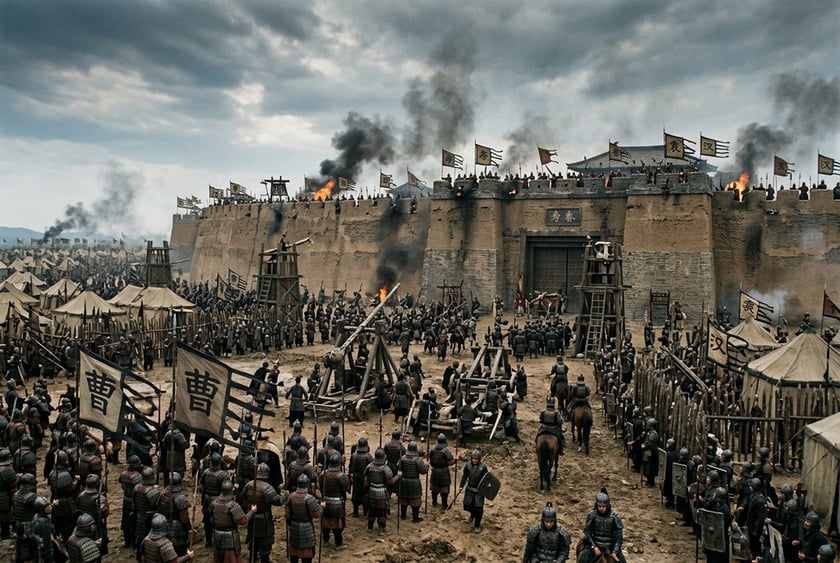
This episode is embedded in the middle phase of Liu Bei's Yizhou campaign. In the nineteenth year of Jian'an, Zhuge Liang, Zhang Fei, and Zhao Yun divided their forces and pushed upriver from Jingzhou to reinforce Liu Bei, who was bogged down at the Luocheng front and had just lost Pang Tong. Zhang Fei's column was tasked with clearing the water and land corridor from Bajun to Luocheng; the objective was not only to take Bajun but to link up with Liu Bei's main force as quickly as possible — if Liu Zhang managed to crush Liu Bei's vanguard before relief arrived, the entire Yizhou enterprise would be instantly reversed. The romance focuses this battle's dramatic weight on "the contest between Zhang Fei and Yan Yan," using a theatrical counterpart to throw into relief Zhang Fei's political maturation. [c:16907]
Principal Figures
Zhang Fei's image before this episode in the romance is that of a fierce general whose "temper flared like fire and who delighted in flogging his troops"; Yan Yan, by contrast, is an old Shu general, Liu Zhang's Grand Administrator of Bajun — aged but with undiminished vigor, and one who had objected to Liu Zhang's invitation of Liu Bei into Shu from the very start, lamenting "sitting alone in a rugged mountain and bringing a tiger in as one's own bodyguard." Their confrontation is not merely a military pairing but a cultural-symbolic pairing of "impetuous young fighting general" versus "unbending elder minister." Zhang Fei's initial handling — shouting for Yan Yan to be dragged out and beheaded — continued his old characterization; but Yan Yan's response in the face of death — "Behead me if you will — what is there to be angry about?" — elevated this face-off to the plane of a contest of moral fiber. [c:16907]
Central Issue
The central theme of this passage is a politicized "winning hearts through virtue." The instantaneous shift in Zhang Fei from threatening execution to personally untying Yan Yan's bonds, steadying him into a seat, and making a bow of thanks carries the romance's narrative of legitimacy-building for the Shuhan regime — Shuhan does not prevail through pure military coercion but wins people's hearts by treating surrendered officials with respect. Yan Yan's transformation is also not a simple individual submission: it brings about the chain surrender by dispatch of a letter through forty-five passes along the route. [c:16908] From a governance-logic standpoint, Zhang Fei's "soft approach" here solved for Liu Bei a broader political problem — how to take over Liu Zhang's old subordinates. With Yan Yan as the model, the gentry of Shu saw that surrender was not a disgrace but an opportunity to be received by the new master as "a man of heroic character."
Political Consequences
The most direct consequence was that Zhang Fei's rate of advance greatly exceeded expectations; he in fact arrived at the outer perimeter of Luocheng ahead of Zhuge Liang's main force. [c:16908] The strategic significance of this acceleration for the overall Yizhou campaign was that the pressure on Liu Bei's Luocheng front was relieved; Liu Zhang rapidly lost confidence under the dual encirclement. The deeper influence was that, within the narrative arc of the romance, Zhang Fei's personal image completed its transition from "impetuous fighting man" to "a general capable of recognizing protocol" — the political weight he carries in the subsequent episodes of holding Langzhong, defending Baixi against Zhang He, and ultimately his fatal end all have their foundation laid here. Simultaneously, Yan Yan's reversal of identity from "old scoundrel" to "advance vanguard" provided a narrative precedent for Shuhan's absorption of Shu-born generals such as Wu Yi, Li Yan, and Wu Lan.
Counterfactual Analysis
Had Zhang Fei actually executed Yan Yan, several cascading consequences would have followed. First, the forty-five passes east of Bajun would not have surrendered on receipt of a letter, forcing Zhang Fei to assault each position in turn — a delay of at least several months. Second, with the Luocheng front unable to wait for relief, Liu Bei might have been compelled to fall back on Jingzhou, and the Yizhou campaign as a whole might have collapsed. Third, the gentry of Shu would have formed the frightened perception that "surrender equals death," and the Liu Zhang faction's will to resist would actually have been strengthened, dragging out a prolonged war of attrition. Viewed from this angle, the real value of Zhang Fei's action was not a personal "moral awakening" but a commander-level judgment — at the decisive stage of a campaign, deploying force and political acuity simultaneously. It is worth noting that the official histories do also record that "Fei, respecting his spirit and integrity, released him and treated him as a guest," but do not elevate Yan Yan to the rank of a Shuhan general, and contain no dramatic extension of "surrendering forty-five passes along the way" — the romance's amplification at this point serves the narrative of Shuhan as a regime founded on virtue.