Origins
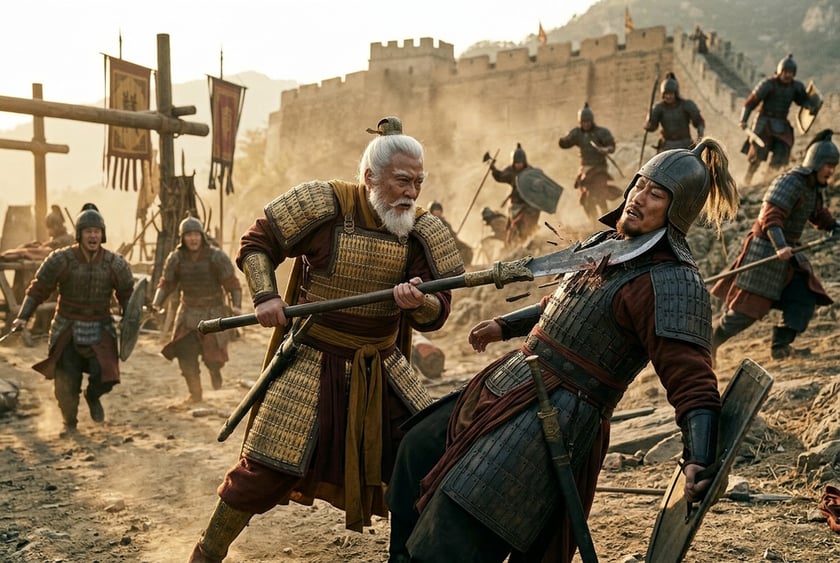
The Yellow Turban Uprising of the first year of Zhongping (184) convulsed the empire, but the main Yellow Turban forces, once suppressed, did not disappear. Across the junction of the North China plain and the Taihang mountain range, large numbers of Yellow Turban remnants, displaced migrants, and discharged provincial troops retreated into the highlands and formed fresh "mountain-and-marsh bandits." Zhang Yan — born with the surname Chu, a native of Zhending in Changshan — rose to prominence the fastest among them. He gathered young men to form a bandit band in 184, roaming the mountains and marshes; before long he merged with Zhang Niujiao, who was leading a simultaneous uprising. Zhang Niujiao was struck by an arrow in battle and, on his deathbed, commanded his followers that "you must make Yan your commander," whereupon Chu Yan took the surname Zhang. [c:16898] This detail of "a dying commander passing authority by last order" reflects an early organizational model for the Black Mountain bandits that was closer to a roving militia than a regular military body.
Participating Forces
The Black Mountain Army's geographic heartland was the eastern slope of the Taihang range, radiating outward to the mountain valleys of Changshan, Zhao, Zhongshan, Shangdang, and Henei commanderies. Internally it was far from monolithic: Sun Qing, Wang Dang, and others submitted their contingents to Zhang Yan, who was honored as paramount chief, but individual units retained considerable independence. The "one million" figure publicly claimed at peak strength was clearly inflated; actual combat troops available for mobilization are estimated at several tens of thousands. This force was sandwiched among four powers: to the south, Yuan Shao and Cao Cao; to the east, Gongsun Zan; to the west, the Xiongnu and Qiang tribal groups; to the north, the governor of Youzhou, Gongsun Du. Zhang Yan exploited the mountainous terrain to hold off complete absorption by any one power, while nimbly hedging between the four — leaning toward whichever was ascendant at a given moment.
Key Turning Points
The Black Mountain Army experienced three pivotal turning points. The first came in the fifth year of Zhongping (188), when Emperor Ling issued an edict appointing Zhang Yan as General Who Pacifies Difficulties and permitting him to be incorporated into the imperial framework. This "pacification" conferred nominal legitimacy on the Black Mountain Army without dissolving its armed structure. The second came from the third year of Chuping (192) through the Xingping era, when Zhang Yan aligned with Gongsun Zan to attack Yuan Shao; he was defeated by Yuan Shao's generals Lv Bu and Jue Yi, suffering a setback but not a decisive elimination. The third came after the Battle of Guandu in the fifth year of Jian'an (200), when Yuan Shao was defeated and the Yuan family's grip on Hebei steadily weakened; Zhang Yan began to reassess his political options — continuing to resist the ever-stronger Cao Cao held no future.
Suppression and Outcome
In the tenth year of Jian'an (205), Cao Cao pacified Yuan Tan and consolidated complete control over Jizhou. The Black Mountain Army's situation was unambiguous: the Yuan family's Hebei power no longer existed, the fence to straddle had vanished; Cao Cao, newly in possession of Hebei, needed a stable mountain-border order but was unwilling to expend further troops on a war of conquest. Both sides' interests aligned, and Zhang Yan voluntarily led a following of one hundred thousand to submit; Cao Cao appointed him General Who Pacifies the North, enfeoffed him as Marquis of Anguo, and granted him a food stipend of five hundred households. [c:16899] After the submission, Zhang Yan's forces were garrisoned at Yecheng, effectively completing the transition from mountain-and-marsh bandits to a Caowei border general. This mode of settlement — exchanging titles and stipends for the dissolution of an armed force — was the final stroke in Cao Cao's pacification of Hebei and stands as a classic instance of absorbing a vast latent military threat at minimal cost.
Historical Resonance
The historical resonance of the Black Mountain Army operates on three levels. The first is the military-geographic level: Zhang Yan's submission meant that the "highland vacuum" along the eastern slope of the Taihang range was filled in; Caowei was then able to establish a stable political-military center around Yecheng. The subsequent process by which Cao Pi displaced the Han — with Yecheng functioning as one of the five imperial capitals and remaining stable over the long term — is closely connected to the exit of the Black Mountain Army from the stage. The second level is social: the existence of the Black Mountain Army is an extreme specimen of the Han-dynasty-collapse process of "displaced people becoming armed." Their submission provided a template for the withdrawal of large-scale armed migrant bands from warfare — trading official rank and stipends for lasting peace — a formula that recurred repeatedly in Caowei's subsequent handling of the Wuhuan and Xiongnu. The third level is historical narrative: in the main storyline of San Guo Yanyi, the Black Mountain Army and Zhang Yan are little more than background figures, often ignored altogether; but in the official histories they rank alongside the Yellow Turbans, the Bai Bo, and the Qingxu and Runan Yellow Turban remnants as one of the principal bandit forces of the Han dynasty's collapse — active for twenty years and mobilizing on the scale of one hundred thousand, easily the equal of any second- or third-tier warlord. Zhang Yan personally, as a man who began his career in the mountains and marshes and ultimately enjoyed a peaceful old age, has a political trajectory more typical of his era than many of the lords who receive far more attention in the histories. In the chaos of a dying dynasty, those who truly survived were often precisely those who knew at which moment to stop.