Final Circumstances
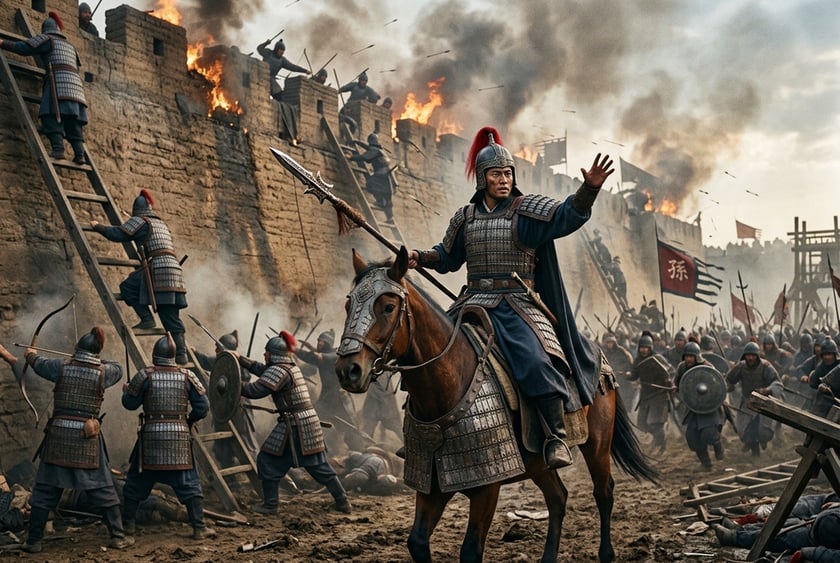
In the nineteenth year of Jian'an (214), Liu Bei's campaign to enter Yizhou had already run two years since raising troops at Jiameng — Fucheng had fallen, Mianzhu had been taken, and the front had been pushed to the walls of Luocheng, the seat of the Yizhou Shepherdship. Luocheng stood on the northern edge of the Chengdu Plain and was Liu Zhang's last solid military-administrative stronghold; its fall would leave Chengdu's gateway wide open. Pang Tong was serving as Junior Chancellor-Commandant, the actual strategic architect of Liu Bei's Yizhou campaign, and during the siege he personally led troops in the assault. According to the "Biography of Pang Tong" in the Shu section of the San Guozhi, he was struck by a stray arrow during the fighting and died on the spot, aged thirty-six. The event itself involved no dramatic ambush or personal duel — merely an unexpected battlefield death of a command-level strategist during siege operations. Yet this "ordinary military casualty" produced a political shockwave wholly disproportionate to its cause.
Final Words and Testament
The orthodox histories record no last words from Pang Tong, and his historical weight resides primarily in the honors bestowed after his death and in strategic consequences rather than in any specific utterances. Notably, the San Guozhi's account of this casualty is almost entirely free of literary embellishment — no omen, no dying words, no prophetic dream. This restrained narration is itself a posture: Pang Tong as military strategist was valued by results, not by dramatic moments. The later fictional additions of "Luofengpo," the "de Lu harms its master" prophecy, and Zhang Ren's ambush all find no basis in Chen Shou's original text.
Aftermath
Liu Bei's reaction is recorded as an unusually open display of emotion — "the First Ruler was grief-stricken and wept whenever he spoke of it". Such a public outpouring of feeling was rare for Liu Bei. His follow-up actions operated on three levels. First, he posthumously appointed Pang Tong's father to the rank of Counselor, then promoted him to Remonstrating Grand Master — extending the honors to the previous generation. Second, he posthumously granted Pang Tong the noble title of Marquis Within the Passes and the posthumous name "Jing" — meaning "respectful and composed, sparing in words" — a name consistent with the reputation for careful and meticulous planning that Pang Tong had maintained in his lifetime. Third, Zhuge Liang "personally went to prostrate himself" in mourning — a gesture that was not only a private tribute but also an elevation of Pang Tong to the same rank as Zhuge Liang in the sequence of "chief strategic advisers." Pang Tong's younger brother Pang Lin later accompanied Huang Quan on the Wu campaign, suffered defeat, and entered Wei — the Wei Emperor Cao Pi, on account of the family's conduct of righteousness, bestowed upon him bedding, curtains, and clothing. This is a rare instance of the Pang family receiving special treatment in both Wei and Shu.
Historical Assessment
The true weight of Pang Tong's death lay in how it forcibly rewrote Liu Bei's strategic disposition. Before Pang Tong's death, the personnel configuration for Liu Bei's Yizhou entry was "Zhuge Liang holding Jingzhou, Pang Tong accompanying the army into Yizhou" — Jingzhou as the great rear base, Yizhou as the new frontline, the two chief strategists each anchoring one region, corresponding to Liu Bei's overall strategy of "straddling Jing and Yi." Pang Tong's sudden death in battle shattered this configuration: Zhuge Liang was compelled to lead Zhang Fei and Zhao Yun up the river to reinforce from the west, and what had originally been Jingzhou jointly held by Zhuge Liang, Guan Yu, and Zhang Fei was abruptly reduced to Guan Yu holding it alone. Five years later (219), Guanyubeifa ended when Lv Meng seized Jiangling, and Jingzhou changed hands overnight — not unrelated to the rigidity in troop deployment under the "single-defender" structure. Seen from this angle, Pang Tong's single stray arrow effectively crippled one of the two legs on which the Longzhong strategy outlined in Zhuge Liang's Longzhong Dui stood. Losing Pang Tong was not merely the loss of a strategist — it was the loss of the strategic precondition of "Zhuge Liang in Jingzhou." Chen Shou in Pang Tong's biography calls him "a remarkable talent," stating that he "was passionate about assessing men of note, learned in scholarship and rich in strategic thinking; the Jing and Chu region of his time called him outstanding" — and compares him to Wei's Xun Yu and Guo Jia. It was precisely that caliber of figure that made one ordinary siege casualty the heaviest personnel loss in the history of Shuhan's founding.