Background
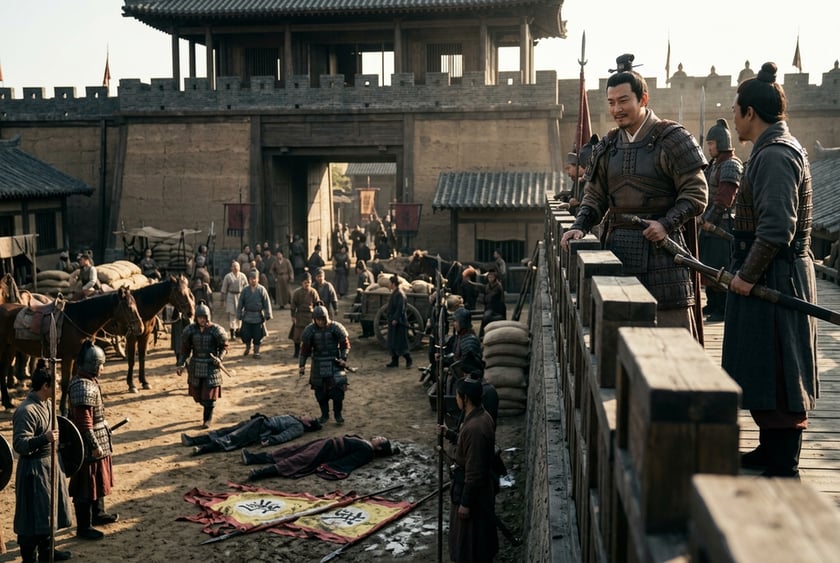
This purge was the closing event of Sunwu's "Two Palaces Struggle." The struggle, known as the Ergongzhizheng, arose after Sun Quan established Sun He as crown prince in the fifth year of Chi'wu (242), then proceeded to lavish on Prince of Lu Sun Ba treatment nearly equal to that of the crown prince — splitting the court into "Crown Prince faction" and "Prince of Lu faction," with each side attacking the other and cultivating alliances in the inner palace, dragging on for nearly eight years. The Prince of Lu collective was anchored by Quan Ji, Wu An, Sun Qi, and Yang Zhu, with connections behind the scenes to Princess Quangong, Sun Hong, and others among the inner palace and powerful officials. Sun Quan's attitude in the earlier phase was ambiguous, and he tolerated the Prince of Lu's near-equal standing — the result was a continuously escalating intensity of factional struggle, shaking morale throughout Wu's upper echelons, driving veteran official Lu Xun to die of indignant sorrow, causing Zhu Ju, Gu Tan, and other great-family members to be exiled or executed, and severely destabilizing the state's foundations.
Key Figures
The target of this purge was Prince of Lu Sun Ba and his associates. Sun Ba was Sun Quan's fourth son; having enjoyed Sun Quan's partiality and a title as Prince of Lu, and having long maintained near-crown-prince status, he assembled a coterie of household clients and young officials into a faction, of whom Quan Ji — a son of Quan Cong, deeply intertwined with imperial family affinal connections — was most prominent; Wu An and Sun Qi were from the outer branches of the imperial clan; and Yang Zhu was the most vigorous in slandering the crown prince. The decision-maker was Sun Quan himself; the execution was carried out by the senior judicial officials and inner-palace attendants in a simultaneous combined strike of "depose the crown prince — execute the Prince of Lu — purge the associates." Yang Mu, playing the role of remonstrator as Yang Zhu's elder brother, repeatedly advised his younger brother against participating in framing the crown prince; after the event, because he had clearly remonstrated, he was spared execution and merely exiled — a rare example of lenient treatment in this purge.
Core Issues
The core issue here is not "who should be the heir" but "how Sun Quan was to re-establish a single axis of authority in the final years of his life." The root cause of the Two Palaces Struggle was a "twin-center structure" Sun Quan had deliberately created — whether by design to hold a balance or to observe and assess, the effect was to divide the court into two opposing camps and to force the Jiangdong great families' political alignment into the question of succession. By the thirteenth year of Chi'wu, Sun Quan was approaching seventy; if he did not break the twin-center structure, he would carry internal fracture into the politics of the succession. Deposing Sun He and killing Sun Ba — appearing to reject both sides simultaneously — was in reality a clearing of the existing succession framework to make room for a new, young emperor who could be governed by outside regents (Sun Liang, then seven years old). The death sentence on Sun Ba, the posthumous flogging of Yang Zhu, and the pursuit and execution of three factions' members constituted a comprehensive surgical strike "purging all factional core members through iron-fisted means," with the objective of leaving "no faction to compete."
Political Consequences
In the short term, the event ended the eight-year succession struggle, established Sun Liang as crown prince, and superficially zeroed out court factionalism. But the cost was equally heavy: Sun Quan with his own hands smashed the central-elite stratum on which Wu's regime depended; figures such as Zhu Ju, Lu Yin, and Gu Cheng were caught up in the purge, damaging the trust of Jiangdong's native great families in the Sun clan. The Prince of Lu faction was gone, but the power vacuum was filled by imperial-clan veterans and inner-palace attendants such as Sun Jun and Sun Hong — sowing the seeds for Sun Jun's autocracy and Sun Liang's regicide following Sun Quan's death. Over the longer timeframe, the Two Palaces Struggle and its terminal purge mark the inflection point of Sunwu's "late-phase involution": from that point forward Eastern Wu was never again able to produce a stable regent collective, imperial successions became frequent, and the capacity to mount a strategic response to the fall of Shu Han was directly eroded.
Counterfactual Analysis
What if Sun Quan had not simultaneously removed both crown prince and Prince of Lu in the thirteenth year of Chi'wu but had eliminated only one? One possibility is retaining Sun He: Sunwu might have avoided the chaos of governance by a young emperor under regents, but with the Prince of Lu's associates unremoved the court would still have harbored a second center of power. Another possibility is retaining Sun Ba, reclassifying the Prince of Lu as heir: Sunwu might have entered a more aggressive but also more unstable period of rule; the court's perception of the traditional norm of "establish the eldest son as heir" would have been overturned, and the degree of resistance from the Jiangdong great families would not necessarily have been lower than that which accompanied the deposition of the crown prince. Viewed through the logic of Sun Quan's personal decision-making, his choice of the path of "mutually destructive for both factions, enthrone the young child and wait" was fundamentally driven by the highest priority of "ensuring that no one could interfere with his arrangements after his death." This logic was most thorough in the short term and most dangerous in the long term. The death sentence issued in the thirteenth year of Chi'wu was the fragile equilibrium that Sun Quan purchased with his last act of iron authority — and also the clear watershed marking Eastern Wu's turn from flourishing to decline.