Circumstances of Death
As a biographer looking back at Dantu in the fifth year of Jian'an, the assassination of Sun Ce carries a historical weight far exceeding the attack itself. At the time Sun Ce was covertly planning a strategic operation to "strike Xudou and receive the Han emperor" — his most ambitious northward venture after unifying Jiangdong and seizing Lujiang, intended to exploit the window created by Cao Cao and Yuan Shao's mutual deadlock at Guandu and launch a surprise attack on the Central Plains from the southeast. But before the operation could be set in motion, he was suddenly attacked by retainers of Xu Gong during a routine hunt in the western hills of Dantu — struck by several spear wounds and an arrow in the cheek; he failed to recover from his injuries and died within months. As for location: Dantu lies on the southern bank of the Yangtze, directly adjacent to the Yangzhou front north of the river — a strategic node from which Sun Ce was inspecting preparations for the northern advance. As for timing: this was the very moment his personal career had reached its peak.
Final Words and Dying Instructions
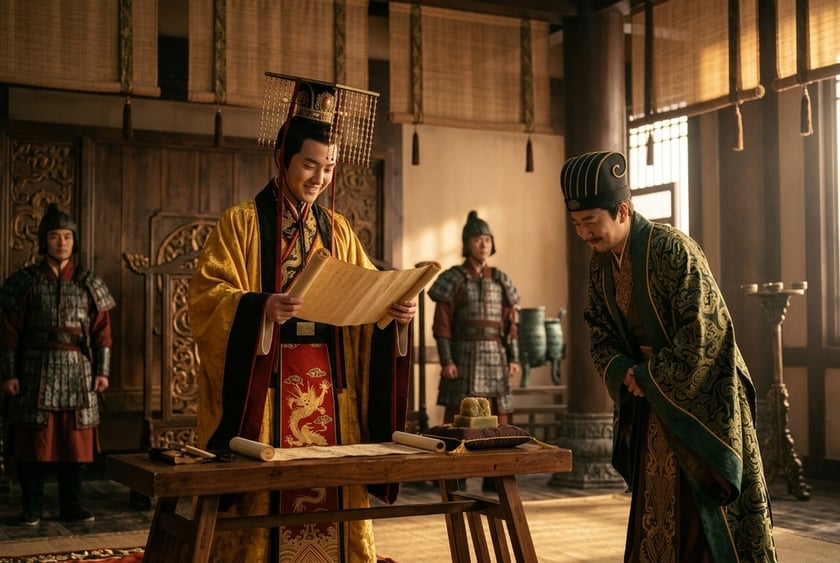
The official histories preserve no detailed account of Sun Ce's dying words; the San Guozhi main biography is extremely brief on this point. But drawing on the sources cited in Pei Songzhi's annotations and later historians' syntheses, in his final phase he did two decisive things: first, he summoned veteran officials including Zhang Zhao and Zhou Yu to his sickbed and explicitly entrusted Jiangdong to his younger brother Sun Quan, emphasizing that the governing principle should be "elevate the worthy, employ the capable, hold Jiangdong"; second, he presented Sun Quan with the official seal, completing a legitimate transfer of power. The significance of these two acts lies in the fact that although Sun Ce was dying suddenly from an assassination rather than from illness, he still had sufficient clarity of mind and sound judgment to transform an utterly unexpected crisis into a smooth transition. This is why "Sun Ce's deathbed regency" is considered one of the most successful regency acts in the entire San Guo period.
Aftermath
The course of events in Jiangdong after Sun Ce's death proved the soundness of his dying instructions. Sun Quan, with the support of Zhang Zhao and Zhou Yu, quickly stabilized the regime; Xu Gong's remaining followers were eliminated, and the seeds of local rebellion were suppressed. Cao Cao initially intended to advance south and absorb Jiangdong but was dissuaded by his advisors; he instead made a marriage alliance (a daughter of Cao Ren married Sun Kuang) to court the Sun clan. In the eight years that followed, Sun Quan consolidated the territories his father and brother had left, reorganized civil and military administration, and by the time of the Battle of Chibi in 208 was able to ally with Liu Bei and defeat Cao Cao. Although Sun Ce's death ended his personal "northward strike at Xu" plan, it objectively preserved Jiangdong's strength — a Sun Ce who had marched north too early might have met disaster in a head-on clash with Cao Cao, while Sun Quan, steadfastly guarding Jiangdong, instead carried the region into becoming one pole of the tripartite balance.
Historical Assessment
Historians through the ages have assessed Sun Ce's assassination with a dual tone of regret and reflection. Chen Shou judged him as "impetuous and rash, bringing ruin on himself through his own conduct," pointing to his character flaws as the direct cause of the tragedy — a man who, when he had already become a target for many, still went hunting with light escort and insufficient protection. Guo Jia had long predicted that "Sun Ce would surely die at the hands of a petty man," basing this precisely on the character analysis of "reckless and unprepared, impulsive and unstrategic." From the perspective of political consequences, Sun Ce's assassination actually enabled Jiangdong to avoid a premature decisive confrontation with Cao Cao, gave Sun Quan time to build a riverine army system centered on holding the Yangtze, and made possible both the later Battle of Chibi and the long-term establishment of Jiangdong as an independent polity. Viewed from this angle, the assassination contains a historical paradox beyond the tragedy: an event that could have rewritten the outcome of the Battle of Guandu instead, through the death of the person at its center, caused the San Guo configuration to finally take its definitive shape. For readers today, what most deserves reflection about Sun Ce's assassination is not "what might have happened if he had lived" but rather why a genius who had laid the foundations of a state before the age of twenty-six was ultimately killed by household retainers of a former prefect he himself had executed — the proposition that "the conqueror dies because of a detail" is a recurring theme in the study of political leaders of the late Han.