Strategic Background
As a modern military historian looking back at Jiangdong between 195 and 199, Sun Ce faced a battlefield that appeared fragmented yet was deeply localized. Liu Yao held Qua with the official title and prestige of Yangzhou Governor; Yan Baihu occupied Wu Commandery, styling himself "Virtuous King of Eastern Wu"; Wang Lang held Huiji Commandery in a wait-and-see posture; Hua Xin controlled Yuzhang as a potential outside supporter. These forces shared a common characteristic: strong enough to hold their ground, too weak to expand. If Sun Ce could eliminate them one by one, he could unify Jiangdong without requiring outside assistance. From a strategic-geographic standpoint, the river crossings of the lower Yangtze, the waterway networks east of Lake Tai, and the hills south of the Qiantang River together formed a battlefield of successive layers — whoever could master the rhythm of "cross first, break quickly, strike continuously" could achieve unification without giving the opposition time to mount a coordinated counterattack.
Dispositions of the Two Sides
The core of Sun Ce's forces consisted of three thousand of Sun Jian's old soldiers along with the household troops of Zhu Zhi and Lv Fan, supplemented by the elite hundred fighters Zhou Yu brought from Shucheng. The offensive was divided: Zhu Zhi, Lv Fan, Cheng Pu, Huang Gai, and Han Dang formed the frontal assault; Zhou Yu moved in a concealed flanking maneuver; Zhang Zhao and Zhang Hong remained in the rear managing internal affairs and diplomacy. On the opposing side, Liu Yao deployed Zhang Ying and Fan Neng at Niuzhu as his forward screen, with his trusted general Taishi Ci stationed at Shenting; Yan Baihu sent his brother Yan Yu with the vanguard to Fengqiao; Wang Lang relied on the terrain of Huiji for a defensive stand. Overall, Sun Ce's forces were numerically inferior but elite, unified in command, and fast in decision-making; the opponents were more numerous but dispersed and lacking strategic coordination, sustained only by terrain and nominal authority.
Critical Decision Points
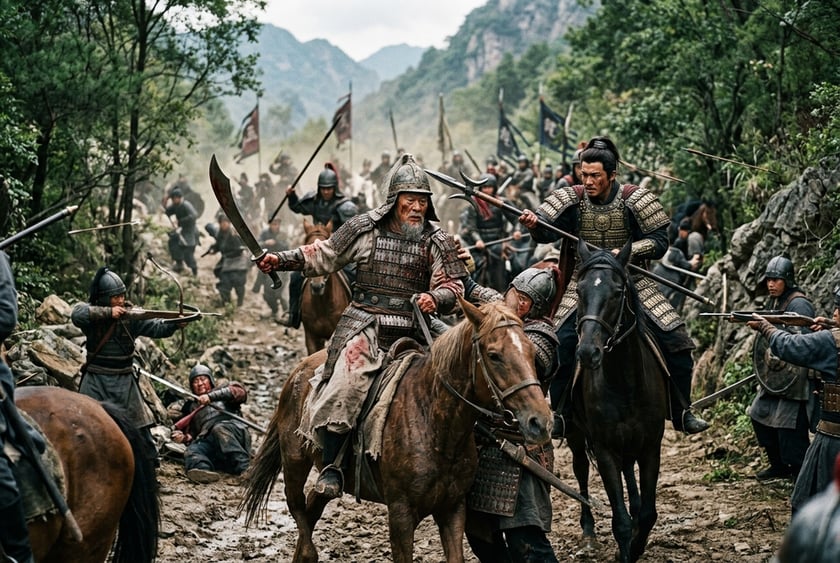
Several decisive moments shaped this campaign. First, the duel at Shenting: Sun Ce's personal combat with Taishi Ci impressed Taishi Ci with his martial courage, planting the seed for Taishi Ci's later submission. Second, the seizure of Qua: Zhou Yu led troops around to strike Liu Yao's rear and take Qua; just as Taishi Ci on the front lines was locked in close combat with Cheng Pu, he heard that "Zhou Yu had seized Qua and Chen Wu was entering the city to receive it," and Liu Yao's entire army lost heart and withdrew in disarray, whereupon Zhang Zhao immediately offered a plan for a night assault. Third, the feigned death at Moling: after Sun Ce was struck by a stray arrow, he ordered his army to spread the rumor that the commander-in-chief had died and to break camp and advance, luring the enemy out of the city — the most ingenious psychological warfare maneuver of the entire Jiangdong campaign. Fourth, the dispatch of Yan Yu: Sun Ce struck him down with a thrown sword in his command tent, declaring "what manner of rat dares compare himself to me?" and ordered the severed head sent into the city, forcing Yan Baihu to abandon the city and flee. Fifth, the approach to Huiji employed a mixed strategy of non-violent persuasion first and forcible assault if necessary; ultimately Wang Lang was driven to flee and Dong Xi came to present Yan Baihu's severed head, completing the pacification of the eastern Jiangdong front.
Results and Reverberations
The results of the campaign extended far beyond a mere change of rulers across six commanderies. First, Jiangdong for the first time possessed a genuinely unified political-military center; the local shi-clan families, treated with courtesy by Sun Ce, gradually joined the new regime, and many of Liu Yao's former troops were pardoned and absorbed. Second, Sun Ce's military prestige reached all the way to Xudou, forcing Cao Cao to submit a memorial to the court appointing him General Who Subdues Rebels and Marquis of Wu, and to pursue a marriage alliance — Cao Cao's remark that "the lion cub is not someone to contend with lightly" dates from this period, reflecting his sober assessment of Jiangdong's military might. Third, the 199 seizure of Lujiang and defeat of Liu Xun extended the Jiangdong sphere northward to the Hefei front, bringing it into direct territorial contact with Cao Cao's forces; this geopolitical configuration was the material starting point for every subsequent clash in the Sun–Cao relationship. Fourth, this sustained campaign forged a high-caliber military-political team — Cheng Pu, Huang Gai, Han Dang, Taishi Ci, Zhang Zhao, Zhang Hong, Zhou Yu — who became the core staff for Chibi, Hefei, and decades of Eastern Wu's subsequent wars.
Counterfactual Analysis
Suppose Sun Ce had been defeated by Taishi Ci in the Shenting duel, or had failed to pull off the feigned-death stratagem at Moling — a failure at any single critical juncture could have mired the Jiangdong campaign in stalemate and given Liu Yao, Yan Baihu, and Wang Lang time to mount a coordinated counterattack. Alternatively, suppose Yuan Shu had seen through Sun Ce's "borrow troops to establish independence" plan and cut off his supply lines or seized his family members after the campaign began — Sun Ce's southern march would then have been impossible to sustain. And suppose Cao Cao had marched south into Jiangdong before 200, using Liu Yao's remnants and Yan Baihu's survivors to mount an internal-external pincer — Sun Ce might have been annihilated while still in the process of unification. None of these scenarios came to pass, because Sun Ce seized the strategic gap between Yuan Shu and Cao Cao, exploited the common weakness of Jiangdong's regional lords — strong enough to hold, too weak to expand — and leveraged the coordinated advantage of a tight-knit team. From a macro-historical perspective, Sun Ce's campaign to pacify Jiangdong was one of the cleanest and most efficiently executed conquests of the early San Guo era: four years, starting from three thousand troops, sweeping through six commanderies, and building a proto-state — that pace and quality of execution was almost without parallel in the chaos of the late Han, and it was precisely this that directly determined how the era would evolve from a "two-power struggle" into the final tripartite balance.