Background
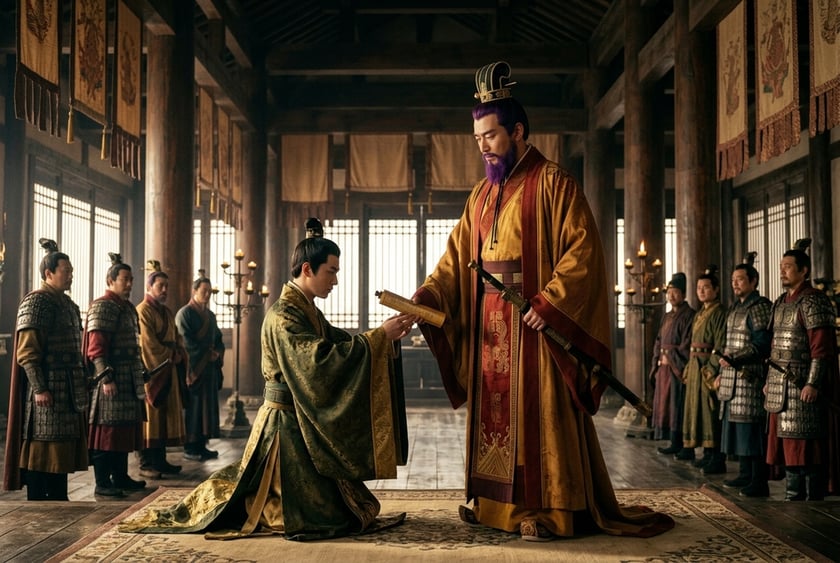
Looking back as a modern political historian at Wuchang in 229, Sun Quan's choice to designate Sun Deng as Crown Prince in the same year he proclaimed himself emperor was not merely an expression of paternal feeling — it was an institutional declaration to build legitimacy for the new dynasty. Under the old Eastern Han order, imperial relatives, eunuchs, and local magnates had been entangled in overlapping conflicts; Sun Quan's proclamation as emperor meant he had to shape a new central dynasty atop the soil of Jiangdong, which was sustained by its local great clans. Establishing a crown prince was the most critical step in this process: it told the realm that the Sunwu regime would not repeat the old cycle of "a young ruler and power slipping to another surname," and handed the Jiangdong great clans a promissory note about the future distribution of power.
Key Figures
Sun Deng was Sun Quan's eldest son, known for his benevolent and generous character — historical sources record him as "respectful toward the shi class and loving toward the people." The "Four Friends of the Crown Prince" gathered around him — Zhuge Ke, Zhang Xiu, Gu Tan, and Chen Biao — were precisely the sons of the four major ministers Zhuge Jin, Zhang Zhao, Gu Yong, and Chen Wu. This arrangement was no coincidence: Sun Quan hoped that by having the crown prince grow up alongside the sons of the great clan families, he would forge in advance the core team at the center of the court's future. Zhuge Ke was sharp and multi-talented, Zhang Xiu steady and careful, Gu Tan gifted in composition and rhetoric, Chen Biao versed in military law — a youthful team combining strategic acumen, administrative, and military experience. Sun Quan himself resided primarily in Jianye, while Sun Deng held his station mainly in Wuchang, both sharing the monitoring duties of the realm and avoiding the suspicion that might arise from father and son sharing the same capital.
Core Issues
The designation of Sun Deng as crown prince had to address three long-term issues. The first was the balance of power between local Jiangdong families and northern-immigrant officials; the selection of the Four Friends of the Crown Prince clearly favored the great Jiangdong clans and the descendants of meritorious officials. The second was the center's control over regional military commands: Sun Deng's station at Wuchang gave the central Yangtze military-political zone an imperial proxy. The third was the stability of the succession order: Sun Quan hoped that the unambiguous ranking of "firstborn legitimate son" would prevent princes from fighting one another. Yet the success of the first two points planted the hazard for the third — a crown prince deeply shaped by the participation of the Jiangdong gentry would inevitably make second and third princes, whose maternal lineages were of less prominence, feel excluded; the political divide of the Ergongzhizheng was already taking shape while Sun Deng still lived.
Political Consequences
Sun Deng's early death in 241 was Eastern Wu's most grievous single loss. The vacancy in the succession immediately triggered violent conflict between the crown-prince faction and the Lu Wang faction: Sun He was designated and then deposed, Sun Ba put to death, and senior ministers including Zhu Ju and Lu Xun were demoted or died of grief and frustration. In the end Sun Quan designated the young Sun Liang and entrusted the administration to Zhuge Ke — who was precisely one of the Four Friends of the Crown Prince from the Sun Deng era, but without Sun Deng as a center of gravity he rapidly consolidated personal power, drawing a coup by Sun Jun and launching the chain reaction of successive dominant-minister replacements that afflicted Eastern Wu. Traced along this line, the success and the failure of the Sun Deng crown-prince designation were in substance what determined Eastern Wu's political trajectory over its final thirty years.
Counterfactual Analysis
Had Sun Deng been able to live past forty and achieve a smooth succession, Eastern Wu could very plausibly have taken a path utterly different from what history records: an adult emperor deeply trusted by the Jiangdong great clans who was also familiar with the military situation at Wuchang would have been capable of suppressing royal clan members and powerful ministers alike, avoiding the coups of the Sun Lin and Sun Jun type, and providing stable political backing for the strategic deployments of the Lu Kang generation of commanders. The window for the Simashi to sweep south and destroy Wu might thereby have been compressed, and the rhythms of attack and defense along the Xiangyang defense line would have played out differently. Looked at more broadly, the Sun Deng crown-prince designation was the most deeply considered, longest-range political design of Sun Quan's lifetime — yet it was undone by the unpredictability of life and death, falling short at the very last step. This episode reminds us that even the most meticulous institutional design needs a successor who will still be alive on the day of its execution; otherwise it is merely a promise that was never honored.