Background
After Sun Quan proclaimed himself emperor in 229, Eastern Wu's diplomatic strategy entered a phase of "casting broadly for northern allies." Zhuge Liang's repeated campaigns on the western front had never managed to dislodge Caowei from the Longxi region, and Sun Quan likewise recognized that repeated assaults in the Hefei direction could never break through the depth of the Huainan defenses. Liaodong represented Caowei's single largest uncontrollable variable in the northeast — the Gongsun clan had held Liaodong in hereditary succession for three generations since Gongsun Du, nominally submitting to Wei while in practice operating as a semi-independent power, in constant friction with Wei. In 232, after his conflicts with Caowei intensified, Gongsun Yuan proactively dispatched envoys south to pledge loyalty to Sun Quan. From Sun Quan's perspective, this looked like a strategic opportunity to move a heavy load with little force: if Eastern Wu could forge a maritime alliance with Liaodong, Caowei would be forced to divide its troops simultaneously across three directions — the northeast, the southwest, and Huainan — and the San Guo balance of power might be broken.
Key Figures
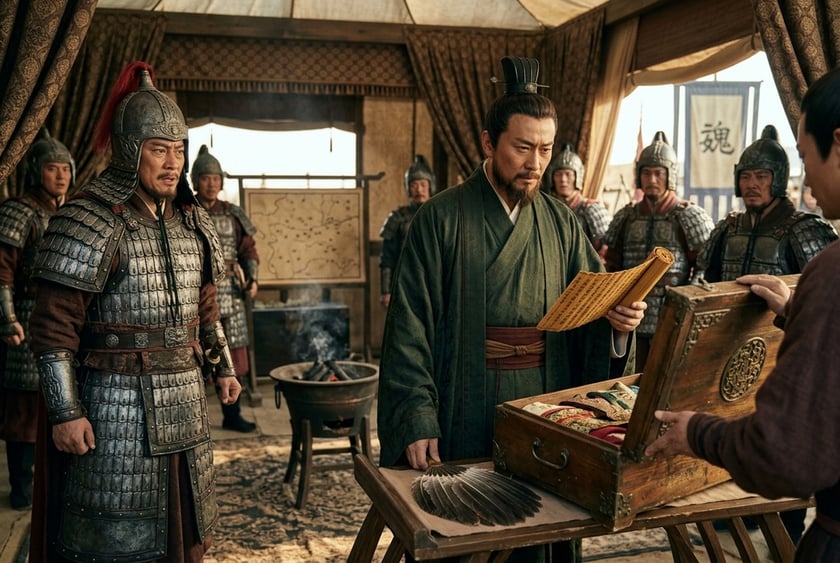
Sun Quan had already been emperor for five years and held himself in very high regard; he greeted Gongsun Yuan's diplomatic overture with almost no wariness. Gongsun Yuan, however, proved a far more complicated adversary than Sun Quan expected. He needed Eastern Wu's title to strengthen his bargaining position with Caowei; he had no genuine intention of submitting to Jiangdong, and even less desire to enter a formal alliance with Jiangdong while Caowei's cavalry could sweep in unchecked. Zhang Zhao embodied the highest political judgment of the Eastern Wu veteran ministers, and he immediately identified Gongsun Yuan's inconstancy and untrustworthiness, urging Sun Quan in the strongest terms not to dispatch a large ceremonial delegation. But Sun Quan, at this point, had let the strategic opportunity go to his head; he was willing to openly quarrel with Zhang Zhao over it. Zhang Mi and Xu Yan, serving as Grand Chamberlain and Commander of the Palace Guards respectively, were central government officials of Eastern Wu. Their mission was simultaneously a political assignment and a matter of national prestige, which is why Sun Quan assigned them an enormous delegation of more than ten thousand men and lavished them with gold and precious curiosities — which only made the haul all the more tempting when Gongsun Yuan decided to turn on them.
Core Issues
This diplomatic disaster turns on three core issues. The first is "long-distance alliance-building under information asymmetry." Liaodong and Jiangdong were separated by nearly two thousand sea miles; Wu had no way to verify Gongsun Yuan's true intentions in real time and no ability to mount any rescue if the delegation ran into trouble. The second is "the backfire of projecting wealth." Sun Quan equipped the delegation with gold and treasures specifically to win Gongsun Yuan over, but the larger the prize, the greater Gongsun Yuan's incentive to turn against them — Sun Quan had, in effect, handed the bait directly onto the hook. The third is "the sovereign's pride overriding institutional judgment." Zhang Zhao's warning carried institutional weight — the collective wisdom of the Eastern Wu veterans ought to have served as a genuine check on the sovereign's decisions — but Sun Quan chose to use his personal authority to suppress that check. This reflects the dangerous drift toward autocracy that began after he proclaimed himself emperor and would later reach its apex in the Ergongzhizheng succession crisis.
Political Consequences
The most immediate consequence was that Zhang Mi and Xu Yan were beheaded, their heads sent to Luoyang as tribute, and Gongsun Yuan received a noble title from Wei — the full diplomatic investment of Eastern Wu evaporated entirely. Sun Quan, humiliated and furious, briefly contemplated raising the full strength of the realm to cross the sea and attack Liaodong, only to be talked down by his ministers. Zhang Zhao, his prophecy vindicated, refused to attend court; Sun Quan visited him multiple times and even set fire outside his gate to force him out, and it was ultimately Zhang Zhao who relented and returned to the court — an episode that left a permanent scar on their relationship. At the diplomatic level, Eastern Wu thereafter abandoned any further attempts to build strategic alliances with border powers in Caowei's rear, and foreign policy reverted to the conservative line of "maintaining the Wu-Shu alliance on the western front while continuing to harass the Huainan region." As for Gongsun Yuan, he was suppressed by Sima Yi's army in 238 and Liaodong was absorbed into Wei, making Sun Quan's imagined "northeast-southeast two-front encirclement of Wei" permanently impossible.
Counterfactual Analysis
Had Sun Quan heeded Zhang Zhao's counsel and sent only a small probe mission to Liaodong without carrying enormous quantities of valuables, the cost-benefit calculation for Gongsun Yuan's betrayal would have been far less favorable, and at minimum the catastrophe of over ten thousand delegation members being seized and killed would not have occurred. Even if Gongsun Yuan had ultimately aligned with Caowei, Jiangdong would not have sacrificed so many central officials and strategic resources. Conversely, had Gongsun Yuan genuinely been able to reach a substantive long-term alliance with Sun Quan against Caowei, then when Sima Yi moved to suppress Liaodong in 238, an Eastern Wu naval force could have struck Caowei's flank from the Qingzhou-Xuzhou direction, potentially preventing the Sima clan from achieving a swift decisive victory in the northeast, and significantly delaying the San Guo order. But the probability of that "if" was always vanishingly small — the triple barrier of geographic isolation, information lag, and the difficulty of maritime logistics made any stable long-range Wu-Liao alliance functionally impossible. The greatest lesson of this Enfeoffment of the King of Yan affair is not that Sun Quan was deceived, but that he allowed the will of one man to override institutional judgment — and that same pattern is the root of Eastern Wu's later political collapse.