Background
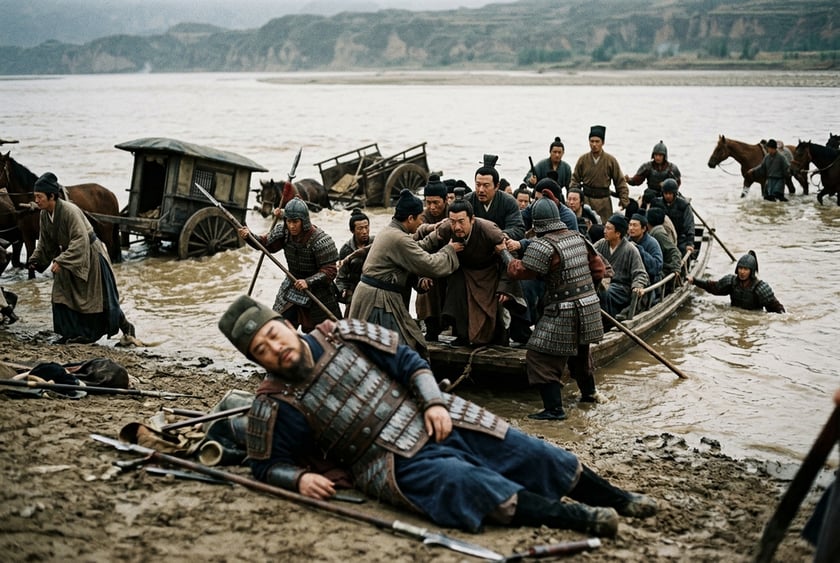
The Imperial Seal was the supreme political symbol of the Qin and Han dynasties, and from the Western Han onward the principle that "whoever holds the seal holds legitimacy" had become near-universal consensus. In the dying years of the Eastern Han, Dong Zhuo deposed the Young Emperor, enthroned Emperor Xian, torched Luoyang, and carried the Son of Heaven westward in captivity — in this chain of upheavals the seal slipped out of the court's direct control. When the Guandong coalition entered Luoyang the palace precincts had already fallen; bodies of palace attendants and scattered relics lay everywhere. Sun Jian, as one of the first lords to enter Luoyang, was therefore in the best position to encounter the dispersed imperial treasures. This episode occurs at the very earliest stage of the San Guo story and marks the pivotal turn in Sun Jian's personal political career from "general" to "independent lord."
Principal Figures
Sun Jian's core identity at this moment was "General Who Crushes Bandits, Grand Administrator of Changsha" — nominally still a guest-general under Yuan Shu. He and veteran subordinates such as Cheng Pu, Huang Gai, and Han Dang formed an extremely tight inner circle; if the acquisition of the seal was real, knowledge of it could only have remained within that small ring. Yuan Shao was the coalition's supreme commander and by coalition rules should have received the seal for safekeeping on behalf of the court. Yuan Shu was Sun Jian's direct superior; once the Imperial Seal surfaced he would inevitably demand possession. These two external pressures were the direct reason Sun Jian chose to conceal the seal. Yuan Shu's later proclamation of himself as emperor — entangled with rumors about the seal's authenticity — perfectly confirms the political seed planted in this episode.
Core Issue
The central theme of this episode is "the privatization of a political symbol." In the Chupíng years, when the imperial order had not yet fully collapsed, secretly retaining the Imperial Seal was both a high-risk act and a potentially high-reward wager. Sun Jian's choice — conceal it, return to the south, and wait for the right moment — is a textbook transitional-lord strategy: he did not immediately proclaim himself emperor (which would have brought the entire coalition down on him), but he also did not voluntarily surrender the seal (which would have instantly forfeited his greatest bargaining chip). This posture of "holding it without using it" allowed Sun Jian to begin his gradual transition from Yuan Shu's subordinate general to an "independent military-political entity." At a higher level of analysis, this episode is also a case study in the political philosophy of "how symbols convert into power in an age of disorder": the seal itself cannot move troops, but its possessor can reshape allies' and adversaries' expectations about his future intentions — and thereby reshape actual political structures.
Outcomes and Ripple Effects
The seal-acquisition event directly caused a serious fracture of trust between Sun Jian and Yuan Shao — in the novel Yuan Shao immediately ordered Liu Biao to intercept Sun Jian's homeward route, providing the proximate cause for Sunjianfaliubiao. Looking further ahead, the Imperial Seal changed hands several times after Sun Jian's death and ultimately fell to Yuan Shu, directly spurring Yuanshuchengdi in Huainan. In other words, this single seal lever-pried two events that transformed the late-Han landscape — "the independence of Jiangdong" and "Yuan Shu's imperial proclamation" — making Sun Jian's acquisition of the seal the original trigger of that entire political ripple effect. In the cultural memory of San Guo, this episode also established the narrative foundation that "the Sun clan of Jiangdong carried an inherent bloodline of legitimacy" — supplying a tacit legal basis for Sun Ce's and Sun Quan's eventual founding of Wu.
Counterfactual Analysis
Suppose Sun Jian had immediately presented the seal to the coalition commander or offered it to the Son of Heaven. He might have earned short-term political prestige ("a general of loyalty and righteousness") and Yuan Shao's goodwill, but the Jiangdong group's path to independence would necessarily have slowed: without the seal as a negotiating chip, Sun Jian would very likely have remained firmly bound to Yuan Shu's service, and when Yuan Shu's imperial gambit collapsed Sun Jian's forces would have been dragged into that political catastrophe as well. Conversely, had Sun Jian chosen to openly declare in the ruins of Luoyang that he "held the seal" and present himself as "the mandated vassal of the Han house," the entire coalition would have viewed this as political usurpation and an allied punitive campaign against him would have been virtually certain. In other words, "concealing it and secretly carrying it back to Jiangdong" was virtually the only available choice that could both preserve his life and accumulate future momentum. This episode teaches us: in an age of disorder, the true power of a political symbol lies not in displaying it but in hiding it — a seal locked away moves the course of an era more effectively than a seal worn around one's neck.