Background
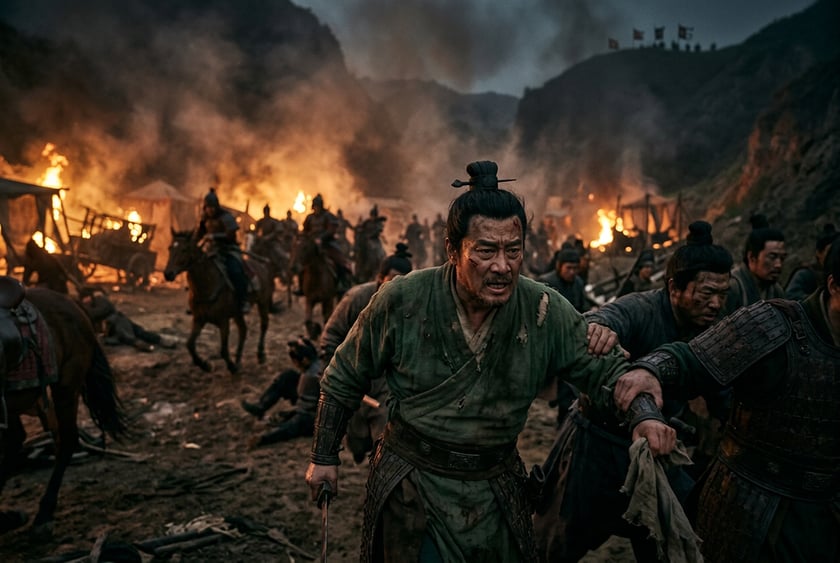
The designation of Sun He as Crown Prince was Sunwu's first and only attempt to "rebuild legitimacy through the succession." Sun Quan's eldest son Sun Deng died in the fourth year of Chiwu, leaving the position of Crown Prince vacant; Sun Quan's second son Sun Lv had died even earlier, forcing the line of succession to move further down. The Crown Prince designation was issued in the first month of the fifth year of Chiwu, accompanied by a general amnesty and the renaming of Hexing County to Jiaxing — this ceremonial package shows that Sun Quan regarded it as the political milestone of "the foundation of the state now established," hoping thereby to resolve the anxiety that senior officials such as Zhuge Jin, Lu Xun, and Bu Zhi felt about the succession question. At the geographic and institutional level, a new round of bureaucratic assignments in the Jianye court, the configuration of the Crown Prince's tutoring staff, and the promotion of the Pan consort clan all followed in train after this designation.
Key Figures
Sun He was nineteen at the time; according to his biography in San Guozhi, from an early age he "was loved and cherished because his mother Wang Furen was favoured," and as a boy had been instructed in literature by Zhongshu Ling Han Ze — he was the most systematically educated of all Sun Quan's sons. After his designation as Crown Prince, Han Ze was appointed Grand Tutor and Xue Zong Junior Tutor, with Cai Ying, Zhang Chun, Feng Bu, and Yan Wei all "attending him at leisure as companions" — this configuration follows the standard Han-Wei model of "training the heir with eminent Confucians," with the aim of cultivating a successor distinguished by both learning and virtue. Sun Quan himself plays a dual role in this episode: both the final authority over institutional arrangements and the source of parental affection — his way of loving Sun He was to construct around him a complete training apparatus of "reading, scholarship, and governance." Zhang Chun, from the Zhang family by birth, had from youth cultivated strict personal conduct, was broad in learning and brilliant in talent, and was exemplary in demeanour and bearing; as Fuyi Duwei he attended the Eastern Palace in close capacity, representing the stable expectation of "sons of great families entering the Crown Prince's service."
Core Issues
The core issue of Sun He's designation as Crown Prince was not "who should be Crown Prince" but "how to secure the Crown Prince's position." At the moment of designation, Sun Quan deliberately delayed the formal installation of an empress and the enfeoffment of the four princes, declining memorials requesting these actions on the grounds that "the realm is not yet settled and the people are weary and taxed" — this restraint was intended to reduce the room for consort clans and imperial relatives to interfere with the succession. Yet in that same eighth month he enfeoffed Sun Ba as Prince of Lu with "treatment no different from the Crown Prince Sun He," instantly placing the two princes on de facto equal institutional footing — this was Sun Quan's single greatest political blunder in his later years, and the structural root cause of the later Ergongzhizheng. The episode is composed of two contradictory signals: on one side "establishing the foundation of the state," on the other "blurring the distinction between the primary and subsidiary heir" — both issuing from the same emperor's hand.
Political Consequences
In the short term, Sun He's position as Crown Prince received broad acceptance from the fifth through seventh years of Chiwu, the division of official responsibilities was orderly, and the scholarly elite placed great hopes in this bookish prince; during the Zhuge Yi feigned-surrender episode he repeatedly remonstrated with Sun Quan, urging him to "exercise caution for a complete victory", showing sound political judgment. In the medium term, however, the title of Prince of Lu and the equal treatment granted to Sun Ba led a portion of officials to shift their investment toward the Sun Ba pathway, and the "Nanlu Party Strife" was from this point underway; later the Grand Princess Sun Luban, nursing a long-standing grudge over the death of Wang Furen, repeatedly slandered Sun He, accelerating the erosion of his position as heir. In the long term, Sun He was ultimately deposed in the thirteenth year of Chiwu, Sun Liang was installed in his place, and subsequently during Sun Jun's era Sun He was sent into exile and ordered to take his own life — Sunwu's succession crisis stretched over more than a decade, and the root of it all can be traced back to the internal contradictions within the supporting policies of this designation.
Counterfactual Analysis
Had Sun Quan immediately after designating Sun He made clear that "the Prince of Lu's ritual rank is below the Crown Prince's," and blocked Grand Princess Sun Luban and other consort-clan figures from intervening in the succession debate, Sun He's power base had every possibility of consolidating over ten years; the scholar-official faction that supported Sun He — Lu Xun, Zhuge Ke, Han Ze, Xue Zong, Shi Ji, and others — could, in principle, have borne the responsibility of building the second-generation political structure of the empire. Conversely, had Sun Quan made an explicit public statement about the succession order immediately after Sun Deng's death (for example, openly declaring "only the Crown Prince may deliberate on matters of succession"), then Sun He's picture of anxiously remonstrating with Sun Quan during the Zhuge Yi feigned-surrender episode might not have been read as a political performance but rather as a sign of a maturing heir. In short, the true tragedy of this episode lay not in the designation itself — but in the separate edict issued in the same year that elevated Sun Ba to equal status. A succession design that could have made a smooth transition, upended by a single counter-decision in the same year: this is the deepest political irony of Sun Quan's later years.