Background
The Yellow Turban remnants in the Qingzhou–Xuzhou region retained a considerable capacity for armed activity even after they had scattered across the Central Plains following the collapse of the Han dynasty. Kong Rong governed Beihai as a celebrated man of letters; his strengths lay in literature rather than military affairs, and his governing style — emphasizing the appeasement of scholar-gentry and the promotion of ritual culture — left him without a reliable counterforce when faced with a genuine military threat. Around the second year of Xingping (195), the Yellow Turban chieftain Guan Hai led a force of several tens of thousands in laying siege to the county town of Douchang, where Kong Rong was holding out. With weak defenses inside the city and both food and relief cut off, Kong Rong sent a plea for help to Liu Bei, the Chancellor of Pingyuan, a man he had never met. The critical problem then became: who could actually get the message out?
Course of Events
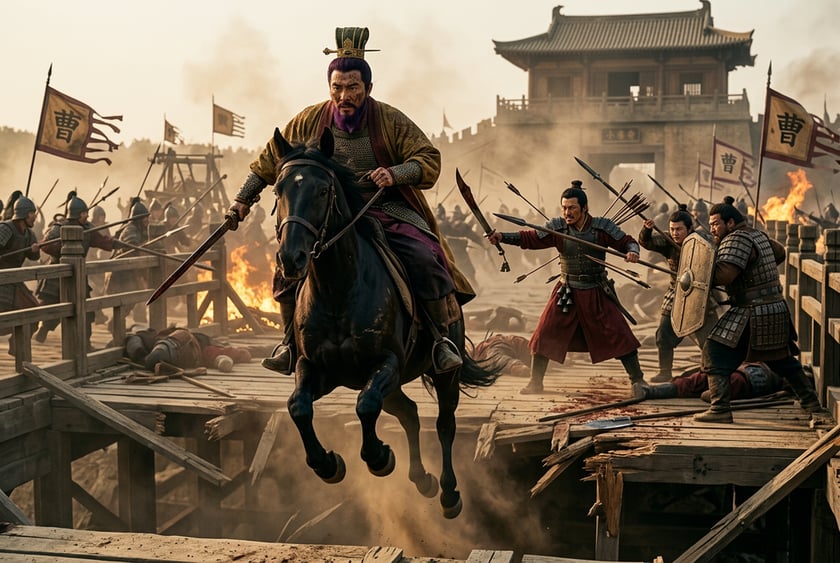
Taishi Ci was a native of Huanxian in Donglai. Having fled to Liaodong to avoid trouble with his home commandery's offices, he had only recently returned to Beihai to visit his mother. Kong Rong had long looked after Taishi Cimu's wellbeing, and she, grateful for the favor, sent her son to repay the debt on her behalf; Taishi Ci therefore entered Douchang alone to present himself to Kong Rong and volunteered to carry the message through the siege lines. The method of his breakout is worth examining: Taishi Ci did not charge recklessly. For several days running he rode out of the city with his bow and arrows and practiced archery at a target range outside the walls, causing the besieging troops to gradually regard it as a routine drill. Then on the appointed day he suddenly spurred his horse toward the siege cordon at full speed with bow drawn; the enemy had no time to loose an arrow before he was already through. This is a textbook example of using "psychological expectation" as a tactical instrument. After breaking through, he galloped to Pingyuan and secured an audience with Liu Bei.
Outcome
Liu Bei was serving at the time as Chancellor of Pingyuan and had no personal connection with Kong Rong, yet he was deeply moved by Taishi Ci's motive for seeking aid — acting on behalf of his mother to repay a debt of gratitude. Liu Bei responded, "Does Kong Beihai know that Liu Bei exists in this world?" and immediately dispatched three thousand picked troops to accompany Taishi Ci in the relief mission. Upon the arrival of the relief force, the Huangjinjun scattered at the sight of it, and the siege of Douchang was lifted. From a military standpoint, this operation resolved an entire siege through a single breakout, a single plea for aid, and a single relief column — a classic case of "substituting morale and righteousness for direct engagement." From a political standpoint, it was the first occasion on which Liu Bei, acting as an independent warlord, intervened in the affairs of the Central Plains scholar-gentry circle, establishing his early reputation for placing honor above self-interest.
Significance
The long-term consequences of this affair ran in two directions. First, for Liu Bei: it added to his account the political asset of "distinguished men of letters willing to seek connections with him on their own initiative" — Kong Rong's reputation and Taishi Ci's initiative in making the journey brought Liu Bei from the category of local military strongman into the company of "men whom the scholar-gentry regarded as worthy of trust." Second, for Taishi Ci: this event was an important step in his personal trajectory. The reputation he built through this episode enabled him to become a subordinate of Liu Yao, Governor of Yangzhou, and subsequently to be valued by Sun Ce and surrender to him — which is to say, it was precisely the prior story of "acting with filial loyalty, breaking through the siege, and saving Kong Rong" that allowed Taishi Ci's eventual joining of the Jiang Dong regime to be received as "gaining a man of heroic stature" rather than "taking in a surrendered officer." Viewed from a wider perspective, this small-scale relief operation was a hidden thread connecting the Central Plains scholar-gentry world with the later forces of Jiang Dong and Jingzhou.
No citations relevant to this event are available; the analysis draws on San Guozhi, the biography of Taishi Ci, and the biography of Kong Rong, as general background, which is why no [c:N] markers appear in the body.