Background
Song Jian was a man from Baohan in Longxi commandery of Liangzhou at the end of the Eastern Han; exploiting the collapse of central authority, he seized territory and declared himself ruler, styling himself "King Who Pacifies the Han at the River's Head," setting up offices modeled on the Han court and governing the Heishou region for more than thirty years. "Heishou" — the Upper Yellow River area near present-day Linxia in Gansu — lies west of the Longshan mountains at the edge of the Qinghai-Tibet plateau, a topographically enclosed region inhabited by a mixed population of Qiang and Di peoples, and one of the fringes most difficult for a Central Plains dynasty to truly control. From the mid-Eastern Han onward this area had been repeatedly convulsed by Qiang uprisings, and by the end of the Han it had nearly completely detached from central authority. After Cao Cao broke Ma Chao at the south of the Wei River in the sixteenth year of Jian'an (211) and subsequently subdued Han Sui, resolving the main theater in Liangzhou, what remained before him was precisely this kind of long-entrenched local regime represented by Song Jian.
Course of Events
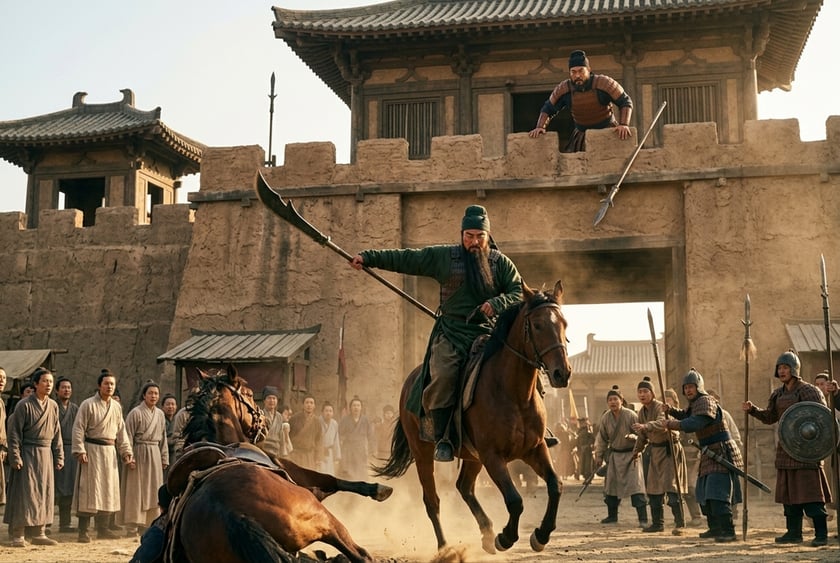
In the nineteenth year of Jian'an (214), Cao Cao ordered Xiahou Yuan to lead forces westward from Xingguo. Xiahou Yuan was already renowned for his "tiger's stride through the Guanzhong passes" — his speed of march was exceptional. He bypassed Qiang and Di strongholds and drove straight to the walls of Baohan. Song Jian held the city in defense, but lacked mobile field forces and had no external aid coming. Zhang He simultaneously dispatched troops to clear Qiang and Di settlements along the Hekuan area, severing supplies from outside the walls. After a siege lasting more than a month, Baohan was stormed, Song Jian and the officials he had installed in his usurped court were all executed, and the city was reportedly razed.
Outcome
As a military operation this campaign was not large in scale, but its political significance was considerable. First, it formally ended the regional separatism in the Heishou area that had persisted for more than thirty years, bringing Liangzhou's administration back under Caowei's direct control. Second, it sent a clear signal to the Qiang and Di peoples of the Hexi and Huangzhong regions — the Central Plains power was no longer content to merely subdue the Han ethnic warlords of the western borderlands, but was beginning to intervene in the deeper tribal zones. Third, it freed up Xiahou Yuan's strategic mobility, allowing him to turn his attention the following year to becoming involved in Hanzhong and facing Liu Bei's main forces directly. Cao Cao's year-end order "to have the various generals collectively superintend all forces in Guanzhong" is also closely related to this.
Impact
Viewed on a longer time scale, Xiahou Yuan's campaign against Baohan was the final piece in Cao Cao's western-front integration. Once this campaign was complete, Caowei gained a complete depth on the western front — Hanzhong as the forward position, Guanzhong as the base, and Liangzhou together with its Heishou extension as the strategic rear. After Xiahou Yuan was killed at Dingjunshan in the Battle of Hanzhong (217–219), Caowei lost Hanzhong, but held Liangzhou throughout — a fact directly connected to the prior razing of Baohan and absorption of Heishou. Put another way, the suppression of Song Jian was unobtrusive, yet it kept Caowei's "Liangzhou line" of the Wei-Shu border stable throughout the entire early period of San Guo confrontation, and exerted a structural influence on Shuhan's choice of northern campaign routes (out through Longyou rather than through Guanzhong).
No citation text is linked to this event; the analysis draws on the Wudi Ji and the biography of Xiahou Yuan in the San Guozhi, as well as general geographical background knowledge of Liangzhou, and accordingly no [c:N] markers appear in the main text.