Background
The real fruits of the Battle of Chibi were the formation of a Sun-Liu encirclement of Cao Cao's Jiangling garrison along the Jiangling–Gong'an–Xiakou line. Yet the alliance carried two embedded contradictions from the very start: first, ownership of Jingzhou's Nanjun was unresolved; second, the strategic direction of "the next step" was unclear. Lu Su, from the moment of the alliance's formation, advocated jointly resisting Cao Cao together with Liu Bei; Zhou Yu, by contrast, persistently regarded Liu Bei as "a man endowed with the resources of an overlord" who had to be suppressed before he could be used. In the spring of the fifteenth year of Jian'an, Cao Cao had not yet stabilized Guanzhong, and Sunwu had only just finished absorbing Nanjun — this was precisely the time window in which Zhou Yu judged "taking the Ba-Shu west" was feasible.
Key Figures
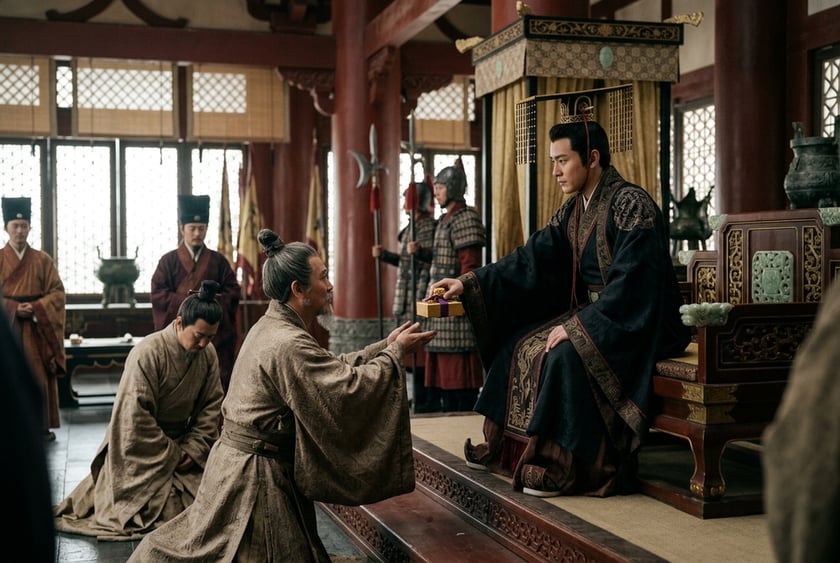
At this point Zhou Yu was the supreme military decision-maker of Sunwu, holding the rank of assistant general and serving concurrently as governor of Nanjun; Jiangling was in his hands, and he controlled the upstream navigation corridor of the Yangtze. His proposal therefore had the realistic conditions to move directly from conception to execution. Sun Quan occupied the role of "lord and decision-making hub," and had to choose between Zhou Yu's binary argument and Lu Su's pro-Liu line. Liu Bei at this time was encamped at Gong'an, nominally holding Nanjun "on loan from Sun Quan," but in practice waiting to see which direction Jiangdong's strategy would clarify. Add in Liu Zhang of Yizhou, Zhang Lu of Hanzhong, and Ma Chao in the Guanzhong west — four variables simultaneously in play — and the entire western front resembled a pot of water boiling from all sides at once.
Central Issue
Zhou Yu's plan can be broken into four steps: first, advance west up the Yangtze and take Ba-Shu (taking Jiangzhou first, then pushing toward Chengdu); second, use Shu territory as a base to absorb Hanzhong and press Guanzhong; third, forge an alliance with Ma Chao of the western borderlands to create a two-front encirclement of Cao Cao; fourth, withdraw troops to Xiangyang for a decisive battle with the Central Plains. The advantage of this plan lay in sidestepping the deadlock of the Jingzhou contest — once Jiangdong held Ba-Shu, Jingzhou would become a secondary interest for Jiangdong and could be shared with Liu Bei. The disadvantage was equally clear: it required Sunwu to mount a distant expedition along the supply-difficult upper Yangtze, while placing Liu Bei in a "bypassed" position — Liu Bei's reaction would be utterly unpredictable.
Political Consequences
Zhou Yu set out from Jiangling, fell gravely ill en route to Baqiu, and died there, cutting the entire plan short. Sun Quan turned instead to adopting Lu Su's counter-proposal of "lending Nanjun to Liu Bei" — in essence, given the impossibility of taking Ba-Shu by force, trading Jingzhou for Liu Bei's bearing of the anti-Cao pressure on the western front. Thereafter Yizhou was taken by Liu Bei, Hanzhong was taken by Liu Bei, and Sunwu was instead forced to contest Jingzhou with Liu Bei along the Yangtze — every development ran precisely opposite to the assumptions built into Zhou Yu's original plan. From an institutional standpoint, this reversal of direction also shifted Sunwu's military-political axis from "dominated by front-line veteran generals" to "dominated by central deliberating counselors," and the succession of Lu Su — Lv Meng — Lu Xun took shape from this moment.
Counterfactual
Suppose Zhou Yu had not died and carried out the plan to enter Shu: Sunwu would very likely have clashed with Liu Zhang in the sixteenth or seventeenth year of Jian'an. Given the logistical capacity Zhou Yu had built up at Jiangling, combined with generals familiar with Shu's terrain such as Gan Ning, Wu forces could at minimum have seized Jiangzhou and the Kuimen gorge; but whether they could have pacified Chengdu at a stroke and quickly absorbed Hanzhong would have depended on events in Guanzhong — if Ma Chao's uprising against Cao Cao had occurred earlier than it did in actual history, Cao Cao would have been unable to look south, and Sunwu might for the first time have achieved a genuine "bisection of the realm." But if the timing ran a year late, Liu Bei would already have entered Shu, and Sunwu's westward advance would no longer be "against Liu Zhang" but "against Liu Bei," which would have fractured the Sun-Liu alliance one or two decades ahead of schedule. Zhou Yu's death was less a personal death from illness than a systemic "branching point" in the entire San Guo configuration.