Strategic Background
After Guandu, Yuan Shao died of illness and Hebei fractured into the rival camps of Yuan Tan and Yuan Shang. Cao Cao adopted the strategy of "watching developments and defeating them in sequence": first tolerating the fratricidal war between Yuan Tan and Yuan Shang, and only sending troops north when Yuan Tan, having been defeated, sought submission. In the first month of the ninth year of Jian'an, Cao Cao "crossed the river, diverted the Qi River into the Bai Canal to open the grain supply route," deploying the logistical infrastructure of the Hebei campaign ahead of the army itself. This "first build the road, then deploy the troops" style of engineering forethought was a distinctive feature of Cao Cao's military style setting him apart from other late-Han warlords. Yecheng — Yuan Shao's painstakingly developed Hebei political center, with abundant grain stocks, a concentrated gentry class, and complete defenses — was the critical node that had to be cracked.
Force Dispositions
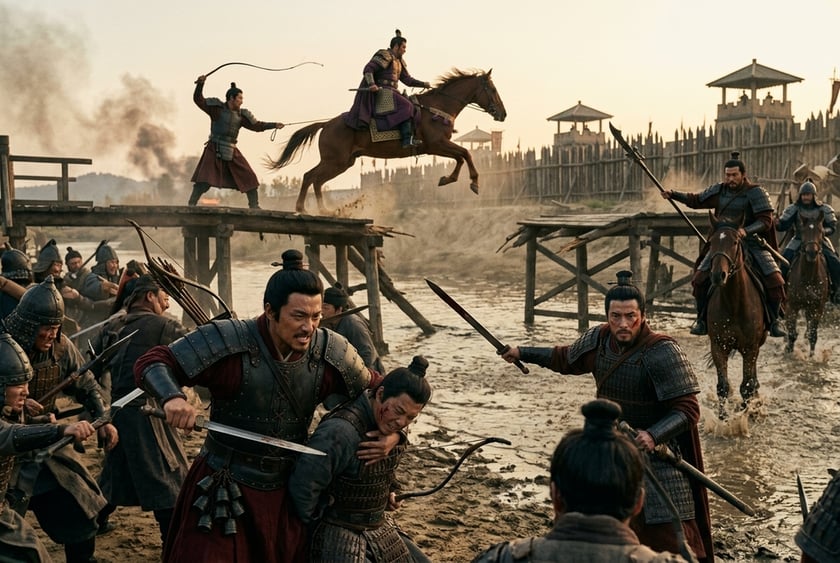
On Cao Cao's side, the supreme commander personally led the main force to besiege Yecheng, Cao Hong screened along the river to cut off Yuan Shang's relief force, while Zhang Liao and Xu Huang were held as a mobile reserve. Simultaneously, outlying Yuan strongholds were being cleared: Yin Kai was defeated at Maocheng to sever the upper Shangdang grain route, and Ju Gu was defeated at Handan to sweep the flanks. This deployment of "pruning the perimeter while besieging the center" was the mature template for siege warfare in ancient China. On Yuan Shang's side, his main force had originally been attacking his brother Yuan Tan in the Pingyuan direction; when news came of Yecheng being besieged he attempted to relieve it, but Cao Cao had anticipated this. Shen Pei was the animating spirit of the Yecheng garrison — once Yuan Shao's most relied-upon counselor, he now bore the role of the Yuan clan's "final dam," personally ascending the walls for inspection and working day and night without rest. The grain stocks within the city were ample, but even ample stores would eventually run out under prolonged siege.
Critical Decision Points
The first critical decision was Cao Cao's abandonment of the tunnel-warfare approach. Initially following the plan of Ma Yan and Feng Li, the tunneling attempt was countered by Shen Pei with stone-weighted sluice gates that collapsed the tunnels, and Cao Cao's forces lost three hundred stout soldiers in the underground passages. Cao Cao promptly abandoned tunneling and instead diverted the Zhang River to flood the city — the classic "using water in place of troops." The second critical decision was Shen Pei's choice of posture when the city's grain was finally exhausted. When Xin Pi shot into the city with arrows bearing "seals-and-ribbons letters of surrender" to attract defectors, Shen Pei's response was to execute more than eighty members of Xin Pi's family and hurl their bodies from the wall — he chose the path of "using terror to hold the garrison's will," but simultaneously sealed off all possibility of surrender to Cao Cao. The third critical decision was the inner intelligence provided by Shen Rong. As Shen Pei's nephew and a man with longstanding ties to Xin Pi, after witnessing the butchering of Xin Pi's eighty-plus family members at his uncle's own hand, Shen Rong decided to open the western gate and admit the Wei army. This juncture shows that under a prolonged siege, extreme measures by the defending side will inevitably tear apart the personal bonds within its own ranks.
Outcome and Aftermath
After the fall of Yecheng, Shen Pei was captured and refused to surrender, dying facing north at his execution; Yuan Shang fled to Zhongshan and was ultimately killed by Gongsun Kang; Chen Lin, Xin Pi, and large numbers of Hebei gentry transferred their allegiance to Cao Cao. The several far-reaching consequences of this battle: first, Cao Cao effectively completed the annexation of Hebei, and Yecheng became the actual political center of Caowei thereafter — years later, when Cao Cao was elevated to Duke of Wei and then King of Wei, Yecheng was his seat of government; this battle thus laid the capital-level political foundation for the founding of Caowei. Second, Cao Pi's marriage to Lady Zhen in Yecheng opened the complex literary and political entanglement between Cao Pi and Cao Zhi known as "the two Caos," ultimately influencing the succession structure of Caowei. Third, the episode of Xu You's insolent arrogance over his contributions — resulting in his killing by Xu Chu — also occurred shortly after the Yecheng campaign: this was an early preemptive settling of accounts by Cao Cao against "overbearing meritocrats," with lasting effects on the internal political atmosphere of Caowei.
Counterfactual Analysis
Had Shen Pei initially failed to use stone-weighted gates to destroy the tunnels, Cao Cao's forces would have broken into Yecheng through the tunnels within two months, but Cao Cao's actual control over Hebei would not have been as thorough as the five-month-long siege allowed through its comprehensive reshaping of personnel loyalties. Had the members of Xin Pi's family not been executed by Shen Pei, Shen Rong would have had no powerful motivation to open the gate from the inside — the very terror tactics Shen Pei employed to hold the city's defenses inadvertently caused his own destruction. Had Yuan Shang, instead of persisting in attacking Pingyuan, returned to relieve Yecheng in the early phase of the siege, Cao Cao would have faced the combined pressure of Yuan Shang's main force and Shen Pei's garrison, possibly extending the campaign by months or introducing more variables; yet the fraternal enmity between the Yuan brothers prevented cooperation, and Cao Cao reaped the dividend of their mutual hostility. The true historical significance of the Battle of Yecheng lies in this: it shows that what determines victory is not only the fortifications and the troop count, but also whether the defending side can hold together its internal human bonds throughout the long siege. A horror of eighty-plus family members opened a fortified city from the inside — the most tragically charged detail in all of medieval Chinese siege warfare.