Strategic Background
In the spring and early summer of the fifth year of Jian'an (200), the strategic contest between Yuan Shao and Cao Cao entered its formal phase. Yuan Shao held the four provinces of Ji, Qing, Bing, and You, with a decisive advantage in population, armor, advisers, and grain stocks; Cao Cao had just pacified Xuzhou, absorbed Lv Bu's former troops, and — having purged the anti-Cao forces inside Xudou following the Yidaizhao affair — was now facing a southward assault by an enemy several times his own size. Yuan Shao's strategic intent in this offensive was to achieve a quick victory by weight of numbers: sending Yan Liang's vanguard first to take Baima, and then Wen Chou to cross at Liyang and follow up, while Chunyu Qiong oversaw grain storage at Wuchao and the full army pressed toward Guandu. Baima (northeast of modern Huaxian, Henan) sat on a ford on the south bank of the Yellow River — the first indispensable node for Yuan Shao's army to cross south; whether a foothold could be secured there determined whether the Yuan army could advance methodically along the river or would be forced to seek another crossing point from the Liyang line. For Cao Cao, losing Baima meant the Guandu front line would have to face Yuan Shao's main force directly, compressing preparation time to less than a month; conversely, if he could delay the Yuan army at Baima and eliminate one of the enemy's leading commanders, he could use the moment to readjust the defensive depth at Guandu and buy more time for a sustained standoff. The chapter of the Romance covering this strategic node focuses sharply on three things: Yuan Shao's misuse of personnel, Cao Cao's recruitment of Guan Yu, and Guan Yu's killing of Yan Liang in battle [c:17399].
Deployments
On Yuan Shao's side, Yan Liang was sent as vanguard commanding "one hundred thousand elite troops" (an inflated Romance figure; the actual vanguard was probably several thousand crack cavalry plus a supporting force of some tens of thousands), advancing on Baima. Ju Shou had explicitly remonstrated that "Yan Liang's nature is too narrow; though he is fierce and valiant, he cannot be given sole command," and Yuan Shao dismissed this with "my finest generals are not for you to appraise" [c:17399]. This is a characteristic sample of Yuan Shao's camp's long-standing pattern of "ample talent, poor deployment": Yan Liang's martial prowess was exceptional, but he lacked the political and strategic experience for independent command; he should have been given a supervising officer or a deputy commander. Yuan Shao, acting from political considerations shaped by his consistent suppression of Ju Shou, instead sent Yan Liang out alone — setting a trap in the command structure before the battle even began. On Cao Cao's side, there was urgent deliberation on raising troops; Guan Yu, who was at this point provisionally lodged with Cao's camp, took the initiative to request a commission at the prime minister's office, and Cao Cao demurred — "I would not presume to trouble the general; I will summon you when the moment comes" [c:17399] — keeping Guan Yu's card for use at the critical moment. Cao Cao personally led "one hundred fifty thousand troops" (actually roughly twenty thousand deployable) advancing on three fronts, with five thousand first holding Baima by encamping at a hillside — the core purpose of this positioning was not to bring Yan Liang to a pitched battle but to use the high ground to shield against cavalry charges and gain time. Yuan Shao's army formed ranks across the open plain, their formation orderly but with no rapid means of destroying the hilltop position; the two sides thus entered an asymmetric standoff of "Yuan cavalry superiority vs. Cao advantageous terrain."
Critical Decision Points
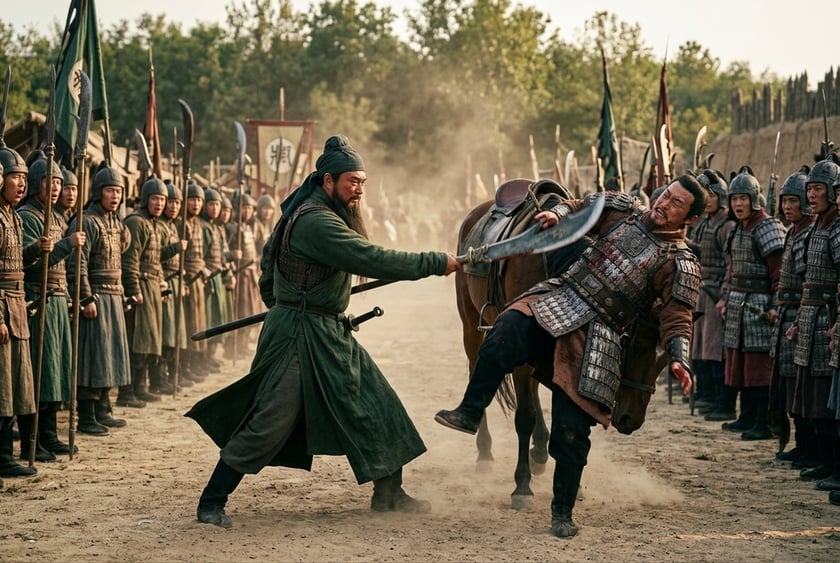
The decisive turning point of the battle was two consecutive decisions. The first was Cao Cao's psychological and personnel judgment after observing Yan Liang's fine troops from the high ground: he first tested Yan Liang by sending out Song Xian and Wei Xu — both were surrendered former Lv Bu officers; Cao Cao's purpose in doing this was on one hand to probe Yan Liang's true combat ceiling and on the other to run a "practical test" of these two surrendered officers, without genuinely expecting them to defeat Yan Liang. Both men were successively cut down, demonstrating that Yan Liang's martial limit was indeed far above that of ordinary Cao commanders and declaring that the plan of "sending regular officers in direct assault" was not viable at Baima [c:17399]. The second step was Cao Cao's final deployment of Guan Yu. This was not a spontaneous decision but one long prepared: when Cao Cao accepted Guan Yu's surrender at Xiapi in Xuzhou he had already conferred a marquisate, given a fine horse, and extended the richest courtesies — precisely in order to harvest both political and military returns at this kind of critical moment. Guan Yu rode out and, amid tens of thousands of troops, drove straight for Yan Liang's command banner, thrust him through and returned with his head; the speed of execution was such that the Yuan army had no chance to close the encirclement — the Romance's rationalization of "Yan Liang was unprepared, mistaking the approaching rider for someone delivering a message" (detailed in the sub-event entry for Guangongzhanyanliang) provides a plausible account of the opening. The Yuan vanguard instantly disintegrated with the instantaneous death of its commander; Wen Chou's follow-on deployment was also forced to adjust, and Cao Cao in a single stroke reaped the triple dividend of "annihilating the enemy's main commander + disrupting Yuan Shao's rhythm + cashing in Guan Yu's political value."
Results and Resonance
The direct result of the Battle of Baima was the collapse of Yuan Shao's vanguard and the relief of the Baima siege; Cao Cao immediately organized the orderly withdrawal of the Baima population to Yanjin, using a scorched-earth strategy to turn Baima into an empty city, forcing the Yuan army to give up this crossing line and seek a breakthrough elsewhere, while Cao Cao's forces won precious preparation time for the extended standoff. In the medium term, Wen Chou was subsequently eliminated by Cao Cao's forces at Yanjin using the same "lure and counterattack" pattern; the two most important vanguard commanders under Yuan Shao were lost in succession at the opening stage of the campaign — this "opening loss of two generals" inflicted a psychological blow on the Yuan camp far greater than the sheer numerical loss. In the long term, the Battle of Baima was the critical node at which Guan Yu's personal image in the Romance narrative first ascended to "the level of a war god transcending ordinary generals": previously his role in the three heroes' battle against Lv Bu at Humen Gate was "one member of a group engagement," his Wenjiuzhannaxiong (beheading Hua Xiong over warm wine) was "a distant narrative the reader was not shown directly," and only the Baima slaying of Yan Liang was "a close-range narrative — going to the front line, facing the strongest general of a regular army, achieving a one-stroke kill." It is from this episode onward that Guan Yu completes the image upgrade from "brave general in Liu Bei's camp" to "foremost martial symbol of the late Han" — laying the symbolic capital for later episodes such as crossing five passes and slaying six generals, and releasing Cao Cao at Huarongdao. From the perspective of military history, the Battle of Baima also demonstrated a classical tactic: using terrain to delay superior cavalry while using a top-tier single combatant to eliminate the enemy commander — a line of thinking that finds echoes in later engagements such as Feishui and Pengcheng.
Counterfactual Analysis
The most worth exploring counterfactual is Yuan Shao accepting Ju Shou's remonstrance and not giving Yan Liang sole command of the vanguard. If Yan Liang had been assigned a steady deputy (such as Zhang He or Gao Lan), Cao Cao's "probe — release Guan Yu" two-step plan would very likely have been seen through at the first stage: the deputy commander would, after Song Xian and Wei Xu were cut down, have proactively contracted the formation and protected Yan Liang personally, making it extremely difficult for Guan Yu to deliver a single fatal blow even if he charged through. If the Yuan vanguard could hold steady at Baima, Cao Cao's forces would have been forced into the Guandu sustained standoff at a point of insufficient preparation, the vulnerability of Wuchao's grain stores would have been exposed sooner — Yuan Shao might not have lost any later, but the course of the campaign would have been substantially different, and Guan Yu's image upgrade would also have been delayed or might not have occurred at all. A second counterfactual is Cao Cao not deploying Guan Yu but instead sending Zhang Liao or Xu Huang. Xu Huang was already assisting in the formation during this engagement [c:17399]; though powerful, he might not have achieved a single kill against Yan Liang; and even if he had slain Yan Liang, the political-narrative value produced would have been far less than that produced by Guan Yu. Cao Cao's deepest calculation in this battle was to transform Guan Yu from "a guest general temporarily lodged in Cao's camp" into "a renowned commander who had rendered great meritorious service for Cao Cao" — so that even when Guan Yu later returned to Liu Bei, he would be ethically obligated to Cao Cao in some sense — the foreshadowing for Guan Yu's release of Cao Cao at Huarongdao was buried right here at Baima. Viewed from this level, the Battle of Baima was not merely one engagement in the opening phase of Guandu — it was, in the narrative economics of the Romance, an extremely sophisticated piece of capital deployment: one move simultaneously resolving the battlefield situation, molding a heroic image, and laying down the causal chain of future plot threads. The trade-offs represented in this chapter of the Romance are far richer than the brief account in the official history Weizhi — "Guan Yu spied Yan Liang's command banner, spurred his horse and thrust him through amid ten thousand troops" — and that richness is precisely the fundamental reason why the Romance has long overshadowed the official histories in the realm of popular narrative.