Strategic Background
The Battle of Jieqiao in the winter of the second year of Chuping (191) was a landmark engagement marking the transition of the post-Han warlord fragmentation into its phase of "upper-tier reorganization above the commandery-state level." Three key variables define the context. First, Han Xiandi had just been seized and taken to Changan by Dong Zhuo, the eastern coalition had dissolved, and the former members of the "anti-Dong alliance" had turned to devouring one another. Second, after Han Fu yielded Jizhou to Yuan Shao, Yuan Shao truly took charge of the richest commanderies in Hebei, though his footing was not yet secure. Third, Gongsun Zan had won a series of victories over the Qingzhou Yellow Turbans along the Youzhou front, his prestige was at its peak, and his ambition to push south and swallow Jizhou was unmistakable. The immediate trigger was the death of Gongsun Zan's brother Gongsun Yue — struck by a stray arrow from "Dong the chancellor's household troops" while supporting Sun Jian (in fact at Yuan Shao's instigation) — and Gongsun Zan used this as a pretext to raise troops against Yuan Shao [c:17380]. The balance of forces at this moment favored Gongsun Zan: he had just routed the Qingzhou Yellow Turbans, his cavalry core was intact, and his White Horse cavalry (Baima) were celebrated on the northern steppe frontier — their reputation alone was enough to scatter Qiang tribesmen at the news of their approach. Yuan Shao, meanwhile, had only recently received Jizhou, had not yet completed the integration of his forces, and could rely only on a portion of veteran troops brought from Xingyang and Henei, plus the eight hundred elite Liangzhou soldiers under Qu Yi.
Deployments
Gongsun Zan's formation followed the classic "cavalry center with infantry squares on the flanks" arrangement: thirty thousand infantry deployed in a square formation at the center, over five thousand cavalry on each flank, with the White Horse cavalry positioned at the vanguard as the strike element [c:17380]. This was the standard configuration in the north for countering steppe cavalry, but its use in civil war exposed two vulnerabilities: the infantry squares had poor mobility, and the White Horse cavalry were conspicuous and easily targeted. On Yuan Shao's side, Qu Yi placed eight hundred Liangzhou veterans in a crouching shield formation at the front, with a thousand crossbows flanking them in support, while Yuan Shao himself arrayed tens of thousands of infantry in formation to the rear [c:17380]. This deployment appeared thin but was in fact a carefully designed three-stage sequence — "lure cavalry, unleash crossbows, then close-quarters assault": Qu Yi's small force would draw Gongsun Zan's cavalry into a charge, the massed crossbows would fire at close range to shatter the formation, and then the Liangzhou troops would surge up from beneath the shields for hand-to-hand combat.
Critical Decision Point
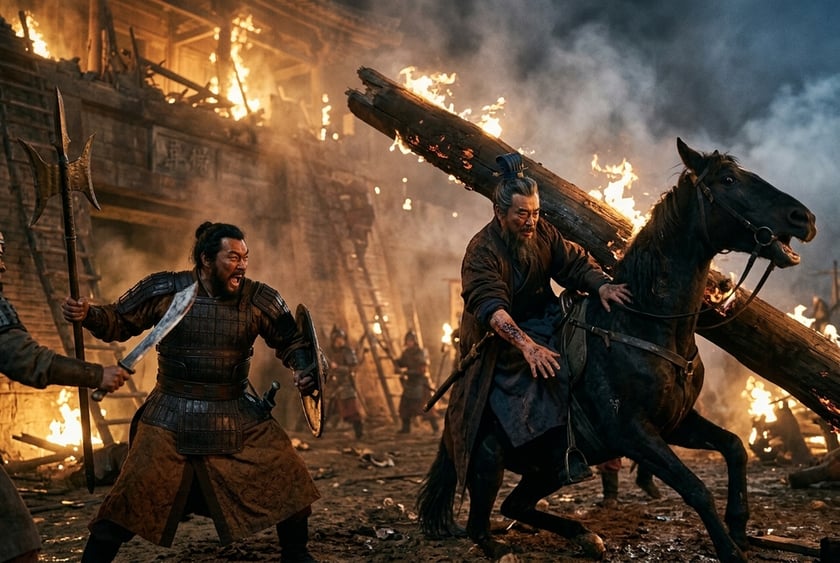
The decisive moment of the battle was when Gongsun Zan saw Qu Yi's small numbers and "released his cavalry to trample them." This was the instinctive choice of a cavalry commander — to crush with horse soldiers a foot formation that was clearly outnumbered — but Gongsun Zan overlooked three things: (1) Qu Yi's force was not ordinary commandery troops but Liangzhou veterans hardened by long campaigns against the Qiang [c:17380]; (2) the effective range of the massed crossbows was greater than the cavalry expected; (3) the shield-bearers crouching motionless were a deliberate lure, not a sign of collapsing morale. When the charge closed to within tens of paces, the Liangzhou troops burst up from their shields and the crossbows thundered in volleys; Gongsun Zan's main cavalry force was shattered in an instant, with the Jizhou Inspector Yan Gang and over a thousand armored heads taken [c:17380]. Once a cavalry formation breaks it cannot re-form, and the infantry squares on both flanks immediately collapsed as well; Qu Yi pressed the pursuit all the way to Jieqiao, where he also routed the rear guard and seized the command banner [c:17380].
Yuan Shao's own critical decision came at the battle's conclusion: riding forward with a light escort, he was surrounded by Gongsun Zan's scattered horsemen. Tian Feng urged him to take shelter in an empty wall, but Yuan Shao dashed his helmet to the ground and swore he would die fighting: "A true man should die fighting in the open — how could I save myself by hiding behind a wall?" [c:17380] This act not only dissolved the immediate danger (the massed crossbows broke through the encirclement), it also established Yuan Shao's image among the aristocratic elite as a commander who was "willing to die at the front," providing him with crucial political capital for his subsequent consolidation of Hebei.
Results and Resonance
The immediate outcome of the Battle of Jieqiao was that Gongsun Zan's main force was badly mauled and his southward momentum was stopped in the Hebei heartland; the strategic consequence was that Yuan Shao transformed from "a political guest who had just taken over Jizhou" into "the actual hegemon of Hebei," rapidly expanding toward Qingzhou, Bingzhou, and Youzhou. Qu Yi earned outstanding merit from this battle, but later grew arrogant about his contributions and was executed by Yuan Shao [c:17380] — a familiar tragic pattern in the late Han "general–lord relationship": commanders who decided the outcome of battles often grew overconfident in their own indispensability and ended up being guarded against by their masters.
The Romance's treatment of this battle in chapter 7 contains extensive literary embellishment: Qu Yi's crossbow-and-shield tactics are simplified to "archers all crouching behind arrow-screens," and the dramatic climax is shifted to the episode of Zhao Yun rescuing Gongsun Zan and fighting Wen Chou to a draw [c:17383]; Liu Bei, Guan Yu, and Zhang Fei are also brought in from Pingyuan to join the battle, allowing the "three heroes" to meet Gongsun Zan at Jieqiao for the first time [c:17385]. From a historical perspective, whether Zhao Yun was actually under Gongsun Zan's command at the time of Jieqiao remains disputed, and though Liu Bei was in Pingyuan, he may not have taken part in this specific engagement; the Romance's handling of the episode forces "Zhao Yun's debut — recognizing his future lord" as a dramatic node onto this battle in order to warm up the narrative for the later Shuhan warrior cohort.
Counterfactual Analysis
If Gongsun Zan had seen through Qu Yi's luring formation and declined to order a cavalry charge — instead using his White Horse cavalry for harassing flanking archery while the infantry squares advanced steadily — then Qu Yi's eight hundred Liangzhou troops alone would have been hard-pressed to decide the battle; Gongsun Zan's numerical advantage should in a prolonged war of attrition have ground down Yuan Shao's improvised forces. But Gongsun Zan's command style was closer to "light cavalry strike, no prolonged engagement," consistent with his tactical habits from long combat against the northern steppe — he lacked patience when facing the combination of heavy infantry and crossbowmen that characterized late Han internal warfare, a structural weakness. Conversely, if Yuan Shao had at the battle's close taken shelter inside the empty wall as Tian Feng advised, he would have been personally safe, but the image of "a commanding general cowering from the enemy behind a wall" would, once it spread, have severely damaged his political standing among the Hebei aristocracy, potentially delaying the entire consolidation of Hebei by several years. This battle illustrates two deep patterns of late Han warfare: (1) cavalry superiority was not inevitably decisive when confronted with a crossbow-and-shield combination; (2) a commander's political reputation was tightly bound to his battlefield conduct, and the posture chosen at critical moments was often as consequential as tactical victory or defeat.