Strategic Background
From the Chuping era through the early Jian'an years, the configuration in the north was Yuan Shao holding Jizhou and Gongsun Zan holding Youzhou, the two powers locked in long-running attrition along the Yi River–Juma River line. Gongsun Zan had in his earlier period been renowned for the Baima cavalry, sweeping the northern frontier's Wuhuan and Black Mountain forces with mobile cavalry, but after being crushed by Ju Yi at the Battle of Jieqiao (191) he gradually shifted to a defensive posture. By the early Jian'an years, Gongsun Zan had built "Yijing" south of the Yi River — a massive fortified complex of high towers and multiple deep moats — declaring "I have stockpiled three million shi of grain; I will end my days here," shifting from strategic mobility to fortified static defense. This change of mindset meant he had abandoned the possibility of deciding the issue through open-field battle, and bound his fate to a single strongpoint. For Yuan Shao, before an imminent showdown with Cao Cao in the Central Plains, he had to completely eliminate his northern rear threat — this is where the Yijing campaign fits in the late Han strategic timetable.
Deployments
Yuan Shao mobilized nearly all of his Jizhou main forces and made contact with Zhang Yan's Black Mountain outlaw troops in the Taihang range seeking to form an inner-outer encirclement. The Yuan army's method was prolonged siege and containment combined with tunneling directly under Yijing's central tower, using engineering warfare to neutralize Gongsun Zan's tower advantage. Gongsun Zan's side relied on Yijing's multiple towers to hold out; his son Gongsun Xu was sent to the Black Mountain to seek reinforcements, hoping that Zhang Yan would bring troops as an outer relief force to work together from inside and outside. Chief Clerk Guan Jing remained in the inner citadel as advisor — the last core figure in Gongsun Zan's late-period decision-making circle.
Key Decision Points
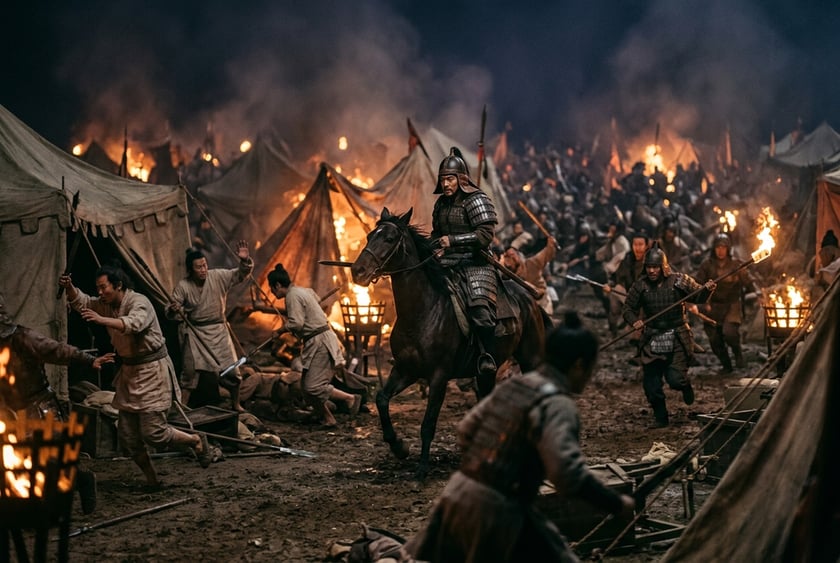
The first decision point was Gongsun Zan's choice to "hunker down in Yijing." This strategy surrendered maneuver rights, ceding strategic initiative entirely to Yuan Shao — Yuan Shao needed only to steadily close the encirclement with no need to risk an open-field engagement. The second decision point was the interception by Yuan Shao of Gongsun Zan's secret letter to Gongsun Xu. Yuan Shao used this to set an ambush: on the night that Gongsun Xu and Zhang Yan's relief force arrived, he counterfeited the fire signal, luring Gongsun Zan to lead his elite forces out of the city to receive them — only to be enveloped and annihilated by Yuan Shao's main force. The third decision point was Gongsun Zan's self-immolation after returning to the city. Knowing the situation was lost, he first killed his wives, children, and sisters, then set fire to himself and burned, to avoid the humiliation of being taken captive alive. The novel glosses over this process in a single stroke — "he was already broken by Yuan Shao" — yet sets the stage for the atmosphere of anxiety in the subsequent scene of Cao Cao and Liu Bei "discussing heroes over heated wine" — Yuan Shao's swift absorption of the north caused deep unease among the Central Plains factions.
Outcome and Resonance
First, Youzhou was absorbed intact into Yuan Shao's territory, and Yuan Shao formally held the four provinces of Ji, Qing, You, and Bing, becoming the largest military-political bloc of the late Han. Second, northern frontier powers such as the Wuhuan and Xianbei lost a long-standing counterbalancing force; their subsequent role in the situation of "the two Yuan sons allying with the Wuhuan" after Yuan Shao's death became a remote cause of Cao Cao's personal expedition to Liucheng. Third, the destruction of Gongsun Zan marked the formal exit of the "northern frontier warlord" as a category of late Han political force — thereafter the Gongsun Du family in Liaodong survived, but no longer participated in the core contest of the Hebei and Central Plains. Fourth, for Cao Cao, the defeat at Yijing was a clear warning of Yuan Shao's capabilities: barely a year later, Cao and Yuan would clash head-on at Guandu, and the swift collapse of Gongsun Zan gave Cao Cao a clear picture of the scale and determination of Yuan Shao's main forces.
Counterfactual Analysis
Had Gongsun Zan adopted a diplomatic posture of "aligning with Cao to restrain Yuan" in the aftermath of the Battle of Jieqiao — with Youzhou cavalry combined with Cao Cao's Yan and Yu infantry, Yuan Shao even holding Jizhou would have found it difficult to complete the unification of Hebei — the late Han north-south configuration might have evolved into a three-way balance: Yuan Shao in the center, Cao Cao in the south, Gongsun Zan in the north. Historically, he chose the opposite direction: fortifying himself at Yijing, yielding the diplomatic initiative entirely. Another counterfactual is Gongsun Zan abandoning Yijing and fleeing north to Liaodong at the very outset of the siege — with his cavalry's mobility he could have regrouped and mutually supported Gongsun Du as a backstop, but his fixation on "ending his days here" caused him to stake all his chips on a single fortified work. The defeat at Yijing is therefore not merely a military defeat but the most representative negative case in the late Han warlords' choice between the "mobile operations" and "fixed strongpoint" strategic lines.