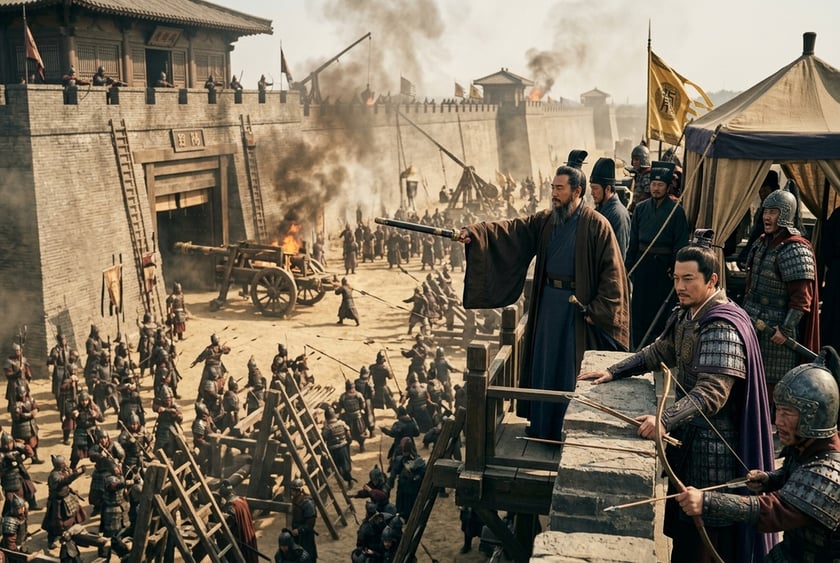
Strategic Background
After Guandu, the Yuan clan did not collapse immediately; it still held the core resources of the four provinces of Ji, Qing, You, and Bing, while it was Cao Cao whose troops and grain supplies were under severe strain. Yuan Shao died in the fifth month of the seventh year of Jian'an, leaving behind a succession dispute among his eldest son Yuan Tan, second son Yuan Xi, and youngest son Yuan Shang. Shen Pei and Feng Ji backed Yuan Shang, while Xin Ping and Guo Tu backed Yuan Tan; in the end Shen Pei's faction, following Yuan Shao's expressed preference, installed Yuan Shang as successor, whereupon Yuan Tan styled himself General of Chariots and Cavalry and the brothers split. Cao Cao chose this moment to campaign north precisely because Yuan internal dissension had not yet fully erupted but was already severely constraining coordination — he fixed his strategic objective as breaking the southern gateway to Hebei's defenses: Liyang.
Dispositions of Both Sides
Yuan Tan led his army to garrison Liyang as the forward position; Yuan Shang had originally given him only a small contingent and dispatched Feng Ji to accompany him as a check, prompting Yuan Tan to kill Feng Ji in frustration. Yuan Shang realized that if Yuan Tan could not hold off Cao Cao alone the entire position would be endangered, and so he ordered Shen Pei to defend Yecheng while he led his main force to the relief; the two brothers formed a joint line at Liyang yet remained mutually suspicious. Cao Cao's side crossed the river and attacked, deploying Zhang Liao and others as a vanguard in a siege-and-relief double-pressure arrangement. The novel dramatizes this as Yuan Shang charging out alone before his relief force arrived, only to be driven back by Zhang Liao "within three exchanges" — a literary embellishment, but one that captures the essence of Yuan clan behavior: each man scrambling for credit, none able to hold his position.
Critical Decision Points
The first critical decision was Yuan Tan's killing of Feng Ji. Within the campaign this was an act of frustration; beyond the campaign it permanently closed the political channel for coordinating with Yuan Shang, escalating "fraternal discord" into "fraternal blood feud". The second critical decision was Yuan Shang's choice to "cross the river in person to relieve Tan" rather than hold Yecheng. Militarily he was compelled to do so — if Liyang fell, Yecheng would have no natural barrier — but politically he abandoned his role as the authority holding Yecheng as base and anchor of command, and was instead drawn onto the open battlefield to be ground down by Cao Cao. The third critical decision was Cao Cao's choice, after taking Liyang, not to assault Yecheng head-on, but instead to "withdraw at night, pursue to Yecheng, harvest its grain, seize Yin'an, and withdraw his army back to Xu" — this apparent retreat was a classic Guo Jia-style strategic adjustment: once the external pressure was removed, the Yuan brothers would immediately begin consuming each other.
Outcome and Repercussions
The immediate result of the campaign was that Yuan's forces lost Liyang, their southern gateway, and their main strength was forced back into the interior of Jizhou; in the third month of spring in the eighth year of Jian'an, the novel records that "Yuan Tan, Yuan Xi, Yuan Shang, and Gao Gan were all routed and fled Liyang", consistent with the historical record. The more important repercussions came months later — when Cao Cao turned south toward Jingzhou on Guo Jia's advice, Yuan Tan and Yuan Shang immediately fell to fighting each other; Yuan Tan was defeated and fled to Pingyuan, where he appealed to Cao Cao for rescue; Cao Cao seized the opportunity to turn back and "rescue" Tan, from which point on he formally intervened in the Yuan internal strife. Through the gradual digestion of the following years, Yecheng, Qingzhou, and Youzhou fell to Cao in succession; the pacification of all Hebei can be traced back to the breach opened by the Battle of Liyang. In the novel, the image of Yuan Shao vomiting blood on hearing of the defeat and dying is the technique of concentrating the symbolic meaning of the Yuan clan's destruction in this one battle.
Counterfactual Analysis
The most interesting counterfactual centers on Guo Jia's advice that Cao Cao "move his forces south toward Jingzhou". Had Cao Cao been tempted to sweep Hebei clean in one stroke and directly assaulted Yecheng after taking Liyang, the result might have been exactly what he encountered when he probed: Yuan Shang's counter-attack still carried considerable force, Cao's logistics were strained, and a prolonged war of attrition might have formed — giving Liu Biao and Sun Quan an opening to intervene in the north. Guo Jia's brilliance lay in recognizing the Yuan brothers' capacity to destroy each other, and advocating "a temporary withdrawal to induce internecine conflict" over "a hard assault for a quick decision." A second counterfactual worth considering: had Yuan Shang not gone personally to Liyang and instead remained at Yecheng with Shen Pei to receive the enemy at leisure — and had the Xin Ping faction not openly favored Yuan Tan — might the Yuan sons have held on for several more years? But this in turn depended on their ability to overcome mutual suspicion, a quality that had already been proven nearly impossible by the chain of reactions from Yuan Tan killing Feng Ji to Yuan Shang dividing his forces in mutual wariness. In other words, the true outcome of the Battle of Liyang was essentially determined the moment Yuan Shao failed to designate his heir.