Yu Huan
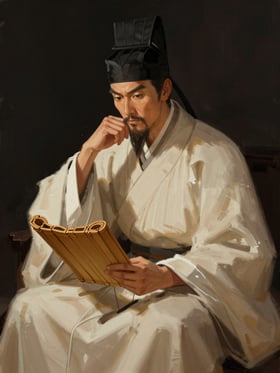
Yu Huan, author of Wei’s *Weilue*, was known for recording people’s deeds and commenting on politics, scholarship, and moral conduct.
Appearances
History 8 vols.
Historical Record
Yu Huan was a man of Wei, appearing in the sources as the author of the Weilüe and a commentator on history. In his annotations to the Weilüe, Pei Songzhi preserved Yu Huan’s accounts and assessments of figures, scholarship, and customs in the Wei era. The surviving sources provide no information about Yu Huan’s native place, official career, or birth and death dates, so these details should not be supplemented with conjecture.
His commentaries often drew conclusions about political trends from people’s deeds. Discussing favorites such as Qin Lang and Kong Gui, he criticized those who enjoyed honors and emoluments without virtue or merit. He argued that only when those in power refrained from making unwarranted appointments and those below refrained from accepting them could sinecures and the growth of sycophancy be avoided. On Lou Gui, he used the image of birds and a net to point out that the rise of Great Wei could not be credited solely to a handful of meritorious men; it also depended on the support and assistance of many others. These two discussions both scrutinize power and merit, while also showing his concern for collective effort.
Yu Huan also took care to record the integrity and learning of scholars. He included Sun Binshuo and others in the Valorous and Chivalrous section of the Weilüe, praising their conduct and sense of righteousness. He explained that he recorded their deeds both to keep them from fading into obscurity and in the hope of fostering honest, generous customs. In his account of Kui Xi, the source notes that Kui Xi once told him that warfare still plagued the land. Yu Huan also sought his guidance on the Zuo Commentary and, in a related appraisal, stressed that learning required perseverance. This shows that he did not merely assess people as an observer, but also sought learning at close quarters. He further commented on the estrangement between Cao Zhi and his brothers, arguing that circumstances and changing situations could influence people’s hearts, and that blame should not be simplistically laid on individuals alone.
His discussions were not limited to political figures. In his assessments of the literary figures Wang Can, Fan Qin, Ruan Yu, Chen Lin, Lu Cui, and others, he lamented that the literary talent and eloquence of his own age were no less than those of earlier times, but had not received equal recognition because the eras were different. At the end of the Xirong section of the Weilüe, he also discussed accounts of peoples beyond the frontier, using them to reflect on how human understanding is limited by place and lifespan. These materials show that Yu Huan not only compiled accounts of individuals, but also used his commentaries to discuss appointments, learning, righteous conduct, literature, and the limits of human knowledge.
In the Novel
This figure does not appear in the novel. The available novel materials are empty, so no appearance, words, actions, or plot can be ascribed to Yu Huan on the basis of the novel; his portrayal should be confined to what the historical sources show of him as the author and commentator of the Weilüe.
Key Relationships
Yu Huan had a direct teacher-student relationship with Kui Xi: Kui Xi spoke of warfare that had yet to cease, and Yu Huan once asked him about the Zuo Commentary and listened to him discuss the study of the Book of Songs. The sources thus present a scene of scholarly exchange between mentor and friend, but do not state when the two met or how extensive their dealings were.
As subjects of his writing, he discussed court figures of Wei such as Qin Lang, Kong Gui, and Lou Gui, and wrote about chivalrous figures such as Sun Binshuo, Yang Aruo, and Bao Chu. He also devoted particular attention to the literary community. These are not personal associations shaped by the novel, but rather the range of figures covered by the accounts and discussions in the Weilüe.
Signature Scenes
The clearest example of Yu Huan’s historical style is his use of the metaphor that “for a bird to fly far, it needs the help of many feathers” to discuss the rise of Wei: meritorious officials were certainly important, but the support of many people could also be the foundation of success. Another vivid scene is his seeking instruction from Kui Xi. Kui Xi replied that he excelled in different ways at the Book of Changes, the Book of Rites, and the Book of Songs. Yu Huan thereby preserved a scholar’s words that he had heard firsthand, and went on to argue that learning must not be interrupted.
His compilation of accounts of chivalrous figures likewise reflects a distinct historical purpose. Deeds such as Sun Binshuo’s rescue of Zhao Qi and Bao Chu’s daring recovery of his mother were included in the account of the valiant and chivalrous. Yu Huan explained that he recorded Sun and Zhu from earlier times and Yang and Bao from nearer times so their righteous deeds would not be lost, and so that such accounts might foster honest, generous customs. Together, these writing scenes form the image of Yu Huan that the sources preserve: he recorded the memory of his age through people’s stories, then used concise metaphors and commentaries to express his judgments.