Background
The episode known as Guaguliaodu — scraping the bone to cure the poison — occupies only a few dozen characters in the "Biography of Guan Yu" in the San Guozhi; it is a case study in military medical practice of the era. Guan Yu had in earlier years been hit by a stray arrow; the arrow was removed and the wound healed, but poison had lodged in the bone, causing pain whenever it rained. The physician proposed to "open the arm, create a wound, and scrape the bone to remove the poison." Guan Yu extended his arm and had it cut open; throughout the procedure he continued dining and conversing with his generals, his arm dripping blood into a basin while his speech and laughter remained unruffled [c:16389]. From a medical standpoint this description is not exaggeration — Later Han surgery already had fairly mature experience in treating wounds; for arrow-poison (typically tetanus-type infection caused by iron rust or arsenic-based toxins) the standard treatment was indeed incision and drainage followed by scraping of necrotic bone. That a battle-hardened general like Guan Yu could endure a lengthy debridement procedure without anesthesia is in itself worthy of recording in a biography.
Course of Events
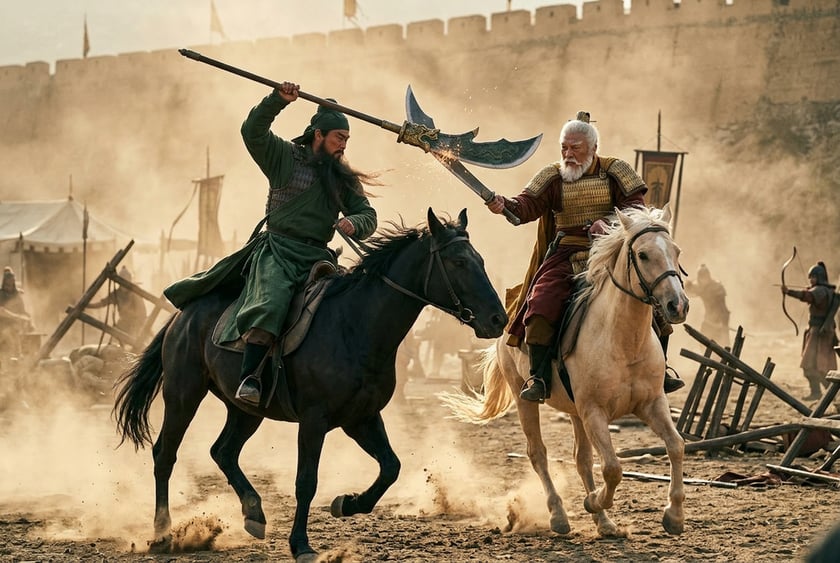
The Romance restitches this medical case into the narrative pivot of the Fancheng campaign in its seventy-fourth chapter: Guan Yu personally led his advance to the north gate of Fancheng, standing in his saddle in a half-draped breastplate with his green robe falling from one shoulder, whipping his horse — whereupon the five hundred crossbowmen on Cao Ren's tower all released together and he was struck in the right arm by a crossbow bolt and tumbled from his horse [c:16390]. This rewriting concretizes "when and where" the wounding occurred, giving the otherwise sceneless historical fragment a dramatic battlefield context. The seventy-fifth chapter (not cited in this batch) then dispatches Hua Tuo to perform the treatment, turning the entire procedure into a public display of heroism: the ritual staging of a stake, an iron ring, and white silk bound over the arm stands in contrast to Guan Yu's steady composure as he plays chess and drinks wine without changing expression. This sequence of rewrites in effect expands the four characters "speech and laughter unruffled" from the San Guozhi into a multi-modal theatrical performance.
Outcome
In the historical record, the bone-scraping procedure was simply one debridement among Guan Yu's many wounds and did not impair his command capacity in the subsequent Xiangfan campaign. In the Romance's narrative, it becomes a brilliant set piece within the story of Guan Yu's northern expedition: the Guan Yu who had just flooded and destroyed the Seven Armies and whose name shook all of China next demonstrates through bodily suffering that his will transcends the ordinary, driving his heroic image to its apex in the sequence before his defeat at Maicheng. This narrative arc of "achievement → suffering → martyrdom" essentially treats the bone-scraping as a crucial stepping-stone in Guan Yu's apotheosis — the physician's elevation from anonymous figure to Hua Tuo is equivalent to installing a witness of divine physician status to accompany a hero on his way toward tragedy.
Cultural Impact
From the perspective of cultural history, the bone-scraping episode has exerted far-reaching influence on both medical history and heroic narrative. First, the fictional pairing with Hua Tuo [c:16390] made Hua Tuo one of the central sources of the image of "the founding father of Chinese surgery." The legends of "Mafei San" (an anesthetic powder) and "abdominal surgery" thus gained a broader popular foundation; although the claim that the Qingnang Shu was lost is itself fictional, this cluster of stories made Hua Tuo the most potent medical symbol in the traditional imagination of Chinese medicine. Second, the four characters "guaguliaodu" ascended from a specific clinical vocabulary into a Chinese idiom, used to describe the thorough treatment of chronic ills and the excision of deep-rooted problems in political or social reform, far transcending the original medical sense. Third, alongside "drinking warm wine to behead Hua Xiong," "Dandaofuhui" (the solo-blade banquet), and "the righteous release of Cao Cao at Huarongdao," this episode forms the standard portrait of "valor–loyalty–righteousness–steadfastness" in the cult of Guan Yu, profoundly shaping the popular Chinese conception of heroism — a true hero must not only win battles but must also maintain composure amid inescapable pain. From the standpoint of historical criticism, understanding the tension between the spare single stroke of the San Guozhi and the dramatic rewriting of the Romance is precisely the most rewarding entry point for appreciating this episode: the historical Guan Yu was a commander capable of enduring real pain; the imagined Guan Yu was further elevated into a cultural icon who "validates his own sanctity through suffering."