Strategic Background
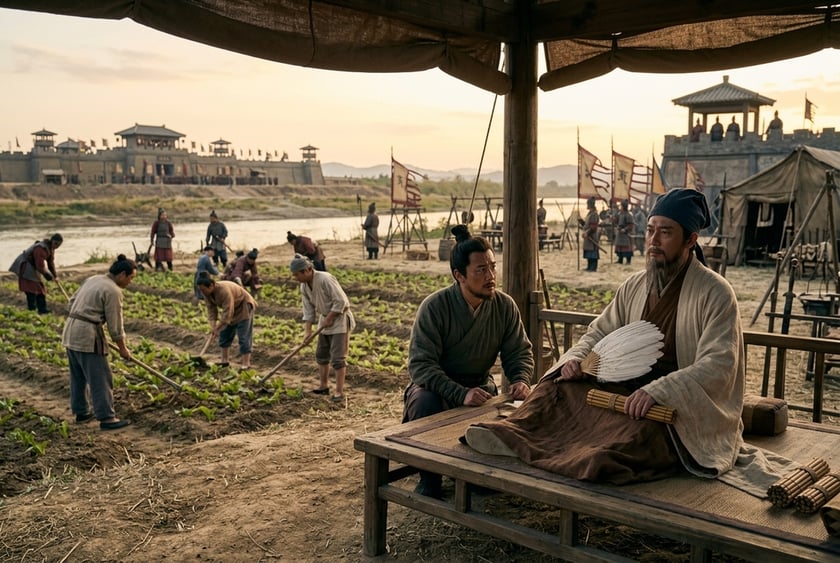
In the spring of the second year of the Jianxing reign (253 CE), Zhuge Ke had only the previous winter decisively routed Sima Zhao and Hu Zun's seventy thousand Wei troops at the Battle of Dongxing, and his prestige momentarily surpassed that of every regent appointed in Sun Quan's final years. But the essence of the Dongxing victory was "defensive counter-strike" — Wei had attacked, Wu defended and counter-punched, so the victory owed itself to favorable terrain and Wei's overconfidence, not to Wu's capacity for offensive campaigning. Zhuge Ke did not soberly evaluate this distinction; instead, he treated the victory as a template that could be infinitely reproduced, insisting on mobilizing two hundred thousand troops for a great northward offensive in the late spring and early summer, and dispatching a letter to Shuhan's Jiang Wei proposing a strategic coordination to "divide the empire between them." This leap from passive defense directly to active distant campaigning was the root cause of the entire campaign going wrong from the very start of its strategic conception.
Deployment of Forces
Wu's main force advanced north along the old Hefei road, with its initial objective set at Hefeixincheng — the forward outpost fortress that Caowei's Man Chong had constructed at the foot of Jimingshan to compensate for Old Hefei's lack of natural defenses, sited alongside the old channel of the Shui River. New Hefei was not large, but its foundations were set along a hillside and adjacent to an old watercourse — designed precisely "to exhaust the attacker in a prolonged siege." The garrison commander was yamen commander Zhang Te; together with the outer relief forces of Guan Qiujian and Wen Qin, the actual defending strength inside the walls numbered no more than three thousand. Wei's coordination showed deeper strategic layering: Sima Shi instructed his generals not to rush to relieve the siege, directing the Huainan governor Guan Qiujian and the Yangzhou governor Wen Qin to contain the flanks of the Wu forces in the outer perimeter, while the main army temporarily encamped at Luoyang in readiness, leaving the entire rhythm of the decisive engagement to the triple attrition of intense summer heat, epidemic disease, and supply depletion.
Critical Decision Points
Zhuge Ke's critical failure lay not in "the failure to take the city," but in his response after epidemic disease had already broken out massively in the army during the second month of the siege: he continued to refuse adverse battlefield reports from his commanders, executing subordinates who brought bad news, and forcing all ranks to "report only good news, never bad." This destroyed his real-time situational awareness. The second critical decision point was falling for Zhang Te's "delaying stratagem": Zhang Te sent men out of the city to communicate with Zhuge Ke, citing the Wei statute that "a garrison holding out over a hundred days without relief may surrender without punishment of the family clan," pleading that the siege had almost reached a hundred days and requesting a few days' grace for the defenders to prepare their families. Zhuge Ke actually took this at face value and suspended the assault that night; Zhang Te spent the night dismantling house timbers to repair the fortifications and adding a second inner wall. The next day, when Wu forces resumed their attack, they found the defenses stronger than the day before — the momentum was instantly reversed. This battle example of "the besieging party being deceived" is extremely rare in military history.
Outcome and Echoes
After over a month of siege, Wu forces were decimated by epidemic deaths, heat stroke, and dysentery; morale collapsed entirely. Zhuge Ke was compelled to withdraw in late summer. On the retreat, rather than consoling the casualties, he attributed every failure to his subordinates' evasions, executing and demoting a large number of officers along the road back to Jianye — pushing the entire official class of Jianye into opposition against him. A few months later, in the tenth month of winter, Sun Jun used a court audience as cover to ambush Zhuge Ke with hidden soldiers, had him executed in the hall, and annihilated three generations of his clan. From that point on Eastern Wu entered a five-year period of unbroken autocracy by the brothers Sun Jun and Sun Liang. The Battle of New Hefei was therefore not an ordinary military defeat — it was the detonator for the complete collapse of the Eastern Wu central power structure. From the Baidituogu regency arrangement of Sun Quan's final years, through the suspicious and paranoid politics of the reigns of Sun Xiu and Sun Hao, this campaign serves as the watershed.
Counterfactual Analysis
Had Zhuge Ke adopted the pace of "hold and build strength" of Lu Xun's style after the Dongxing victory — converting the dividends of that victory into accumulated internal prestige rather than immediately burning through two hundred thousand troops in the following year's northern campaign — he could at least have held the regency position until Sun Liang came of age and transferred power smoothly. Sun Jun would not have obtained sufficient political justification for a coup. Even had he still chosen to campaign northward, had he launched his offensive in autumn or winter — avoiding the peak season for epidemic disease in the Huai region — and compressed his forces to eighty or one hundred thousand, targeting Old Hefei in coordination with Jiang Wei's advance in Longright, his odds of success would have been far higher than going alone to besiege New Hefei. The single most lethal step was "executing those who reported unfavorable news" — completely shutting off the genuine information channels within the army, the polar opposite of the style of Zhuge Ke's uncle Zhuge Liang, who "never executed those who reported defeat but always investigated the cause of defeat." Had Zhuge Ke preserved even half of that family tradition, the order to withdraw at New Hefei would not have been delayed until more than half the army had died of epidemic disease, and Sun Jun's coup would not have had such ample pretext — the political history of Eastern Wu's middle and later periods might have been written very differently.