Background
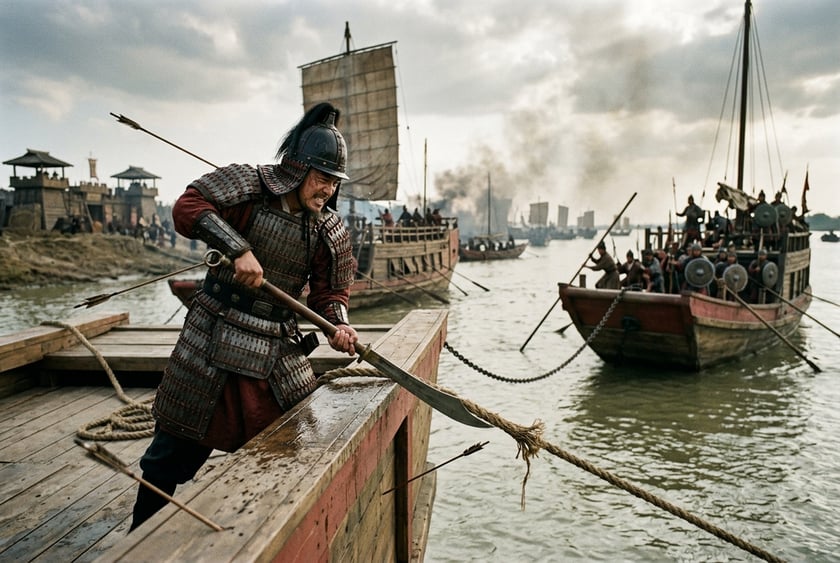
The Zang Hong incident occurred at the moment when the Yuan and Cao coalitions had completed their "Yanzhou-Jizhou alliance" and were jointly suppressing the remnant forces of Zhang Miao and Lv Bu. Around Jian'an year one, Yuan Shao was expanding broadly along the Yellow River front — to Dongjun, Henei, and other key crossings — while Cao Cao was mopping up the Yanzhou rebellion. Zang Hong, as Administrator of Dongjun, was the only senior official within Yuan Shao's domain who possessed full independent character and also bore an old grievance against Cao Cao. He was one of the early core figures of the Suanzao assembly of the campaign against Dong Zhuo, and the fraternal bond of the Suanzao alliance took precedence in his mind over Yuan Shao's system of regional governance. When Zhang Chao was besieged by Cao Cao at Yongqiu and appealed for relief, Yuan Shao's choice was in essence a binary — "honor the alliance or honor old friendship": marching to save Zhang Chao would antagonize Cao Cao, who was fighting on the front line; not marching amounted to declaring that the Yuan faction had completely abandoned the moral legacy of the campaign against Dong Zhuo. Yuan Shao chose the former; Zang Hong chose the latter; and two parallel value-trajectories collided head-on at Dongjun.
Principal Figures
Zang Hong is the moral axis of the event. Born in Guangling Sheyang, a former subordinate of Zhang Chao and old client of Zhang Miao, his blood oath and speech at Suanzao were transmitted as a classic by contemporaries. Yuan Shao occupies the dual identity of "lord" and "executor" — on one hand needing to sustain the newly formed Yuan-Cao alliance; on the other needing to eliminate the "uncontrollable element" within his own commandery. Chen Lin is the most subtly positioned figure: both the chief secretary of Yuan Shao's headquarters and a fellow native of Zang Hong, his assignment to write a letter urging surrender was itself one link in the chain of political coercion. Zang Hong's reply letter (the prototype of the famous "Letter in Reply to Chen Lin") became a representative piece of open political protest literature of the late Han. Chen Rong, who died in the city, is another notable subplot: after the city fell, he rebuked Yuan Shao to his face — "My lord, you have killed a loyal and upright man" — and was also executed, further deepening the tragedy of the entire event.
Core Issue
On the surface the issue is "whether a subordinate may defy his lord for the sake of old friendship"; at a deeper level it is the violent friction within the late-Han transition from the ethics of "private loyalty bonds" toward the structure of "public lord-subject submission." Zang Hong represents the old political ethic of "binding the lords together through righteousness" that characterized the Suanzao era; Yuan Shao represents the already-formed new political structure of "governing subordinates through the regional-governor system". Yuan Shao did not disregard Zang Hong — the historical record notes he "originally admired Hong" and hoped for his submission even after the city fell — but when the hard rules of the lord-subject system clashed with the soft emotion of personal regard for talent, the former necessarily prevailed. The siege that dragged on for years before finally requiring execution proves precisely that Yuan Shao understood: to let a regional administrator who had openly defied orders go free was to acknowledge that within his commandery there existed a loyalty axis not belonging to him. This issue recurred in different forms in the later figures of Guan Yu, Yu Jin, and Pang De, constituting the early archetype of the San Guo mother-theme of "the difficulty of loyalty and righteousness."
Political Consequences
The immediate consequence of the event was that Yuan Shao's governance in Hebei became further ossified: officials at the administrator level who, like Zang Hong, had retained independent character fell silent thereafter; the voice of headquarters civil officials such as Shen Pei and Feng Ji rose sharply; and commandery governance began to evolve toward "privatization within the lord's household." Second, Yuan Shao forfeited an important tranche of moral capital — many in late-Han scholarly circles lamented Zang Hong's death; Chen Shou's San Guozhi dedicated a special biography to "Zang Hong Zhuan" and evaluated him very highly; even Yuan Shao's most loyal subordinate Ju Shou, in his pre-battle remonstrations before Guandu, used "the lord lightly executes scholars" as one argument against pressing for quick battle. The third layer of consequence was that Chen Lin was "bound to Yuan Shao's chariot" — he had participated in the failed persuasion attempt, then been commissioned to draft the "Proclamation to Yuzhou on Yuan Shao's Behalf" denouncing Cao Cao; later, when he entered Cao Cao's service after Guandu, he repeatedly pleaded "the arrow was on the bow and had to be released" as his defense — evidence of the long shadow the Zang Hong affair cast on his personal conscience.
Counterfactual Analysis
What if Yuan Shao had allowed Zang Hong to relieve Zhang Chao? The most direct consequence would have been the premature rupture of the Yuan-Cao alliance — in 196 the timing was unfavorable for Yuan Shao to start a war; he had not yet fully absorbed Gongsun Zan in Hebei, while Cao Cao had consolidated his footing in Yanzhou. War on two fronts would have severely worsened Yuan Shao's strategic environment and would have benefited Gongsun Zan's resurgence in Youzhou. From this angle, Yuan Shao's execution of Zang Hong was not a mistake in "short-term political calculation." But if the time scale is extended to the eve of the Battle of Guandu, scholarly opinion of Yuan Shao had shifted enormously from his early reputation; the defections of senior advisors Xu You and Zhang He on the battlefield each carried, under the surface, the judgment that "Yuan Gong is thin on righteousness." In other words, by sacrificing Zang Hong, Yuan Shao purchased several years of alliance stability — but at the cost of drawing heavily against the moral credit accumulated across four generations of the "Three Excellencies," a debt not called in until the defeat at Guandu.