Origins
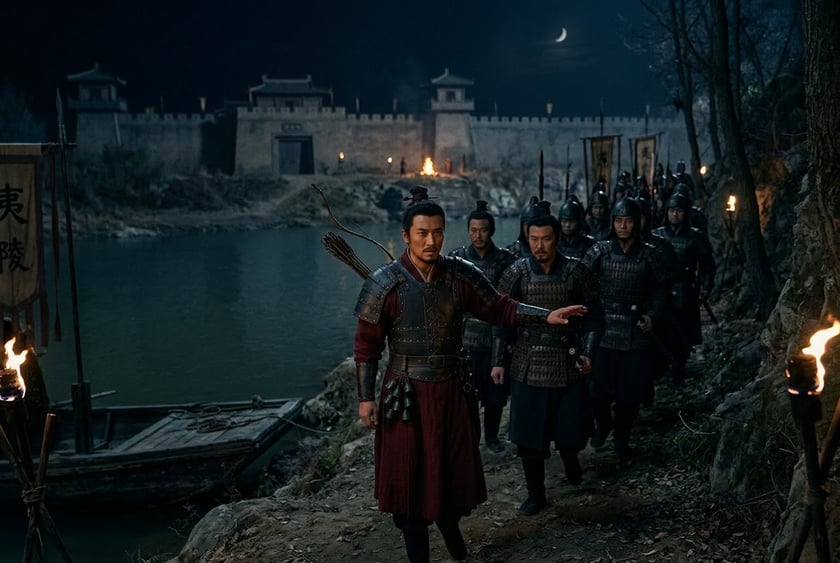
In 188, Yizhou was in an underappreciated state of pressure approaching a breaking point. After the main Yellow Turban forces of Jizhou were crushed in the first year of Zhongping (184), remnant units moved south along the Han River and Jialing River valley, merging with local farmers who had been driven to flight by extortionate levies; successive waves of small armed groups styled as "rice bandits" or in the manner of the Wudoumidao appeared in Guanghan, Bajun, and Qianwei. The Yizhou Inspector Xi Jian had governed the region with a reputation for extortion, and his approach to suppressing revolts — "levy more grain to fund the crackdown" — pushed already-collapsed local governance to the breaking point. Ma Xiang and Zhao Zhi were minor strongmen from the area around Mianzhu, not necessarily adherents of the Way of Great Peace, but they perceived one thing: in a province where even the Inspector was notoriously corrupt, the "Yellow Turban" banner alone could raise tens of thousands of followers within ten days.
Participating Forces
The main body of the rebel force consisted of local dispossessed refugees driven to vagrancy by harsh governance, together with remnant Yellow Turban units that had come south along the Han River from Jizhou; Ma Xiang and Zhao Zhi claimed the title of leaders under the Yellow Turban banner, and Ma Xiang promptly proclaimed himself "Son of Heaven" — an explicit claim to imperial dignity extremely rare among Yellow Turban-style uprisings, reflecting their assessment that an administrative vacuum existed at the provincial level. The true agent of suppression on the other side was not the regular imperial army — the court at this point was mired in the debate at Luoyang over the new Inspector/Governor (zhoumu) system and in the western Liang campaign, with no capacity to attend to the south — but rather local Yizhou strongmen: armed forces led by the Congshu (administrative adjutant) Jia Long, together with private militias from the manorial estates of Qianwei and Guanghan. In the eighth month of that same year, the court resolved to restore the office of Provincial Governor (zhoumu) in the disturbed provinces and appointed the imperial clansman Liu Yan as Yizhou Governor to enter Shu; although this political force did not take part directly in the fighting, it profoundly determined the aftermath of the uprising.
Critical Turning Points
The first turning point in the campaign was Ma Xiang's declaration of emperorship. When, after capturing Mianzhu and Luo County, he immediately proclaimed himself "Son of Heaven," he in effect pushed Yizhou's local strongmen into a position where they had to "pick a side" — a commoner claiming imperial dignity meant that their manorial estates, household troops, and official ranks would all be redistributed under the new regime. Local figures such as Jia Long, who might otherwise have adopted a wait-and-see posture, were thus driven from a posture of protecting private militias into active suppression. The second turning point was the mismatch between terrain and time. Ma Xiang's forces had swept through three commanderies in a surge of momentum, but this simultaneously meant their troops were scattered across Guanghan, Bajun, and Qianwei; the local forces Jia Long concentrated were positioned along the Qianwei line, and in counterattacking the dispersed rebels piecemeal, they broke the rebel main force in little over a month, with Ma Xiang and Zhao Zhi successively killed. The third turning point was the simultaneous political maneuver: at the very moment of the uprising the court deliberation passed the Provincial Governor reform, and Liu Yan entered Shu from Jingzhou; Jia Long not only suppressed the rebellion but also welcomed a new master.
Suppression and Outcome
Militarily, the rebel force was extinguished in little over a month — a "flash in the pan" in terms of scale, yet the political vacuum it created was enormous. The Yizhou Inspector Xi Jian was dead; the existing official structure had collapsed; the provincial seat at Mianzhu had been ravaged by fighting; and Caowei's administration in Yizhou would have to be rebuilt almost from the ground up. Jia Long, leading the local strongmen to welcome Liu Yan, effectively transferred actual control of Yizhou to a new administrator who combined imperial-clan status with political capital. Liu Yan promptly relocated the provincial seat from Mianzhu to Chengdu, suppressed local strongmen, and cultivated the Eastern Province Troops (Dongzhou soldiers) — laying the foundation for the nearly thirty years of the "Liu Yan and Liu Zhang father-son regime" that followed. In other words, though Ma Xiang's uprising failed, it permanently pushed Yizhou off the track of direct Han-court governance at the provincial level and onto the track of a "semi-independent warlordized regime."
Historical Resonance
Ma Xiang's uprising is usually glossed over in one line in the San Guo grand narrative, yet its two legacies run deep. First, the Provincial Governor system was thereby empirically validated — Liu Yan's successful pacification of Shu led to the extension of the zhoumu system across the provinces south of the Yangtze in succession, indirectly generating the multi-polar configuration of Liu Biao governing Jingzhou, Tao Qian governing Xuzhou, and the Sun Jian father-and-son holding Wu. Second, the model in which Yizhou local strongmen "sheltered behind private armies and then changed their stake to a new lord in exchange for political capital" was first fully realized in Jia Long — and this model was used repeatedly thereafter: Fa Zheng and Zhang Song welcoming Liu Bei into Shu, Qiao Zhou persuading Liu Chan to surrender to Caowei — behind all of these lies the same political instinct of "strongmen selecting their lord." In one sense, the local uprising in Mianzhu in 188 provided an early full dress rehearsal for all the tensions between locality and center that would characterize the entire San Guo era.