Origins
The Houyinpanluan is a "warning signal from the heartland" that the traditional San Guo narrative has severely underappreciated. It erupted at the turn of Jian'an years twenty-three and twenty-four (218–219 CE). On the surface it was a personal rebellion by the garrison commander of Wancheng; in reality it reflected a long-accumulated cluster of structural contradictions in the Nanyang region during the twilight of Cao Cao's reign. The first layer was the burden of corvée and taxation — Nanyang was one of the core zones of Cao Cao's military-colony system and had borne heavy responsibilities for military grain supply and labor conscription since the Jian'an period. Cao Cao's western campaign against Zhang Lu in 215, his operations against Sun Quan in 217, and preparations for confronting Liu Bei over Hanzhong in 218 stretched the manpower of Nanyang almost to its breaking point. The second layer was a governance problem — the Nanyang prefect Dong Li Gun administered poorly, with sources hinting vaguely that he handled relations between local magnates and the garrison troops with particular clumsiness. The third layer was strategic misalignment — Cao Ren had originally been stationed at Wancheng to watch Guan Yu, but in 218 Cao Cao transferred him south to Fancheng, leaving the defenses of Wancheng conspicuously thinned and opening a window of opportunity for would-be rebels. These three factors compounded each other, causing what might otherwise have been a suppressible mutiny to escalate into a "local-scale rebellion" that briefly occupied the prefectural seat.
Participants
The rebellion's core was Hou Yin and Wei Kai. Their specific backgrounds are poorly recorded — Hou Yin was probably a commander native to Wancheng or Nanyang, and Wei Kai was likely his deputy or a local strongman. Two details of their conduct are worth attention. First, at the very outset of the uprising they "arrested and confined the prefect," indicating that they had a solid read on local sentiment and felt confident enough to publicly detain a court-appointed official. Second, they immediately petitioned Guan Yu for reinforcements, demonstrating clear-eyed self-assessment — the rebel force alone could not withstand Cao Ren when he returned, and they needed outside support to survive. What Guan Yu actually did in response is disputed: one account holds that Guan Yu did dispatch a small mounted detachment northward to apply pressure and harass Cao Ren's rear; another holds that Guan Yu, with the Fancheng campaign not yet launched, was unable to respond in time. Regardless of whether any actual response materialized, the strategic effect was already real: Hou Yin's rebellion forced Cao Ren to turn back and pacify Wancheng before he could deal with anything else. When Cao Ren again moved south he was a tired army — an unintentional preparatory gift for Guan Yu's flood victory over the Seven Armies. On the Caowei side the instrument of suppression was Cao Ren, who revealed an exceptionally ruthless side in putting down Hou Yin: the massacre of Wancheng was a rare instance of Cao Cao's forces turning their harshest measures against a core-controlled area, reflecting extreme anxiety about popular uprisings in the heartland.
Key Turning Point
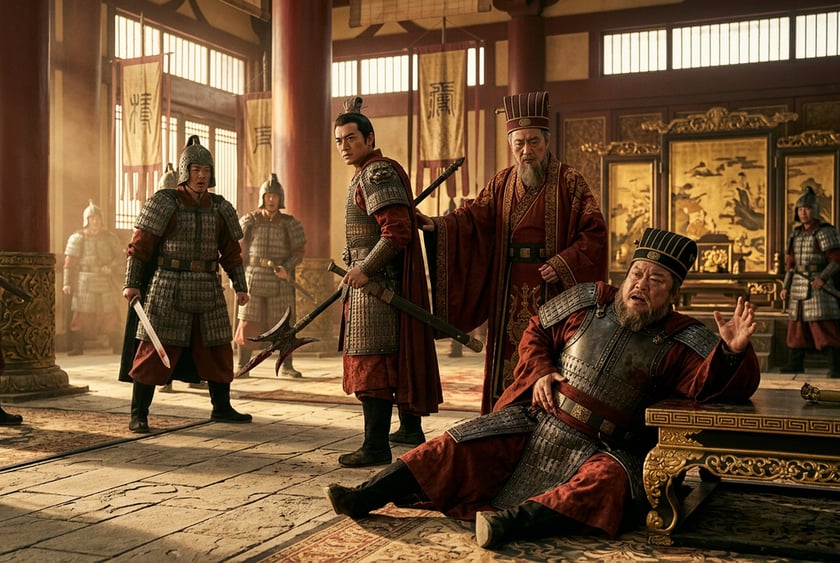
The true turning point of this rebellion lay not on the battlefield but in the decision to massacre Wancheng. From a purely military standpoint, standard post-siege procedure would have been to execute the ringleaders, pacify the population, and restore the defenses — the pattern Cao Cao followed in integrating newly acquired territories such as Jizhou, Qingzhou, and Xuzhou after Guandu. But Cao Ren chose to raze the city, which meant he had concluded that the hearts of the people of Nanyang were beyond recovery and that only extreme intimidation could reestablish deterrence. This decision carried three layers of meaning. First, it signaled to every potential rebel in the Nanyang region: "Side with the enemy and you die — no distinctions made." Second, it reduced subsequent governance costs: after a massacre, no complex sorting of the innocent from the guilty was required — the population structure was simply erased. Third, it demonstrated to Cao Cao himself a capacity for "merciless cleanup," strengthening Cao Ren's political capital as a commander. But the price was heavy: the human-resource base of Nanyang was drastically reduced, leaving Cao Cao and Cao Pi chronically short-handed when they later tried to use Nanyang troops to hold off Guan Yu and Wu, effectively transferring the strategic burden back to the Central Plains heartland.
Suppression and Consequences
The immediate result was the execution of Hou Yin and Wei Kai, the massacre of Wancheng, and the suppression of the rebellion within a few months. The second-order consequence was a quiet reshaping of the strategic environment for Guan Yu's northern offensive: Caowei's force deployment across northern Jing province and western Yu province was simultaneously tightened, so that when Yu Jin led relief forces to Fancheng in the summer and autumn of 219, he could only hastily assemble distant troops — troops that included northern infantry unfamiliar with the hydrography of the Yangtze basin. This mismatch was one of the key technical reasons for the catastrophe of the Seven Armies flooding. The third-order consequence was that Caowei was forced to adjust its governance model in Nanyang: after 220 Cao Pi introduced a more directly centralized system of imperial appointments in Nanyang, significantly curbing the voice of local magnates, while simultaneously relaxing the intensity of the military-colony system in partial acknowledgment of popular grievance. The fourth-order consequence operated at the ideological level: the image of Cao Cao in his final years as a ruler of "stern law" was further cemented by the Wancheng massacre, adding a significant brick to the cumulative "cruel and harsh" label that later ages would apply to Caowei.
Historical Reverberations
Viewed from a broader perspective, the Houyinpanluan was a "stress test" of Caowei's internal contradictions. It revealed three facts that the traditional narrative consistently undervalues. First, the "Central Plains heartland" of Caowei was not a monolithic bloc; on the contrary, under strategic pressure it was capable of generating organized rebellion. Second, rebellions in the San Guo period did not always take the form of "barbarian uprising against Han" or "south against north"; "heartland rebellion against Cao from within the Central Plains" was a real political variable. Third, the Cao Ren model of "massacre to stabilize" was effective in the short term but carried long-term backlash, leaving Caowei perpetually lacking a popular base as it attempted to expand southward. Examining the Houyinpanluan alongside the contemporaneous Weifeng incident (the anti-Cao conspiracy inside Yecheng in 219) reveals that 219 was a year in which multiple internal and external stresses within the Caowei system erupted simultaneously — Weifeng inside, Hou Yin outside, Guan Yu at the front — whose compounded effect made Cao Cao feel, in the final year of his life (early 220), what he described as "the greatest pressure of my entire reign." Reading Guan Yu's flood victory over the Seven Armies through this lens, it appears not merely as the triumph of one man's military genius but as a systemic pushback embedded within Caowei's multiple structural crises — and Hou Yin was the invisible prologue to that systemic rebellion.