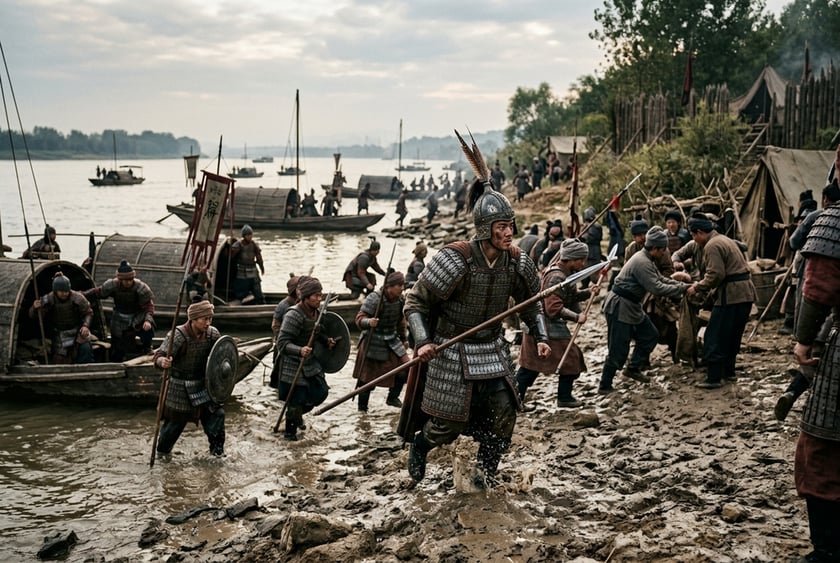
Origins
Since the Han dynasty, the Hexi Corridor had served as the critical hub linking the Central Plains with the Western Regions and the northern nomadic peoples; controlling the four commanderies of Wuwei, Zhangye, Jiuquan, and Dunhuang meant controlling the eastern terminus of the Silk Road. As central imperial authority collapsed at the end of the Eastern Han, Liangzhou itself had long existed in a state of semi-independence under warlords such as Han Sui, Ma Teng, and Ma Chao; even after Cao Cao pacified the Guanzhong region (211 CE), his control over the Hexi commanderies remained primarily indirect. When Cao Cao died in the first year of Yankang (220) and Cao Pi succeeded to power, the political transition of "replacing the Han" produced a brief power vacuum — local commandery governors and military officers throughout Hexi all independently concluded that the moment of self-preservation in troubled times had arrived. Yan Jun of Wuwei, He Luan of Zhangye, Huang Hua of Jiuquan, Qu Yan of Xiping, and others rose in succession, each declaring himself a general, attacking one another, accompanied by raids by local non-Han peoples and blocked roads — posing a severe threat to Silk Road traffic.
Participating Forces
The rebel side's main force was the local Hexi garrison troops under Liao Shi's command together with the local armed forces he had suborned — a structure with two tiers: the upper tier of local strongmen who had seized their commanderies (Yan Jun, Qu Yan, and others), and the lower tier of non-Han tribal groups allied with or operating alongside them (the "three kinds of non-Han peoples" and others). The core of the suppression force was Su Ze, the Grand Administrator of Jinjing. Cao Pi had initially planned to dispatch a large army from the center on a long-range expedition, but Su Ze argued forcefully for using troops already in place — the key to campaigning in Hexi was speed and local resource management, not a center-dispatched army striking from a great distance. Su Ze then coordinated with Guanqiu Xing, the Grand Administrator of Wuwei, and Zhang Gong, the Senior Secretary of Dunhuang, and dispatched Hao Zhao, Wei Ping, Yin Feng, and other generals on separate converging thrusts. It is worth noting that Hao Zhao had not yet made his name at this point — he would not enter the historical record until the second year of Taihe (228), when he independently held Chencang against Zhugeliangbeifa; his early practical combat experience was accumulated precisely during the Hexi pacification campaign.
Critical Turning Point
The pivotal turning point of the entire campaign was the speed of Su Ze's judgment: he chose to defeat the rebels piecemeal while they had not yet formed a cross-commandery coalition, rather than waiting for the central army to arrive. The specific approach was to deal with Zhang Jin of Zhangye first — this was the most powerful rebel force at the time and the center of gravity of the uprising. Once Zhang Jin was broken, Huang Hua, Qu Yan, and the others lost their mutual support and submitted or were suppressed in succession. This strategy of "strike the trunk first, then sweep the branches" embodied the classic experience of Han-Wei border commandery warfare: rather than posting heavy troops everywhere, the aim was to rapidly eliminate strongpoints while the rebellion was still dispersed. Meanwhile, Guanqiu Xing coordinated from Wuwei and Zhang Gong from Dunhuang, ensuring that the western end of Hexi would not be consolidated by the rebels into a continuous front.
Suppression and Outcome
By the third year of Huangchu (222), the Hexi commanderies were essentially pacified; Shanshan, Kucha, Khotan, and other states of the Western Regions sent envoys to pay court, marking the return of official control over the eastern section of the Silk Road to Caowei. Su Ze was promoted to Protector of the Qiang and granted the title of Marquis Within the Passes. In terms of institutional consequences, Caowei after the war strengthened commandery-level control over Hexi and developed the corridor into the western rear base that Cao Zhen, Guo Huai, and others would use to resist Zhugeliangbeifa. Neither Sunwu nor Shuhan ever succeeded in penetrating Hexi — a direct result of this rebellion being swiftly extinguished.
Historical Echoes
The Hexi Rebellion occupies a relatively marginal position in Three Kingdoms historical narrative, yet its strategic significance should not be underestimated. First, it tested Caowei's capacity for rapid response on the frontier after Cao Pi replaced the Han, demonstrating that the new regime had not lost its grip on the border commanderies as a result of the political handover. Second, it established Caowei's dual-track approach to Liangzhou and Hexi: centrally-appointed Grand Administrators combined with local strongmen deployed as auxiliary forces — a model that continued into the later governorships of Xu Miao, Huangfu Long, and others. Third, it kept the eastern stretch of the Silk Road in Caowei's hands against the backdrop of the Wei-Shu standoff, ensuring that the Western Regions' official recognition of a Chinese successor regime continuously tilted toward Caowei — indirectly consolidating the international legitimacy of "Wei as successor to the Han." For a frontier campaign that the novel of the San Guo almost entirely omits, its political and economic consequences reach far deeper than its literary footprint.