Circumstances of Death
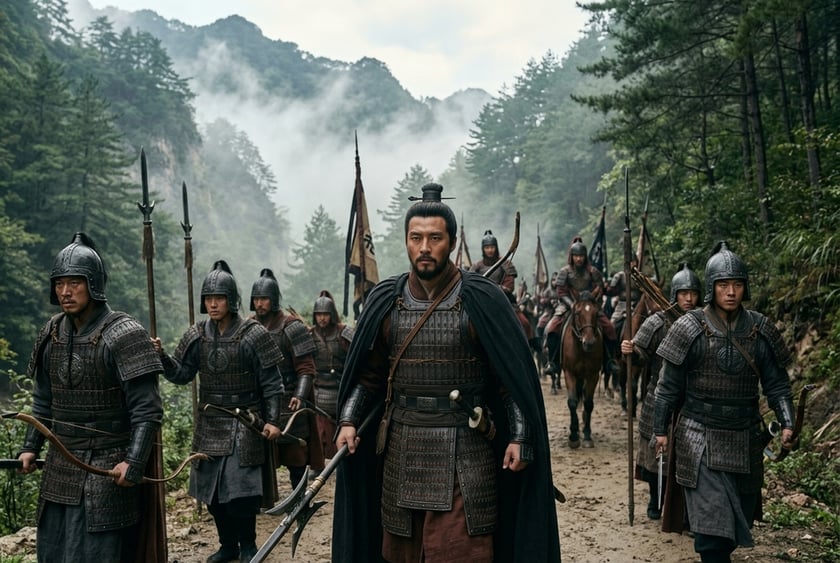
According to Sun Jian's biography in the San Guozhi and the various sources cited in Pei Songzhi's annotations, Sun Jian's death was not a decapitation by rampaging troops after a line collapse. Rather, during the siege of Xiangyang he pressed forward too rashly and was killed in the wooded hills of Xianshan by soldiers under Huang Zu — Liu Biao's subordinate — struck by arrows or rocks fired from ambush. The exact timing, the details of the pursuit, and the specific weapon that killed him differ across sources: the Dianliie stresses that Huang Zu's troops shot him from concealment among bamboo and trees, while the Yingxiongji attributes his death to Lv Gong leading mountain infantry who brought him down with rolling boulders to the head. Yet every version shares one core element: Sun Jian, alone on horseback or with only a light escort, penetrated deep into the hills, was drawn into close-range contact with Huang Zu's forces at a scale too small for conventional battle, and died at an ambush point his enemies had prepared in advance.
Last Words and Final Wishes
Orthodox history records no deathbed words from Sun Jian. This stands in sharp contrast to the novel's dramatization — in which he arranges his affairs and entrusts Sun Ce with his legacy. In history, Sun Jian died with such suddenness that even an orderly transfer of command was impossible. His nephew Sun Ben led the surviving troops back to Yuan Shu; Sun Ce was forced to continue serving under Yuan Shu as a guest-general for several years. The Jiangdong group had no ready succession mechanism; it was only through Sun Ce's own subsequent efforts that his father's remnant forces were reassembled. This "death without a testament" is itself a portrait of Sun Jian's soldierly character throughout his life — he was a charge-at-the-front type of commander who never considered himself a political figure who needed to arrange everything for those who came after.
Aftermath
After Sun Jian's death, Liu Biao's side used the return of the body as a condition for releasing Huang Zu, whom Sun Ce's forces had captured. After that exchange, Sun Ce escorted his father's coffin home to Jiangdong and buried him on the plain of Qua, then began recruiting talent and building strength. This blank period lasted roughly three years, during which the Jiangdong group fell nearly silent in political terms — it had no independent banner, and had lost its most important military figurehead. Sun Ce, however, used those years to cultivate relationships with Zhang Zhao and Zhou Yu, and ultimately in the second year of Xingping received from Yuan Shu the return of his father's old troop rights, crossed the Hanshui southward, and pacified Jiangdong. In the final reckoning, Sun Jian's death did not destroy the Jiangdong group; instead, in a cruel way, it accelerated the maturation of the next-generation leader.
Historical Assessment
At the strategic level, Sun Jian's death in this campaign can be attributed to "overconfidence after a string of victories": he had already routed Huang Zu between Fancheng and Dengcheng, pursued across the Hanshui, and encircled Xiangyang — the battlefield advantage lay entirely on his side; and yet he chose to penetrate deep into the hills alone or with only light cavalry, exposing himself to the enemy remnants' ambush zone. At the level of personal evaluation, he is a textbook example of "someone who ranks as a great general of a moment by valor, but falls short when judged by strategy" — courageous, decisive, able to inspire troops, but lacking the patience and holistic situational awareness of a true supreme commander. Dying at thirty-seven, he was denied the long political career that Cao Cao, Liu Bei, and Sun Quan each had; yet the military organization he left behind — Cheng Pu, Huang Gai, Han Dang — along with his sons Sun Ce and Sun Quan eventually made Jiangdong one of the San Guo kingdoms, and that is the highest historical return any founding figure could ask for. Later commentators frequently called Sun Jian "the Fierce Tiger of Jiangdong," a title that carries both praise and implicit critique: it affirms his martial valor, but also hints that his death came from that very ferocity. For the Sunwu regime, the arrows and stones of Xianshan shattered a father — and forged a dynasty that had to grow up on its own.